Canyon turn
Wed Aug 10, 2016 1:48 pm
Re: Canyon turn
Sorry, Blackrock not Blackjack. I hate this dumb smartphone. Those igits have smartphone as a choice. What about dumbphone?
- contactflying offline
- Posts: 4972
- Joined: Wed Apr 03, 2013 7:36 pm
- Location: Aurora, Missouri 2H2
Download my free "https://tinyurl.com/Safe-Maneuvering" e-book.
Wed Aug 10, 2016 4:10 pm
Re: Canyon turn
The radius of a turn is a function of true air speed and angle of bank. This can not be changed.
The only variable which can be changed is load factor for the flown angle of bank by "unloading the wing" (let the nose drop in the turn).
The shortest turn radius is achieved by the slowest true airspeed possible combined with the steepest bank possible without stalling the aircraft while unloading the wing (1g turn).
Sent from my iPhone using Tapatalk
The only variable which can be changed is load factor for the flown angle of bank by "unloading the wing" (let the nose drop in the turn).
The shortest turn radius is achieved by the slowest true airspeed possible combined with the steepest bank possible without stalling the aircraft while unloading the wing (1g turn).
motoadve wrote:Went to a Mt flying seminar.
Instructor said canyon turn:
Slow it down, 10 degress of flaps and 45 to 60 degree bank turn.
No Immelman, no chandelle, no aerobatics, no full throttle, no full flaps.
Rudder was not mentioned (top rudder better? worse?)
So went out and practiced it the way the instructor described it, its an easy, non extreme manuver, I think anyone can do it easily, and could be good theory if the pilots have never practiced a canyon turn he is stuck in a box canyon and can save him.
I was doing the turn at 60mph , important requirement to make the the turn tighter its slower speed I assume? too much bank,. then increases the stall speed.
But I have a feeling it can be made a lot tighter with the correct technique?
Sent from my iPhone using Tapatalk
Wed Aug 10, 2016 4:58 pm
Re: Canyon turn
Here is a video created by the Arizona Pilots Assn about the Canyon Turn.
- rfinkle offline


- Posts: 334
- Joined: Sat Feb 21, 2009 9:27 pm
- Location: KSZP, KCCR, 18AZ
- FindMeSpot URL: http://share.findmespot.com/shared/face ... gujelTKUbh
You're never too old to learn something stupid.
Wed Aug 10, 2016 5:00 pm
Re: Canyon turn
Well, lets try this again for the Arizona Pilots Assn video.
- rfinkle offline
- Posts: 334
- Joined: Sat Feb 21, 2009 9:27 pm
- Location: KSZP, KCCR, 18AZ
- FindMeSpot URL: http://share.findmespot.com/shared/face ... gujelTKUbh
You're never too old to learn something stupid.
Wed Aug 10, 2016 6:05 pm
- Zzz offline


- Posts: 2855
- Joined: Fri Oct 08, 2004 11:09 pm
- Location: northern
- Aircraft: Swiveling desk chair
Half a century spent proving “it is better to be thought a fool than to open your mouth and remove all doubt.”
Wed Aug 10, 2016 6:48 pm
Re: Canyon turn
EZFlap wrote:Terry wrote:The hammerhead version is not recommend in a Maule.
What version is recommended, by Maule or anyone else, when the width of the "box canyon" is narrower than the turn radius of the airplane?
I think it has something to do with the little interconnect thingy that ties the rudder peddles to the aileron yoke?
Could also be the big tires those Maule guys run? Guess I'm not really sure?

- Terry offline
- Posts: 1365
- Joined: Sat Nov 10, 2007 9:11 pm
- Location: Willamette Valley
- FindMeSpot URL: http://share.findmespot.com/shared/face ... 4GzPHI6t1d
Wed Aug 10, 2016 7:20 pm
Re: Canyon turn
I don't need to do a canyon turn. I have synthetic vision on foreflight. I'll just fly through the clouds in the canyon looking at my iPad. Piece of cake.
Rob
Rob
- OregonMaule offline

- Posts: 6977
- Joined: Fri Sep 01, 2006 9:44 pm
- Location: Orygun
My SPOT page
"They who can give up essential liberty to obtain a little temporary safety, deserve neither liberty nor safety". Ben Franklin
http://en.wikiquote.org/wiki/Benjamin_Franklin
"They who can give up essential liberty to obtain a little temporary safety, deserve neither liberty nor safety". Ben Franklin
http://en.wikiquote.org/wiki/Benjamin_Franklin
Thu Aug 11, 2016 5:13 am
Re: Canyon turn
OregonMaule wrote:I don't need to do a canyon turn. I have synthetic vision on foreflight. I'll just fly through the clouds in the canyon looking at my iPad. Piece of cake.
Rob
LOL
- Crzyivan13 offline
- Posts: 1811
- Joined: Sat Nov 24, 2012 9:50 pm
- Location: Ohio- OI27 Checkpoint Charlie
- FindMeSpot URL: https://share.delorme.com/EvanDavis
- Aircraft: 1957 Cessna 182A
Thu Aug 11, 2016 6:39 am
Re: Canyon turn
OregonMaule wrote:I don't need to do a canyon turn. I have synthetic vision on foreflight. I'll just fly through the clouds in the canyon looking at my iPad. Piece of cake.
Rob


Thu Aug 11, 2016 8:01 am
Re: Canyon turn
The Arizona Pilot's video made some good points, the most important was to let the nose go down in the turn.
- contactflying offline
- Posts: 4972
- Joined: Wed Apr 03, 2013 7:36 pm
- Location: Aurora, Missouri 2H2
Download my free "https://tinyurl.com/Safe-Maneuvering" e-book.
Thu Aug 11, 2016 11:31 am
Re: Canyon turn
Terry wrote:
thingy that ties the rudder peddles to the aileron yoke?
That would be the control lock. I think Maule usually recommends that you remove that before flight, even if you're not flying into a canyon

Just for giggles, how much extra force or strength does it take to operate the Maule control yoke with the interconnect? I am guessing that there is a spring or bungee that is the main part of the interconnect. If you (illegally) disconnected the interconnect would the controls be significantly easier or less tiring to use?
If by some miracle of clever design the previous spring or bungee interconnect was no longer needed, or did not have to apply a resistive force into the control system, and yet the adverse yaw (the likely original reason for the interconnect) was also no longer a problem, would that be of interest to Maule owners?

.
Thu Aug 11, 2016 8:57 pm
Re: Canyon turn
contactflying wrote:The Arizona Pilot's video made some good points, the most important was to let the nose go down in the turn.
Equally important, I think, was the exhortation to SLOW DOWN! It's amazing how small a half circle can be made at 80 mph compared to 120 mph. I like to use the example of Cory Lidle's crash in the "canyons" of New York City--if he'd just slowed down, that 1500' radius circle his Cirrus made would have been much reduced, and he would have most likely cleared the buildings on the other side, even with the 15 knot wind that was blowing him toward the buildings. Flying the canyons at cruise speed, no matter what you're flying, is playing games with eternity.
Cary
"I have slipped the surly bonds of earth..., put out my hand and touched the face of God." J.G. Magee
Thu Aug 11, 2016 9:26 pm
Re: Canyon turn
Exactly right Cary. Energy management automatically provides the slow down, trading cruise speed for zoom. And in a ridge ride to a 10,000 pass, in a low powered airplane, that is not working out, we are at Vy just to keep what little climb ridge lift is giving us.
Even when young, flying in rock walled canyons didn't appeal to me. I mostly used energy management to get out when I wasn't able to make the pass.
Even when young, flying in rock walled canyons didn't appeal to me. I mostly used energy management to get out when I wasn't able to make the pass.
- contactflying offline
- Posts: 4972
- Joined: Wed Apr 03, 2013 7:36 pm
- Location: Aurora, Missouri 2H2
Download my free "https://tinyurl.com/Safe-Maneuvering" e-book.
Fri Aug 12, 2016 9:44 am
Re: Canyon turn
Pinecone wrote:...... I always imagined that if I had to make a short radius (canyon) turn, it would be because I'd jambed myself under a layer and between a few mountains. Pulling up into the cloud in a hammerhead or Imelman turn probably wouldn't end well for me, an it's not a manuever I've practiced enough to be comfortable. If I've got clearance below me, I'd probably bank hard, but not pull. I'd sacrifice some altitude to ensure that I didn't load the wing too heavy .....
It all depends on the situation. IMHO a climbing (aka box) canyon in decent weather is a more typical scenario than both a box canyon AND low clouds. The one time I've had to make a "canyon turn" was when I started too low up a canyon & it was outclimbing me (in a stock C150). No clouds to worry about, so nose up to Vx, full power, partial flaps, and 30-ish degree banked turn made for a tight radius turn and a safe reversal.
Letting the nose down in a turn sounds good, but most canyons narrow as you descend, sometimes very rapidly, so that might put you too close to the terrain. However, they usually widen as you go up-- sometimes enough to make the difference between making the turn vs making a splat. Nose up & full power means gaining some altitude to increase your terrain clearance, full power also gives you a little more cushion against a stall. Limiting bank to 30-ish degrees means less chance of a stall than a steeper bank angle.
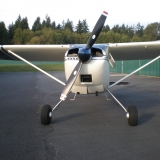
Cessna Skywagon -- accept no substitute!
Fri Aug 12, 2016 10:06 am
Re: Canyon turn
hotrod180 wrote:Pinecone wrote:...... I always imagined that if I had to make a short radius (canyon) turn, it would be because I'd jambed myself under a layer and between a few mountains. Pulling up into the cloud in a hammerhead or Imelman turn probably wouldn't end well for me, an it's not a manuever I've practiced enough to be comfortable. If I've got clearance below me, I'd probably bank hard, but not pull. I'd sacrifice some altitude to ensure that I didn't load the wing too heavy .....
It all depends on the situation. IMHO a climbing (aka box) canyon in decent weather is a more typical scenario than both a box canyon AND low clouds. The one time I've had to make a "canyon turn" was when I started too low up a canyon & it was outclimbing me (in a stock C150). No clouds to worry about, so nose up to Vx, full power, partial flaps, and 30-ish degree banked turn made for a tight radius turn and a safe reversal.
Letting the nose down in a turn sounds good, but most canyons narrow as you descend, sometimes very rapidly, so that might put you too close to the terrain. However, they usually widen as you go up-- sometimes enough to make the difference between making the turn vs making a splat. Nose up & full power means gaining some altitude to increase your terrain clearance, full power also gives you a little more cushion against a stall. Limiting bank to 30-ish degrees means less chance of a stall than a steeper bank angle.
I have to say all of the scary oh SHIT turns I have made were in the Alaska Mountains in shitty weather with a ceiling,rock walls and the ground all converging at some point in the near future!! Should I have been there? To some no!, I was, Made the turn real slow and real tight, and falling towards the 1/2 way point in the turn. Did it work? So far!! I usually am pretty slow by then and if you use the P factor along with your turn and lowering the nose you can make a 180 fairly quickly.
Just my $.02 FWIW!!
- M6RV6 offline
- Posts: 2313
- Joined: Mon Feb 25, 2008 5:52 pm
- Location: Rice Wa. 82WN Magee Creek AERODROME
- FindMeSpot URL: http://share.findmespot.com/shared/face ... sWKXuhKlg2
Have as much Fun as is Safe, and Keep SMILIN! GT,
Fri Aug 12, 2016 10:21 am
Re: Canyon turn
hotrod180 wrote:Pinecone wrote:...... I always imagined that if I had to make a short radius (canyon) turn, it would be because I'd jambed myself under a layer and between a few mountains. Pulling up into the cloud in a hammerhead or Imelman turn probably wouldn't end well for me, an it's not a manuever I've practiced enough to be comfortable. If I've got clearance below me, I'd probably bank hard, but not pull. I'd sacrifice some altitude to ensure that I didn't load the wing too heavy .....
It all depends on the situation. IMHO a climbing (aka box) canyon in decent weather is a more typical scenario than both a box canyon AND low clouds. The one time I've had to make a "canyon turn" was when I started too low up a canyon & it was outclimbing me (in a stock C150). No clouds to worry about, so nose up to Vx, full power, partial flaps, and 30-ish degree banked turn made for a tight radius turn and a safe reversal.
Letting the nose down in a turn sounds good, but most canyons narrow as you descend, sometimes very rapidly, so that might put you too close to the terrain. However, they usually widen as you go up-- sometimes enough to make the difference between making the turn vs making a splat. Nose up & full power means gaining some altitude to increase your terrain clearance, full power also gives you a little more cushion against a stall. Limiting bank to 30-ish degrees means less chance of a stall than a steeper bank angle.
Of course, the usual splat situation in higher terrain is caused because the pilot has waited too long, the airplane is at its very limits of performance due to high density altitude, probably somewhat slower than Vx, the stall warner reminds the pilot that he's blown it, and by then when he banks to turn around, he stalls and falls out of the sky. Let's say hypothetically that the airplane's level stall speed is about 53 knots. So the stall warner comes on at about 60 knots as the pilot tries to outclimb the canyon, he finally reacts to the stall warner, banks the airplane to 45 degrees of bank, and the airplane immediately stalls because at that bank angle, stall occurs at 65 knots.
If the pilot of the hypothetical airplane has his A game going, he can immediately drop flaps to 20 which decreases the stall speed so that he can bank to 45, drop the nose as he comes around, and maybe salvage the situation. But if he had his A game going in the first place, he isn't likely to be in that position, so Mr. Average Pilot is less likely to be able to do the salvaging.
We've had too many of those situations in the Colorado mountains, usually caused because the pilot was Mr. Average Pilot, had no real experience either in the mountains or in high elevation operations, and tried to turn around too late at too low an airspeed. The one that comes most to mind was a PA28-235 that crashed near the Eisenhower tunnel 2 years ago. Here's the NTSB report: http://www.ntsb.gov/_layouts/ntsb.aviat ... 328&akey=1 A PA28-235 is a pretty good high altitude airplane, with high altitude performance similar to a C182 or C180, but in that case, with the density altitude exceeding 15,000' and a heavily loaded airplane, there was no way a proper preflight would have disclosed a way to make it over that pass. Yet there are other routes which he could have taken, which offered a lower elevation to cross. So already we know that the inexperienced pilot wasn't playing with his A game.
There is a plethora of other similar scenario accidents that have added to the aluminum litter, but that one is as text book as any.
Cary
"I have slipped the surly bonds of earth..., put out my hand and touched the face of God." J.G. Magee
Fri Aug 12, 2016 10:47 am
Re: Canyon turn
Hotrod180,
You are correct about the slope toward the bottom nature of ridge/valley systems in the mountains. That is why the target, in the energy management turn, should be the bottom of the valley. Neither the opposite ridge nor the slope down from that ridge should be the target. The danger of a stall is far greater in a medium bank level or climbing turn than in a zero load turn of any bank. We do not have to pull back on the stick in any turn.
If we can simply fly away from the valley/ridge system or canyon comfortably, fine. If not, the target should be the unobstructed terrain farthest from us. This is almost always the bottom of the drainage. Only because we have a very bad habit of pulling back on the stick, do pilots fear the very bank needed to save themselves.
Because we make so many turns to heading, we have the false idea that a turn is fixed maneuver that either fits, diameter wise, the situation or not. Energy management turns give the unique advantage of turns at steep banks, up to ninety decrees, without loading the wing.
Not pulling back on the stick in a turn is so simple and could save so many lives and could allow such safe and efficient maneuvering, Because we fear the ground which is safely at the bottom of the energy management turn, we too often find the ground at the bottom of a stall.
If you get a chance, meet up with me after the Reno races. I will convince you to love the energy management turn.
Contact
You are correct about the slope toward the bottom nature of ridge/valley systems in the mountains. That is why the target, in the energy management turn, should be the bottom of the valley. Neither the opposite ridge nor the slope down from that ridge should be the target. The danger of a stall is far greater in a medium bank level or climbing turn than in a zero load turn of any bank. We do not have to pull back on the stick in any turn.
If we can simply fly away from the valley/ridge system or canyon comfortably, fine. If not, the target should be the unobstructed terrain farthest from us. This is almost always the bottom of the drainage. Only because we have a very bad habit of pulling back on the stick, do pilots fear the very bank needed to save themselves.
Because we make so many turns to heading, we have the false idea that a turn is fixed maneuver that either fits, diameter wise, the situation or not. Energy management turns give the unique advantage of turns at steep banks, up to ninety decrees, without loading the wing.
Not pulling back on the stick in a turn is so simple and could save so many lives and could allow such safe and efficient maneuvering, Because we fear the ground which is safely at the bottom of the energy management turn, we too often find the ground at the bottom of a stall.
If you get a chance, meet up with me after the Reno races. I will convince you to love the energy management turn.
Contact
- contactflying offline
- Posts: 4972
- Joined: Wed Apr 03, 2013 7:36 pm
- Location: Aurora, Missouri 2H2
Download my free "https://tinyurl.com/Safe-Maneuvering" e-book.
Fri Aug 12, 2016 1:10 pm
Re: Canyon turn
If you are not pulling back on the stick, how is the airplane turning?
Seems to me that a bank angle without using lift (acceleration, G, stick pull) to actually turn the direction of the airplane is just a bank... not a turn???
What part of the dynamics of this am I missing ?
Seems to me that a bank angle without using lift (acceleration, G, stick pull) to actually turn the direction of the airplane is just a bank... not a turn???
What part of the dynamics of this am I missing ?
.
Fri Aug 12, 2016 2:21 pm
Re: Canyon turn
After the pitch up zoom climb to trade cruise airspeed for altitude, it is not an aileron and rudder roll to a certain bank angle and then neutralize the controls. It is an aileron and rudder roll to put the target between our legs while releasing back pressure to zero the load, dive toward target just an instant, level the wing with lots of rudder and a little aileron the other way, and then pull up.
It is not a level turn with all the energy inefficient and dangerous characteristics of a level turn. No need whatsoever to pull back on the stick. That was a Pinko Commie lie.
It is not a level turn with all the energy inefficient and dangerous characteristics of a level turn. No need whatsoever to pull back on the stick. That was a Pinko Commie lie.
- contactflying offline
- Posts: 4972
- Joined: Wed Apr 03, 2013 7:36 pm
- Location: Aurora, Missouri 2H2
Download my free "https://tinyurl.com/Safe-Maneuvering" e-book.
DISPLAY OPTIONS
Who is online
Users browsing this forum: No registered users and 0 guests
Latest Features
-
Live to Tell
A Minnesota pilot is surprised to learn that the sudden asymmetric drag of an out-of-rig ski can…Read More -
Creators
Working in some of the Yukon's most beautiful and remote environments, photographer Simon Blakesley captures aircraft in…Read More -
Aircraft Ownership and Maintenance
Upgrading to big tires can make a huge difference in backcountry performance, but with those gains come…Read More -
Tales from Yesteryear
In this tale from bush flying yesteryear, Don Cogger signs up to help Atlee Dodge Jr recovery…Read More


Latest Knowledge Base
-
Destinations
A regional guide with ideas for winter camping destinations in California, Nevada, New Mexico, and Arizona.Read More -
Aircraft
Finding an affordable aircraft that can handle the backcountry for $80K or less? A challenge for sure, but with the…Read More -
Aircraft
01.29.2018 - Zane - Updated tire diameter graphic to add 8.50x10 Guide to tires for use in the backcountry and off-airport landing…Read More -
Pilots
12.22.2013 - Initial article format Operating aircraft on skis and negotiating a snow-covered landscape is an entirely unique skillset and environment.…Read More


