EZFlap wrote:
I also pointed out several facts that affect safety in that kind of emergency situation. Not the least of which is the fact that once you start a hammerhead, you are never flying directly toward any of the canyon walls at slow speed.
So please let me know which facts are BS and why. Tell me which parts of what I said are either untrue on a technical or practical level. And you can't just quote someone else, or point to a page in a book. With all humility, and no "Attitude" intended on my part, I challenge anyone hereto show me technically why you disagree with my statements about the hammerhead and specifically how the Canyon turn is safer.
First off, let point out that while you are never headed at a canyon wall in a Hammerhead turn, you are headed at the ground at an increasing speed and you probably dont have much altitude to work with. In order to slow that descent rate and level off at the same altitude you entered the Hammerhead you must first build enough airspeed to make the wing fly again and then pull out of the dive which will undoubetdly exceed 2 g's...try to pull up too early and you have a secondary stall.
In order to do a hammerhead properly you must achieve a vertical attitude and near stall or stall configuration while still maintaining enough airflow over the rudder to swing the tail. Run out of rudder authority and you will tailslide. If you try a Hammerhead without being vertical you only yaw the aircraft...Yaw + Stall = Spin. Lets not forget the cross control inputs needed to hammerhead properly. Forget to push a little at vertical and you could be on your back...forget to add opposite aileron as the wing begins fall through and you could fall on your back...and heaven forbid you pull past vertical and fall into an inverted spin. Needless to say, a hammerhead takes practice to get it right...do it incorrectly and you are in for a "fun" ride...not the ideal situation for a canyon.
So how are you going to have enough airspeed or power to pull vertical and maintain enough rudder authority to correctly do a hammerhead in a canyon situation? Remember, you are most likely starting at slower than cruise speed and already trying to climb, not to mention you are probably loaded pretty heavily. In the Stearman I start a Hammerhead between 110-120 and that is only achieved after trading altitude for airspeed. Even at that entry speed I am into the rudder at about the same time as I reach vertical...that is the point where I am also almost out of airspeed and the 220 does not have the power to pull the tail around on it's own...and don't even think about trying to do one to the right in a true stall hammerhead. Can I recover at the same altitude that I entered? Sure...but remember that I also dove from that original altitude to gain speed to begin the manuver.
Try putting a bit of a load in that J-3 or T-cart and take it up to a DA somewhere around 6,000 - 7,000 feet...now try to do a hammerhead turn from level cruise flight and see how well it works out...how about that same scenario in slow flight as one would likely find themselves in a tight canyon...can you get the nose vertical and make the turn without falling or spinning out of the manuver?
EZFlap wrote: No "flying turn" maneuver can reverse your direction in as little horizontal room as the hammerhead.
Half Cuban, Split S, Immelman...same horizontal room as a hammerhead when done properly, but I am not advocating any of these turns in a canyon either.


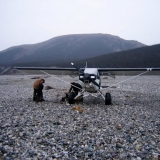


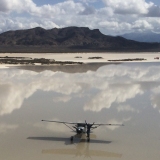

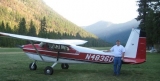

 . He explained to me that he has been reading every book he can, watching every video he can get his hands on, including Youtube video's, and reading/learning what he can on the internet. I tried like hell to convince him to check in with a CFI in McCall, Boise area or anywhere before he makes his trip into the backcountry. I sure hope this guy got with a CFI before his adventure in the backcountry!!