My first post here in the forum.
I have a Rajay turbo-normalized 182P with a Robertson STOL kit. Really like this plane and the Robertson kit is freaking awesome. Almost scary how short this plane will land and take-off verses a standard 182. I'm a relative new pilot with 260 hrs. with 140 hrs in this plane.
Maybe setting aside the virtues of having/not have an AOA indicator from the other thread... Entertaining the idea of adding an AOA/Lift Reserve Indicator as tool to help with high density altitude and short field work. I'm biased towards an analog meter like http://www.liftreserve.com verses one of the digital bar displays.
Is there any practical difference between an AOA or Lift Reserve meter?
Appreciate thoughts.
Digital AOA or Analog Lift Reserve Meter?
Wed Sep 19, 2018 8:36 pm
- nordicdave offline
- Posts: 21
- Joined: Mon Sep 10, 2018 10:11 pm
- Location: San Jose
- Aircraft: Cessna 182P w/Rajay Twin Turbo & Robertson STOL kit
Wed Sep 19, 2018 8:48 pm
Re: Digital AOA or Analog Lift Reserve Meter?
IMO of you have to look down to see it then is not worth it. Th HUD ones are great because they are right there and easily visible while still looking out the window, which is where you really need to be looking while in that phase of flight.
But that's just one guys opinion..
But that's just one guys opinion..


Wed Sep 19, 2018 8:51 pm
Re: Digital AOA or Analog Lift Reserve Meter?
I had a lift indicator on my last plane and the best part of that was setting it up. By the time I had it adjusted where I wanted I didn’t need it anymore. Mounted on top of the glare shield it wasn’t in the way and was easy to look at easy to use. But I hardly ever looked at it.

Wed Sep 19, 2018 9:06 pm
Re: Digital AOA or Analog Lift Reserve Meter?
I haven't looked at any gauge on takeoff and landing, save IFR, in fifty years so I agree with A1Skinner. I hope the headsup AOA will help pilots to acquire a better feel for relative zoom reserve on takeoff and apparent rate of closure speed up on short final (unless we slow a bit.). Math says a certain speed on the airspeed indicator will cause a certain climb, but it doesn't feel as good as well established zoom reserve. 1.3 will get you to the fence at 1.3, but slowing enough to prevent speed up of apparent rate of closure feels better and allows slow and soft touchdown on the numbers consistently.
Welcome.
Welcome.
- contactflying offline
- Posts: 4972
- Joined: Wed Apr 03, 2013 7:36 pm
- Location: Aurora, Missouri 2H2
Download my free "https://tinyurl.com/Safe-Maneuvering" e-book.
Wed Sep 19, 2018 9:38 pm
Re: Digital AOA or Analog Lift Reserve Meter?
A1Skinner wrote:IMO of you have to look down to see it then is not worth it. Th HUD ones are great because they are right there and easily visible while still looking out the window, which is where you really need to be looking while in that phase of flight.
But that's just one guys opinion..
+ 1
Take into account an AoA indicator is not only useful for landing, but all aspects of flight.
Wed Sep 19, 2018 9:39 pm
Re: Digital AOA or Analog Lift Reserve Meter?
A1Skinner wrote:IMO of you have to look down to see it then is not worth it. Th HUD ones are great because they are right there and easily visible while still looking out the window, which is where you really need to be looking while in that phase of flight.
But that's just one guys opinion..
Totally agree.
In my experience, AOA warnings are the single most important safety measure available in light aviation today, but they need to be the right kind of device.
The right AOA warning is one which you don't have to look at. It needs to be there no matter where you are looking, because a good approach is one where you are looking at the touchdown point. They also help in steep turns, where you should be looking outside.
For that reason, just like a traditional stall warning, a horn is most effective. I am fully sold on audible AOA warnings. Mine comes through my headset so it doesn't need to be very loud. It's the single best safety feature I have ever experienced. Highly recommend an audible AOA warning.

Wed Sep 19, 2018 10:13 pm
Re: Digital AOA or Analog Lift Reserve Meter?
Thanks guys for the help. I agree with the comments about needing to put an AOA in the line of sight. If it's down on my panel, it would rarely if never get used. I can also see from a seasoned back country pilot the reduced need for an AOA device.
I'm thinking an AOA would help with training and confirming data.
Robertson STOL Stall speed data:
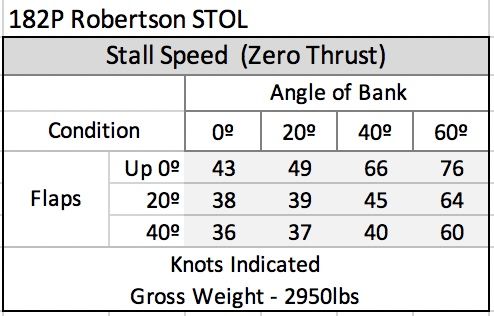
The factory POH 40º flap Stall speed is 50 kts. verses the Robertson 36 kts. pretty amazing.
Question: Considering Vso * 1.3 for ideal descent speed, means Robertson 46 kts verses POH 65 kts. Is this line of thinking correct?
I'm thinking an AOA would help with training and confirming data.
Robertson STOL Stall speed data:
The factory POH 40º flap Stall speed is 50 kts. verses the Robertson 36 kts. pretty amazing.
Question: Considering Vso * 1.3 for ideal descent speed, means Robertson 46 kts verses POH 65 kts. Is this line of thinking correct?
- nordicdave offline
- Posts: 21
- Joined: Mon Sep 10, 2018 10:11 pm
- Location: San Jose
- Aircraft: Cessna 182P w/Rajay Twin Turbo & Robertson STOL kit
Thu Sep 20, 2018 5:30 am
Re: Digital AOA or Analog Lift Reserve Meter?
norticdave,
Going back to the headsup AOA and outside site/sound/feel experience, these can get you down slowly and softly on the numbers. Apparent rate of closure speed up prevention (slow down on short final) is much more important than approach airspeed way out on final. The 46 is probably a good number on short final, but that can get slower coming into ground effect.
The beauty of the headsup AOA, and I like Batson's and motoadve's audio, is that we will have some help getting slow where we need slow: at the numbers. And, as motoadve pointed out, help with zoom reserve on takeoff and with energy management turns. OK, level turns as well.
I hate the chart you put up, not because it warns of load factor, but because it makes no mention of allowing the nose to go down as the airplane was designed to do in turns (energy management turns.)
You are looking at good stuff to help you with backcountry type flying. Just remember it is more about pilot techniques than about the airplane. If it were all about the airplane, we could just get a helicopter.
Contact
Going back to the headsup AOA and outside site/sound/feel experience, these can get you down slowly and softly on the numbers. Apparent rate of closure speed up prevention (slow down on short final) is much more important than approach airspeed way out on final. The 46 is probably a good number on short final, but that can get slower coming into ground effect.
The beauty of the headsup AOA, and I like Batson's and motoadve's audio, is that we will have some help getting slow where we need slow: at the numbers. And, as motoadve pointed out, help with zoom reserve on takeoff and with energy management turns. OK, level turns as well.
I hate the chart you put up, not because it warns of load factor, but because it makes no mention of allowing the nose to go down as the airplane was designed to do in turns (energy management turns.)
You are looking at good stuff to help you with backcountry type flying. Just remember it is more about pilot techniques than about the airplane. If it were all about the airplane, we could just get a helicopter.
Contact
- contactflying offline
- Posts: 4972
- Joined: Wed Apr 03, 2013 7:36 pm
- Location: Aurora, Missouri 2H2
Download my free "https://tinyurl.com/Safe-Maneuvering" e-book.
Thu Sep 20, 2018 6:22 am
Re: Digital AOA or Analog Lift Reserve Meter?
I dont have the audio in my AoA, didnt want the too slow voice combined with the stall warning, kind of too much.
I just use the HUD, that is just personal preference.
I just use the HUD, that is just personal preference.
Thu Sep 20, 2018 6:58 am
Re: Digital AOA or Analog Lift Reserve Meter?
I thought it sounded like a Cessna stall warning, but wasn't sure. Regardless, you make it sing on short final indicating the reduction in airspeed and increase in angle of attack and a bit more power allowing touchdown on the numbers consistently slow and soft.
- contactflying offline
- Posts: 4972
- Joined: Wed Apr 03, 2013 7:36 pm
- Location: Aurora, Missouri 2H2
Download my free "https://tinyurl.com/Safe-Maneuvering" e-book.
Thu Sep 20, 2018 10:16 am
Re: Digital AOA or Analog Lift Reserve Meter?
nordicdave wrote:... I'm biased towards an analog meter like http://www.liftreserve.com verses one of the digital bar displays. ....
I prefer a zoom reserve indicator.
www.zoomreserve.com
Cessna Skywagon -- accept no substitute!
Thu Sep 20, 2018 11:18 am
Re: Digital AOA or Analog Lift Reserve Meter?
Hotrod 180,
I couldn't find that site, but zoom reserve is a term used in "Stick and Rudder" by Wolfgang Langewiesche. He explains zoom reserve on page 53.
Wolfgang's terms sound strange today because almost none, except angle of attack, have shown up in sanctioned texts. How often do we hear "stall down" as the approach used by more experienced pilots?
From your explanation of your full flaps, slow, and steep power pitch approach, I would call it Wolfgang's stall down.
Contact
I couldn't find that site, but zoom reserve is a term used in "Stick and Rudder" by Wolfgang Langewiesche. He explains zoom reserve on page 53.
Wolfgang's terms sound strange today because almost none, except angle of attack, have shown up in sanctioned texts. How often do we hear "stall down" as the approach used by more experienced pilots?
From your explanation of your full flaps, slow, and steep power pitch approach, I would call it Wolfgang's stall down.
Contact
- contactflying offline
- Posts: 4972
- Joined: Wed Apr 03, 2013 7:36 pm
- Location: Aurora, Missouri 2H2
Download my free "https://tinyurl.com/Safe-Maneuvering" e-book.
Thu Sep 20, 2018 12:02 pm
Re: Digital AOA or Analog Lift Reserve Meter?
I've heard it referred to as "stalling it down".
I dislike that term because IMHO it is inaccurate and misleading,
as the airplane is not stalled.
"Mushing it down" might be more accurate.
Or "getting it slow for a high sink rate".
I dislike that term because IMHO it is inaccurate and misleading,
as the airplane is not stalled.
"Mushing it down" might be more accurate.
Or "getting it slow for a high sink rate".
Cessna Skywagon -- accept no substitute!
Thu Sep 20, 2018 1:13 pm
Re: Digital AOA or Analog Lift Reserve Meter?
I have the CYA-100 installed in my 170. The LED strip is mounted horizontally at the very top of my panel, above the G5. I can see the LED's with just the slightest glance. I have flown a plane that had the AOA analog gauge, and I prefer the LED version. Part of that bias is due to the location of where the analog gauge was mounted in the panel. If it had been on the glare shield, it would have been better. I still would go with the LED version. The lights are easy to see, even when it super bright out.
Thu Sep 20, 2018 1:14 pm
Re: Digital AOA or Analog Lift Reserve Meter?
I agree, mush down would be more accurate.
- contactflying offline
- Posts: 4972
- Joined: Wed Apr 03, 2013 7:36 pm
- Location: Aurora, Missouri 2H2
Download my free "https://tinyurl.com/Safe-Maneuvering" e-book.
Sat Sep 22, 2018 10:21 am
Re: Digital AOA or Analog Lift Reserve Meter?
I very much appreciate the thoughtful and constructive help. You are a great bunch of guys. I'm really glad to have found this site.
I just picked up a copy of Stick and Rudder and will read it, especially the section on Zoom Reserve. Also like the recommendations if someone installs an AOA device that it be within the line of sight over the cowl instead of on the panel somewhere.
My 182P is a near perfect mountain bird for a tricycle gear plane (Robertson STOL & Rajay Turbo). I'm very happy with my landings and stabilized approach on final to hit the numbers, and interested in continuing to perfect my short field work at higher altitudes.
Nearly all my 260 hr flying to date is density altitudes below 5000'. Did have a good landing and take-off at Big Bear 8000' density altitude. The turbo was very helpful. Next phase is work my way up the side of the Sierras in California to Truckee with a CFI.
I just picked up a copy of Stick and Rudder and will read it, especially the section on Zoom Reserve. Also like the recommendations if someone installs an AOA device that it be within the line of sight over the cowl instead of on the panel somewhere.
My 182P is a near perfect mountain bird for a tricycle gear plane (Robertson STOL & Rajay Turbo). I'm very happy with my landings and stabilized approach on final to hit the numbers, and interested in continuing to perfect my short field work at higher altitudes.
Nearly all my 260 hr flying to date is density altitudes below 5000'. Did have a good landing and take-off at Big Bear 8000' density altitude. The turbo was very helpful. Next phase is work my way up the side of the Sierras in California to Truckee with a CFI.
- nordicdave offline
- Posts: 21
- Joined: Mon Sep 10, 2018 10:11 pm
- Location: San Jose
- Aircraft: Cessna 182P w/Rajay Twin Turbo & Robertson STOL kit
Sat Sep 22, 2018 10:49 am
Re: Digital AOA or Analog Lift Reserve Meter?
Aktahoe is a good instructor at Truckee.
- contactflying offline
- Posts: 4972
- Joined: Wed Apr 03, 2013 7:36 pm
- Location: Aurora, Missouri 2H2
Download my free "https://tinyurl.com/Safe-Maneuvering" e-book.
Sun Sep 23, 2018 6:38 am
Re: Digital AOA or Analog Lift Reserve Meter?
I have the Reserve Lift indicator installed in my 185. It was there when I bought it and is the type with the rather large round analog meter mounter right on top of the glare shield. When I first saw it I thought what an ugly instrument in a awful spot. In reality it is not at all in the way but a ever so slight glance down puts it in view. I do not look at it as much as I should and am trying to keep it in view during landings. I have a good deal of time in a 180 but only about 110 hrs now in the 185 and there are indeed two different birds. It is kinda interesting how slow you can get and still be in the safe area on the meter. I agree as one gets more comfortable on a particular aircraft its usefulness may become less but at this point I find it helpful.
Tom
Tom
- a3holerman offline
- Posts: 278
- Joined: Mon Oct 05, 2015 7:29 am
- Location: Cape Cod
- Aircraft: Cessna 185
Tue Sep 25, 2018 2:05 pm
Re: Digital AOA or Analog Lift Reserve Meter?
I have the analog version of the Alpha Systems AOA, which I don't think they offer any longer--it looks like the classic lift reserve indicator, but it functions differently, so I understand. In any event, I like it. It's mounted on the top of the glare shield so that I can see it and the touchdown spot without staring at either one of them. I have flown maybe 500 hours with it, vs. some 2400 hours without one. It took awhile to get accustomed to using it, but as a result of doing so, my approaches and landings have been at markedly slower airspeeds when I'm running light, which is most of the time. Although I agree with motoadve that it's usable in other regimes including take offs, I rarely look at it or the airspeed indicator on take off, even from a relatively short strip.
Since I'm so accustomed to high density altitudes, the idea that Big Bear at 6750' is a particularly high density altitude airport always strikes me as funny. But for "flatlanders", I have to agree, and there are a couple of very specifically important things to consider.
First, the engine must be leaned properly. Frankly, I have no idea how to lean a Rajay equipped Continental. I suspect it is usually run full rich like most turbo-equipped engines, but I don't know that. Without the turbo, it has to be leaned just like any normally aspirated engine, to best power.
Second, as important as proper leaning is, it's just as essential to fly normal airspeeds, which fool some folks because of the visual appearances that result from higher groundspeeds. Approaches will be at higher ground speeds, most noticeable as the airplane gets closer to the runway. Even with turbo-charging, ground rolls will be longer, visual appearances of speed will be greater (because the groundspeed is faster), climb out at the correct airspeed will be at a lower rate of climb, and in the event of a go around from a botched approach, the airplane won't recover nearly as well.
Cary
Since I'm so accustomed to high density altitudes, the idea that Big Bear at 6750' is a particularly high density altitude airport always strikes me as funny. But for "flatlanders", I have to agree, and there are a couple of very specifically important things to consider.
First, the engine must be leaned properly. Frankly, I have no idea how to lean a Rajay equipped Continental. I suspect it is usually run full rich like most turbo-equipped engines, but I don't know that. Without the turbo, it has to be leaned just like any normally aspirated engine, to best power.
Second, as important as proper leaning is, it's just as essential to fly normal airspeeds, which fool some folks because of the visual appearances that result from higher groundspeeds. Approaches will be at higher ground speeds, most noticeable as the airplane gets closer to the runway. Even with turbo-charging, ground rolls will be longer, visual appearances of speed will be greater (because the groundspeed is faster), climb out at the correct airspeed will be at a lower rate of climb, and in the event of a go around from a botched approach, the airplane won't recover nearly as well.
Cary
"I have slipped the surly bonds of earth..., put out my hand and touched the face of God." J.G. Magee
DISPLAY OPTIONS
Who is online
Users browsing this forum: No registered users and 0 guests
Latest Features
-
Live to Tell
A Minnesota pilot is surprised to learn that the sudden asymmetric drag of an out-of-rig ski can…Read More -
Creators
Working in some of the Yukon's most beautiful and remote environments, photographer Simon Blakesley captures aircraft in…Read More -
Aircraft Ownership and Maintenance
Upgrading to big tires can make a huge difference in backcountry performance, but with those gains come…Read More -
Tales from Yesteryear
In this tale from bush flying yesteryear, Don Cogger signs up to help Atlee Dodge Jr recovery…Read More


Latest Knowledge Base
-
Destinations
A regional guide with ideas for winter camping destinations in California, Nevada, New Mexico, and Arizona.Read More -
Aircraft
Finding an affordable aircraft that can handle the backcountry for $80K or less? A challenge for sure, but with the…Read More -
Aircraft
01.29.2018 - Zane - Updated tire diameter graphic to add 8.50x10 Guide to tires for use in the backcountry and off-airport landing…Read More -
Pilots
12.22.2013 - Initial article format Operating aircraft on skis and negotiating a snow-covered landscape is an entirely unique skillset and environment.…Read More


