Its obviously getting cold again, the time of year that I am reminded of how not great my carb heat works. I run an O-520 with a Knisely dual exhaust on a '53. Yesterday it was 20 degrees out, my strip is along the river so there is fairly high humidity, to get 35 degrees on the carb temp, I had the carb heat pulled about 75%. When you are asking a lot from the engine their is decent capability for heat, but pull the power back to a 140 indicated and not so much heat available.
My cabin heater sucks too, pretty much dress like you are going outside, the only time I reduce cabin heat in the winter is if I am flying into the sun and dressed to be outside.
A suggestion was made to try removing the cold are inlet hose from the carb heat shroud and letting it pull air from the lower side of the engine. Bad idea, pulling it gradually showed no temp increase until almost all the way out, then it got real hot and almost shut the engine down. And the carb heat inlet to the airbox is only 2.5", doesn't seem like enough for 520 cubic inches.
My direct question is, does anyone have knowledge of an early 180 dual exhaust carb heat and or cabin heat improvement?
Early 180 carb heat
Sun Nov 30, 2025 6:34 pm
- StillLearning offline

- Posts: 463
- Joined: Mon Nov 05, 2018 6:22 pm
- Location: Salmon
- Aircraft: Cessna 180 Skywagon 1953
Tue Dec 02, 2025 9:21 am
Re: Early 180 carb heat
StillLearning wrote: Its obviously getting cold again, the time of year that I am reminded of how not great my carb heat works. I run an O-520 with a Knisely dual exhaust on a '53...........
I'm curious of the Knisley exhaust has flame tubes in the mufflers,
and if the lack thereof would effect the heat available.
I notice that when I slow down, my cabin heat increases.
I'm reminded of when we were using an old residential electric furnace for temporary heat on a construction job--
it was producing very little heat until we partially blocked off the return air opening with some drywall.
The supply air temp went way up.
Same amount of BTU's being produced, but less airflow resulted in more temperature differential ("delta t") across the heating coil.
So you might try partially blocking off the air inlet at the nosebowl & see if that helps.

Cessna Skywagon -- accept no substitute!
Tue Dec 02, 2025 10:19 am
Re: Early 180 carb heat
Not sure how effective the early 180 air inlet "tunnel" is. I have the later "scoop" and it had single exhaust. I converted to the dual Knisely exhaust years ago (good stuff!). I also flush patched the two air inlets on the lower cowl and for cabin heat, the air comes from the later style baffle just under the oil cooler. The carb heat was from a shroud around the LH muffler.
Wed Dec 03, 2025 3:31 pm
Re: Early 180 carb heat
It's important to understand that the certification for CAR 3 airplanes only required sufficient carb heat at a high engine power setting, and FULL carb heat.
I NEVER use partial carb heat. If it needs carb heat, use it all, because at a cruise power setting or lower, you may not have much carb heat at all. Same logic applies to getting carb heat engaged ASAP after an engine stumbles, because that carb heat muff is cooling with the engine failed or at low power.
I NEVER use partial carb heat. If it needs carb heat, use it all, because at a cruise power setting or lower, you may not have much carb heat at all. Same logic applies to getting carb heat engaged ASAP after an engine stumbles, because that carb heat muff is cooling with the engine failed or at low power.


Sun Dec 07, 2025 9:15 pm
Re: Early 180 carb heat
The 180 even with the 470 and especially 520 will need the intake reducer plate in front of the air filter to run well in cold weather.
We tried everything to not use it on the 520 ( there is a bit of power loss) but it was the only way to make it run well.
We tried everything to not use it on the 520 ( there is a bit of power loss) but it was the only way to make it run well.
- Bush Buggy offline
- Posts: 58
- Joined: Wed Oct 25, 2017 5:30 pm
- Location: whitehorse
- Aircraft: Maule and Cessna 206
Mon Dec 08, 2025 9:01 am
Re: Early 180 carb heat
What is a Cessna 180 intake reducer plate? Never heard of or seen one before.
Thx, Ron
Thx, Ron
Mon Dec 08, 2025 11:58 am
Re: Early 180 carb heat
jrc111 wrote:What is a Cessna 180 intake reducer plate? Never heard of or seen one before.
Thx, Ron
Sounds like a bad idea to me.
- StillLearning offline
- Posts: 463
- Joined: Mon Nov 05, 2018 6:22 pm
- Location: Salmon
- Aircraft: Cessna 180 Skywagon 1953
Mon Dec 08, 2025 10:10 pm
Re: Early 180 carb heat
StillLearning wrote:jrc111 wrote:What is a Cessna 180 intake reducer plate? Never heard of or seen one before.
Thx, Ron
Sounds like a bad idea to me.
Straight from the 180 parts book...
-
- Screenshot 2025-12-08 at 10.07.47 PM.png (82.17 KiB) Viewed 2246 times
Mon Dec 08, 2025 11:35 pm
Re: Early 180 carb heat
Yes that one, Cessna was well aware of the issue as you see — most pilots just don’ know about it Lost Knowledge I guess
Just a plate that covers the air filter with a hole in it. It does wonders for the carbed 180s running quality's in real cold weather.
Just a plate that covers the air filter with a hole in it. It does wonders for the carbed 180s running quality's in real cold weather.
- Bush Buggy offline
- Posts: 58
- Joined: Wed Oct 25, 2017 5:30 pm
- Location: whitehorse
- Aircraft: Maule and Cessna 206
Tue Dec 09, 2025 4:44 am
Re: Early 180 carb heat
Bush Buggy wrote:Yes that one, Cessna was well aware of the issue as you see — most pilots just don’ know about it Lost Knowledge I guess
Just a plate that covers the air filter with a hole in it. It does wonders for the carbed 180s running quality's in real cold weather.
I think they made them for a lot of airplanes. I remember as a kid we were leaving Denver on one of those days that was colder than a well digger's ass. Dad couldn't find his, so I remember him making one on the floor of the FBO out of an old license plate. He eventually found the original, but that cut up old license plate is still hanging on the wall at our shop.
Tue Dec 09, 2025 6:48 am
Re: Early 180 carb heat

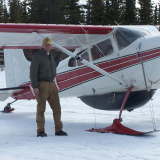
This from my last runs in excess of -30 degrees with our 180H (O-470R). Note the added duct tape to further reduce the opening. The problem is the high density of air at these temperatures which are also typically aligned with high pressure weather systems. The result is the engine operates excessively lean due to ingesting too much air through the as-designed inlet. Easily diagnosed with multi-probe systems which I highly recommend when operating with any restrictor devices.
As for cabin heat, I fabricated an aluminum adapter that slips into the right doorpost heat outlet which converts to 2" scat (about 6') which allows the rear seat occupant to either stick the hose into their jacket, keep equipment warm or defrost the windows (right front seat removed for survey work). Surface temps in the -30 to -40 range typically result in large inversions aloft making engine temperature management challenging.
TR

Tue Dec 09, 2025 7:51 am
Re: Early 180 carb heat
I checked my parts book for the drawing with the air filter cover. The winterization kit also had a set of louvers for the oil cooler, a block off for the left side of the cowl, as well as a part shown at the bottom of the firewall. Perhaps that was to fully close off the cowl flaps? The drawing, however is not of an early 180, and the part numbers shown do not apply to the early serial number airplanes. Not that you couldn't make your own.
I ask, what problems with engine operation are trying to be fixed by the air filter restriction? I also question at what temperature the winterization kit should be utilized. I am not often running in temperatures below zero, I would suspect that the kit is intended for temperatures well below zero F. It sounds from reading some responses in this thread as well as some others from many years ago that the issue was overly lean operation due to very low DA. My owners manual says use enough power as needed for takeoff, it doesn't say max throttle. When cruising at 17 inches my guess is that inlet restriction is redundant, the throttle plate is taking care of that. Unless the restriction plate changes air flow somehow. Maybe my understanding of how a carburetor works is wrong, but it seems that reducing the amount of air through the carburetor would reduce fuel flow, but not enrichen the mixture.
In any case, I don't have engine running issues, I have carb heat that doesn't seem to work as well as most.
I ask, what problems with engine operation are trying to be fixed by the air filter restriction? I also question at what temperature the winterization kit should be utilized. I am not often running in temperatures below zero, I would suspect that the kit is intended for temperatures well below zero F. It sounds from reading some responses in this thread as well as some others from many years ago that the issue was overly lean operation due to very low DA. My owners manual says use enough power as needed for takeoff, it doesn't say max throttle. When cruising at 17 inches my guess is that inlet restriction is redundant, the throttle plate is taking care of that. Unless the restriction plate changes air flow somehow. Maybe my understanding of how a carburetor works is wrong, but it seems that reducing the amount of air through the carburetor would reduce fuel flow, but not enrichen the mixture.
In any case, I don't have engine running issues, I have carb heat that doesn't seem to work as well as most.
- StillLearning offline
- Posts: 463
- Joined: Mon Nov 05, 2018 6:22 pm
- Location: Salmon
- Aircraft: Cessna 180 Skywagon 1953
Tue Dec 09, 2025 8:36 am
Re: Early 180 carb heat
This is a great thread, and Sam’s questions about the physics behind the reducer placer mirror some of my own. Makes sense that it’s to prevent full rich mixture from being too lean at super cold temps, so reduce the intake air.
But man…how do we then enjoy insanely low DA? There should be an “extra rich reserve twist” of the mixture control to make more power. Engine life be damned.
As for carb heat, seems like there’s only three parts to that equation. The exhaust shroud might not be that effective, or blocked? I’m curious to see more on the differences of the Knisely.
Or else the flapper door isn’t operating right. Or the cable isn’t moving freely with full travel?
But man…how do we then enjoy insanely low DA? There should be an “extra rich reserve twist” of the mixture control to make more power.
Engine life be damned.As for carb heat, seems like there’s only three parts to that equation. The exhaust shroud might not be that effective, or blocked? I’m curious to see more on the differences of the Knisely.
Or else the flapper door isn’t operating right. Or the cable isn’t moving freely with full travel?

Tue Dec 09, 2025 10:33 am
Re: Early 180 carb heat
StillLearning wrote: I would suspect that the kit is intended for temperatures well below zero F. I.
The winterization kit for my old man's 185 includes a placard that says it should be removed above 20* F.
Tue Dec 09, 2025 1:11 pm
Re: Early 180 carb heat
eBay has one for sale, but it’s placarded to be removed above -30˚ F.
I don’t think I’m gonna be flying below -30˚ F. Good info to know, though!
Wed Dec 10, 2025 4:48 pm
Re: Early 180 carb heat
My experience with the intake restrictor plate is with the Cessna 185, and for that airplane, operated at very cold temps, that plate is designed to prevent overboosting the engine, based on density altitude of induction air. That engine (IO-520) will make well more than its rated 300 hp at -30 to -40 F. The 185 has an alternate air door, which I'm not sure the 180 has, but maybe. The alternate air door, located in the induction tunnel of the cowl, opens inward (from the inside of the cowling) in the the induction filter is iced up. Iced up filter causes a vacuum in the induction tunnel, which opens the alternate air door to allow warmed air from the lower cowl into the induction. If ice is the issue, you just go home with unfiltered but warm induction air.
If, on the other hand, it's -40 (and, btw, you do know the ONLY good thing about minus 40, right?? You don't have to convert F to C) and you put the restrictor plate on to warm the induction air. The restrictor, when you push up a lot of power, such as on takeoff, creates a vacuum in the induction tunnel because the inlet hole is too small for full power. Again, that opens the "backfire door", allowing warm engine compartment air to flow into the induction, thus increasing induction temps, and preventing overboost.
The rest of that Cessna "Cold Weather Kit" consists of the plate that goes over the right side of the main cooling air inlet (to the right of the prop). It has two slots, one to allow some air to flow over the oil cooler, the other limits inlet air to the interior heat system. Again, this is on the 185, can't speak for the 180.. There's also a similar shaped plate that covers the left side of the cowl inlet.
But, what those plates effectively do is severely reduce cabin heat air flow, and block a LOT of cooling air from flowing over the engine. In the 185, with those plates installed, surface temps at -30F, engine was fine till you climbed out of the inversion (and there's always an inversion in Interior AK when temps are that cold. Climb up out of the inversion to say -25F and you'll watch your CHTs spike really fast. So, back down in the inversion....and slog along in extremely cold temps all day......really dumb.
What everyone operating in really cold temps with the fuel injected Cessnas anyway, is put duct tape over about half of the oil cooler, install in the induction plate, and go fly. It makes no sense to block off cooling air to those cylinders. Close the cowl flaps in the climb if need be.
But, that induction restrictor will prevent overboosting the engine at takeoff power when it's -30 or colder, and I've done a lot of those.
Is the induction plate really necessary on the 180?? Nope, just use carb heat if your induction gets iced over, or if you are taking off in extreme cold and concerned about overboost. Carb heat is your friend.
And, I would NEVER install those block off plates on the engine cooling openings. I knew guys who worked out of NARL (Naval Arctic Research Lab) in Cessna 180s. A couple of our 180s were assigned there, and had been to the North Pole more than once. Those pilots told me they never installed the cooling air block off plates, just duct tape on the oil cooler.
If, on the other hand, it's -40 (and, btw, you do know the ONLY good thing about minus 40, right?? You don't have to convert F to C) and you put the restrictor plate on to warm the induction air. The restrictor, when you push up a lot of power, such as on takeoff, creates a vacuum in the induction tunnel because the inlet hole is too small for full power. Again, that opens the "backfire door", allowing warm engine compartment air to flow into the induction, thus increasing induction temps, and preventing overboost.
The rest of that Cessna "Cold Weather Kit" consists of the plate that goes over the right side of the main cooling air inlet (to the right of the prop). It has two slots, one to allow some air to flow over the oil cooler, the other limits inlet air to the interior heat system. Again, this is on the 185, can't speak for the 180.. There's also a similar shaped plate that covers the left side of the cowl inlet.
But, what those plates effectively do is severely reduce cabin heat air flow, and block a LOT of cooling air from flowing over the engine. In the 185, with those plates installed, surface temps at -30F, engine was fine till you climbed out of the inversion (and there's always an inversion in Interior AK when temps are that cold. Climb up out of the inversion to say -25F and you'll watch your CHTs spike really fast. So, back down in the inversion....and slog along in extremely cold temps all day......really dumb.
What everyone operating in really cold temps with the fuel injected Cessnas anyway, is put duct tape over about half of the oil cooler, install in the induction plate, and go fly. It makes no sense to block off cooling air to those cylinders. Close the cowl flaps in the climb if need be.
But, that induction restrictor will prevent overboosting the engine at takeoff power when it's -30 or colder, and I've done a lot of those.
Is the induction plate really necessary on the 180?? Nope, just use carb heat if your induction gets iced over, or if you are taking off in extreme cold and concerned about overboost. Carb heat is your friend.
And, I would NEVER install those block off plates on the engine cooling openings. I knew guys who worked out of NARL (Naval Arctic Research Lab) in Cessna 180s. A couple of our 180s were assigned there, and had been to the North Pole more than once. Those pilots told me they never installed the cooling air block off plates, just duct tape on the oil cooler.
Wed Dec 10, 2025 8:24 pm
Re: Early 180 carb heat
StillLearning wrote:I checked my parts book for the drawing with the air filter cover. The winterization kit also had a set of louvers for the oil cooler, a block off for the left side of the cowl, as well as a part shown at the bottom of the firewall. Perhaps that was to fully close off the cowl flaps? The drawing, however is not of an early 180, and the part numbers shown do not apply to the early serial number airplanes. Not that you couldn't make your own.
I ask, what problems with engine operation are trying to be fixed by the air filter restriction? I also question at what temperature the winterization kit should be utilized. I am not often running in temperatures below zero, I would suspect that the kit is intended for temperatures well below zero F. It sounds from reading some responses in this thread as well as some others from many years ago that the issue was overly lean operation due to very low DA. My owners manual says use enough power as needed for takeoff, it doesn't say max throttle. When cruising at 17 inches my guess is that inlet restriction is redundant, the throttle plate is taking care of that. Unless the restriction plate changes air flow somehow. Maybe my understanding of how a carburetor works is wrong, but it seems that reducing the amount of air through the carburetor would reduce fuel flow, but not enrichen the mixture.
In any case, I don't have engine running issues, I have carb heat that doesn't seem to work as well as most.
The whole point is to be able to open the throtttle to allow more fuel flow , at partial power is where you lean out even more.
In real cold weather the only way you can take of at all ( without the restrictor) is by using full carb heat to reduce air volume that way.
So partial throtle is not a solution. If you never ran a reducer you will not know how much it helps. By the way the hole is relatively small one would not think that it actualy works — but it does.
- Bush Buggy offline
- Posts: 58
- Joined: Wed Oct 25, 2017 5:30 pm
- Location: whitehorse
- Aircraft: Maule and Cessna 206
Wed Dec 10, 2025 8:29 pm
Re: Early 180 carb heat
jrc111 wrote:I found the part # for my serial number C180B: 0700313-4
eBay has one for sale, but it’s placarded to be removed above -30˚ F.
I don’t think I’m gonna be flying below -30˚ F. Good info to know, though!
Without checking I would guess 30 degrees not-30
The reducers on the cooling air intakes are more critical for temps and I never use them , reduce the outlet instead for
max top deck pressure this gives way more heat. Just as MTV has mentioned
- Bush Buggy offline
- Posts: 58
- Joined: Wed Oct 25, 2017 5:30 pm
- Location: whitehorse
- Aircraft: Maule and Cessna 206
Thu Dec 11, 2025 7:23 am
Re: Early 180 carb heat
Restrictor plates were not intended for the comfort of the cabin occupants, they are designed to mitigate negative effects on the engine when operating in temperatures below those in which the systems (induction, oil coolers and cooling pressure boxes) were designed. Most operators will never have a need for them, however, for those that operate in these temperatures, they are a method to keep the engine in its "as designed" operating parameters (oil temps, cyl head temps and fuel/air ratios).
I do not get wrapped up with what the temperature placards state. Remember that when these devices were made, the "as delivered" aircraft instrumentation was/is crude at best. Now with accurate multi-probe systems, the operator knows with accuracy what the temps are as long as the probes are placed correctly. For example, I typically have a portion of my oil cooler covered even in the summer to maintain proper oil temperatures. There are those that believe these devices are not warranted, that is their opinion, however, as an operator who has operated thousands of hours in subzero temps (coldest -45), I believe otherwise and have the data in terms of overhaul conditions to back it up. Honor the parameters and you will be rewarded with engine longevity. The first step in proper engine care and feeding is installing a multi-probe system. The second step is actually using the supplied data to make the appropriate changes to keep the engine in its "as designed" parameters.
TR
I do not get wrapped up with what the temperature placards state. Remember that when these devices were made, the "as delivered" aircraft instrumentation was/is crude at best. Now with accurate multi-probe systems, the operator knows with accuracy what the temps are as long as the probes are placed correctly. For example, I typically have a portion of my oil cooler covered even in the summer to maintain proper oil temperatures. There are those that believe these devices are not warranted, that is their opinion, however, as an operator who has operated thousands of hours in subzero temps (coldest -45), I believe otherwise and have the data in terms of overhaul conditions to back it up. Honor the parameters and you will be rewarded with engine longevity. The first step in proper engine care and feeding is installing a multi-probe system. The second step is actually using the supplied data to make the appropriate changes to keep the engine in its "as designed" parameters.
TR
Thu Dec 11, 2025 11:02 am
Re: Early 180 carb heat
For those operating Cessna 180s in cold weather, do you have the front induction crossover tube insulated? That makes a huge difference in cold weather ops on these carbureted engines. In my experience, any ops below zero F, the engine tends to run pretty rough without this crossover insulated with pipe wrap insulation.
Last edited by mtv on Thu Dec 11, 2025 11:09 am, edited 1 time in total.
DISPLAY OPTIONS
Who is online
Users browsing this forum: No registered users and 12 guests
Latest Features
-
-
Featured Bush Planes
As one of the undisputed legends of bush flying, the Cessna 180 hauls a…Read More -
Aircraft Ownership and Maintenance
9 modification mistakes aircraft owners make when trying to "bush out" their birds—why some…Read More -
Live to Tell
A Minnesota pilot is surprised to learn that the sudden asymmetric drag of an…Read More


Latest Knowledge Base
-
Destinations
Canada offers some of the most spectacular backcountry flying on the continent. Here's what you need to know before you go.Read More -
Safety and Survival
Hope that you never have to use your survival vest but knowing you have it and knowing how to use…Read More -
Destinations
A regional guide with ideas for winter camping destinations in California, Nevada, New Mexico, and Arizona.Read More -
Aircraft
Finding an affordable aircraft that can handle the backcountry for $80K or less? A challenge for sure, but with the…Read More