Backcountry Pilot • Engine Problems

Engine Problems

Have problems with your aircraft? Maybe just questions about how best to tune or adjust something? Regs or maintenance? Need to know the best way to do something?
19 postsPage 1 of 1

Engine Problems

I made an offer on a Maule MX7-180C a couple of weeks ago and was getting excited until the pre-purchase inspection. We found what I thought was a lot of metal in the oil filer element. Here's a picture of the metal we found:

Image

The best guess is that the metal is coming from the camshaft and lifters because the plane has only been flown ~ 15 hours in the last 18 months. The cylinders are not a likely culprit because compressions were all 76 or 77/80. Any thoughts about other sources of metal that I should be worried about?
Flyhound offline
Supporter
User avatar
Posts: 976
Joined: Sat Feb 23, 2013 6:39 am
Location: Port Townsend
Aircraft: MX7-180C

Re: Engine Problems

It isn't easy to tell in the photo, but that is a thumb under the container. The circle of metal bits is about the size of a large thumbnail.
Flyhound offline
Supporter
User avatar
Posts: 976
Joined: Sat Feb 23, 2013 6:39 am
Location: Port Townsend
Aircraft: MX7-180C

Re: Engine Problems

I can't tell since the thumbnail pic won't blow up... But.... Any metal flakes size should sound a LOUD warning sign in your mind, and the mechanics too.... :shock:
Stol offline
User avatar
Posts: 1048
Joined: Wed Dec 07, 2005 8:32 pm
Location: Jackson Hole Wy

Re: Engine Problems

That's very hard to see, it's a real small picture if you could repost the pictures so we can get a better look at it and is that all the metal you found?
richw56 offline
User avatar
Posts: 124
Joined: Tue Feb 06, 2007 8:37 pm
Location: Vancouver
Aircraft: Cessna 120 125 Lyc.

Re: Engine Problems

Let's see if I can get this better:

Image

The current pricing for the plane is based on a plan to replace the camshaft, the camshaft bearings, the lifter bodies, the rods & rod bearings, the hose oil return and hose intake. While the engine is open, the pistons and rings will be replaced and the cylinders honed.
Flyhound offline
Supporter
User avatar
Posts: 976
Joined: Sat Feb 23, 2013 6:39 am
Location: Port Townsend
Aircraft: MX7-180C

Re: Engine Problems

Let me flip it around: Why would you still consider this plane instead of moving on to the next one? An engine making metal is a pretty big deal and there better be a pretty big reason to keep it in contention.
rw2 offline
User avatar
Posts: 1799
Joined: Sat Dec 22, 2012 1:10 pm
Location: San Miguel de Allende
FindMeSpot URL: https://share.delorme.com/LaNaranjaDanzante
Aircraft: Experimental Maule
Follow my Flying, Cooking and Camping adventures at RichWellner.com

Re: Engine Problems

Ferrous or nonferrous. Use a magnet to tell. Could be corrosion related. Where is the aircraft located located? 18 months of inactivity (low activity in Lousiana is more of an issue than Elko Nevada. If your going to do all you say, then I suspect the price is low. I'd at least yank one cylinder if your going to do them any how and look to see if you have a corrosion pitted margins. Then your cylinders may not hone out too well. Or if you have a borescope look inside and see if you have a bunch of pitting. Fish out a lifter and see if it has pitting and corrosion. Could be the source. Cases do corrode inside, especially if the previous owner used a lot of Mogas. The blow by is corrosive and builds up in the oil, so if they didn't use a buffered oil then it could be corroding inside. So ferrous or nonferrous is a good place to start.
dogpilot offline
Took ball and went home
Posts: 902
Joined: Sun Feb 19, 2012 10:20 pm
Aircraft: Cessna 206H Amphib, Caravan 675 Amphib

Re: Engine Problems

Get the plane at the lower price to factor the engine repairs, pocket the $$ until such time as you need to do the work. That's not really a large amount of metal and I would suggest flying it for a couple hours and checking the filter again, or pull a cylinder and check the cam first. My person thoughts on metal contamination is - don't panic, aircraft engines make metal occasionally... Of course if someone else is paying the bill and you can afford the downtime then do what's necessary for your own peace of mind :D

Here's some info below copied from a Lycoming Flyer...


Because the failure to look for metal in the screens and filter, or
ignoring what is found, can lead to catastrophic engine failure,
we’ll attempt a logical approach to the proper action to be taken
when metal shows up in the oil screen or oil-filter cartridge.
The lack of printed matter on this subject may be due to the difficulty
in adequately describing types and amounts of metal. It’s
like asking for a precise measurement and getting the answer,
“why it’s 25-thousandths plus a little bit.” Therefore, what follows
are meant to be general guidelines, but each case must be
considered as an individual one. Lycoming does not consider this
discussion a technical bulletin, but merely a source of generally
helpful information.
GENERAL INFORMATION
1. On small amounts of shiny flakes or small amounts of short
hair-like bits of magnetic material. Experience has shown that
engines are sometimes pulled unnecessarily.
2. Don’t panic if it’s a low-time engine. A few bits of metal left
from manufacturing are not too uncommon in the oil screen
or filters on new, rebuilt or overhauled engines.
3. Don’t panic again, if it’s a low-time engine, it may be a
replacement for one that had previously suffered a structural
failure. The metal may have just been dislodged from some
hiding place in the oil cooler, oil lines or oil tank.
4. Item 3 brings up the importance of properly cleaning all items
transferred from a failed engine to a replacement engine. On drysump
engines, don’t overlook cleaning of the oil tank. Oil coolers
and oil lines should be cleaned by a proven method or replaced.
5. In some rare cases where the pleated cylindrical-type oil screen
is used, the screen itself may be making metal. Closely inspect
the end of the internal relief valve ball. If the ball is deformed,
this may be the culprit. Replace the screen assembly.
6. In cases where metal shows up in the filter of a factory engine
that is under warranty, and its origin is unknown, the metal may
be forwarded to the Lycoming factory for inspection. In all cases,
the factory Product Support Department should be called before
the material is shipped.
EXAMPLES:
1. Several pieces of shiny flake-like, nonmagnetic, or several short
hair-like pieces of magnetic material — place aircraft back in
service and again check oil screen or filter in 25 hours.
2. As in Item 1, but larger amount, such as 45-60 small pieces
— clean screen, drain oil and refill. Run engine on ground for
20-30 minutes. Inspect screen. If clean, fly aircraft for 1 to 2
hours and again inspect screen. If clean, inspect screen after 10
hours of flight time.
NOTE — In cases one and two, we are determining whether
the small amount of metal was a “one shot and done deal”
(not entirely uncommon).
3. Chunks of metal ranging in size of broken lead pencil point or
greater. Remove suction (sump) screen as large pieces of metal
may have fallen into the sump. In any event, ground aircraft
and conduct investigation. A mixture of magnetic and nonmagnetic
material in this case often times means valve or ring and
piston failure. Removing bottom spark plugs usually reveals the
offending cylinder.
4. Nonmagnetic plating averaging approximately 1/16" in diameter;
may have copperish tint. Quantity found — ¼ teaspoonful
or more; ground aircraft and investigate. If origin can’t be determined
and this is a factory engine (not a field overhaul) that is
under warranty, mail metal to Lycoming factory for analysis, to
the attention of Product Support.
5. Same as Item 4, but may be slightly larger in size and minus
copperish tint. On direct-drive engines, propeller action may be
impaired. Ground aircraft. If origin can’t be determined and it is
a factory engine under warranty, mail material to Lycoming, to
the attention of Product Support.
6. Nonmagnetic metal brass or copperish colored. Resembles
coarse sand in consistency. Quantity of ¼ teaspoonful or more
— ground aircraft. If origin can’t be determined and it is a factory
engine under warranty, mail metal to Lycoming, to the
attention of Product Support.
7. Anytime metal is found in the amount of ½ teaspoonful or
more, it is usually grounds for engine removal. An exception
should be where problem is confined to one cylinder assembly
(rings, valves, piston, cylinder). In this case, if the entire engine
does not appear to be contaminated, the offending cylinder
assembly kit may be replaced. After corrective action is completed,
conduct the routine ground running and screen inspection
as previously described in Item 2.
8. If any single or several pieces of metal larger than previously
mentioned are found, magnetic or nonmagnetic, ground aircraft.
If this is a factory engine under warranty, and origin of the
metal contamination cannot be determined, a call may be made
to the Lycoming Product Support Department. A good description
of the metal may result in placing its origin. When phoning
Lycoming or when returning metal removed from engines, supply
the complete engine model designation, serial number, history of
engine, oil temperatures, oil pressures and and any odd behavior of
the engine on the ground or during flight.
onefitty offline
Posts: 233
Joined: Wed Oct 10, 2012 12:39 pm
Location: Here

Re: Engine Problems

The trouble with a Lycoming engine is you can't see much beyond the accessory drives (if you pull a mag) and cylinders with a borescope, need to remove a cylinder to check the cam...
onefitty offline
Posts: 233
Joined: Wed Oct 10, 2012 12:39 pm
Location: Here

Re: Engine Problems

Following this with interest. The plane I made an offer on has a lycoming with 14 hours on it spaced out over 5 years. Stored in a very dry climate.
Last edited by whee on Sun Apr 28, 2013 3:26 pm, edited 1 time in total.
whee offline
User avatar
Posts: 3386
Joined: Fri Jan 20, 2006 1:59 pm
Location: SE Idaho

Re: Engine Problems

15 hours over 18months doesn't seem that bad if it was flown regularly before that. But don't know anything about lycomings.
whee offline
User avatar
Posts: 3386
Joined: Fri Jan 20, 2006 1:59 pm
Location: SE Idaho

Re: Engine Problems

Flyhound wrote:The current pricing for the plane is based on a plan to replace the camshaft, the camshaft bearings, the lifter bodies, the rods & rod bearings, the hose oil return and hose intake. While the engine is open, the pistons and rings will be replaced and the cylinders honed.


Yeah, let them open it up and replace anything that is found to be making metal... on their nickel. Its common on Lycomings that sit too much to have corrosion on the cam. When the engine returns to service, the corrosion wears off but so does the hardening and spalling ensues. You should be fine if the engine shop is judicious in their IRAN process.

Image
SixTwoLeemer offline
User avatar
Posts: 1285
Joined: Thu Feb 07, 2008 10:53 am
Location: Wasatch Front
Altitude is Time…. Airspeed is Life!

Re: Engine Problems

It's one thing to have these engine issues in your own airplane, which you've had for awhile and have your heart and soul and wallet firmly attached to it. Then you look for ways to preserve what you have.

It's another thing entirely to be looking at an airplane to buy, with these engine issues. There are a lot of good airplanes out there which have no potentially expensive issues. Basic rule: Don't fall in love with an airplane with known problems. It's a lot like falling in love with a beautiful woman who while sober is a delightful person, but who has a serious drinking problem. Can you afford, at your stage of life, whatever it may be, to nurse this particular airplane back to good health, if its problems become overwhelming?

Personal experience: When I bought LRB, she had 960 hours on the O-360, an engine well known to be "bullet proof" with a 2000 hour TBO, had only flown a couple of hours a year for the last several, had a really decent low time airframe. 15 hours after purchase, a bearing spun, an oil passage was blocked, and a rod locked up on the crank and was thrown through the top of the case. I landed in a field, with minimal damage.

$23,000 and 3 months later, I had a hand-built, wonderfully good engine, and in the downtime had a lot of other things done to update the airplane to the tune of roughly $8,000. My engine guy opined that the engine's problems would never have been discovered in even the most meticulous pre-buy, because it would have had to be torn down to discover what led to the bearing spinning. 9 years later, I still have her, I love her, she's a great little airplane, and I've put many more thousands of dollars into her, some for maintenance, some for improvements. I think I have one of the most expensive 50 year old 172s out there!

But had there been known engine problems when I was ready to buy her, I wouldn't have bought--or perhaps I would have, but I would have planned for a new engine and dickered the price down accordingly.

BTW, losing an engine at low altitude is not a fun experience, to put it mildly.

Cary
Cary offline
User avatar
Posts: 3801
Joined: Sun Jan 10, 2010 6:49 pm
Location: Fort Collins, CO
"I have slipped the surly bonds of earth..., put out my hand and touched the face of God." J.G. Magee

Re: Engine Problems

Get a microscope and do wear particle analysis - better yet, have them pay someone with experience to do it for you.

You can tell from the size, shape, type, and variety of wear particles where they could be coming from. If it's something that's commonly found on rusty filters, no worries. If it's case-hardened cam shaft steel, or a brinnelling bearing, run away...
Battson offline
Knowledge Base Author
User avatar
Posts: 1810
Joined: Wed May 09, 2012 11:19 pm
Location: New Zealand
Aircraft: Bearhawk 4-place
IO-540 260hp

Re: Engine Problems

The metal is ferrous. I was able to move it around with a magnet. I'll have more analysis done. The plane is in a damp climate - pacific northwest. One of the jugs will come off this week for the first peek into the internals. I'm not absolutely in live with this plane yet, but I do have a serious crush. I'll provide ongoing updates. I've heard from multiple sources that Lycomings have trouble with their cams if they aren't run regularly and if the oil isn't changed regularly - even if the plane isn't used much. The cam sits in the air space at the top of the engine and that air can become corrosive. Thanks for ask the good feedback. This site is a wealth of good information.
Flyhound offline
Supporter
User avatar
Posts: 976
Joined: Sat Feb 23, 2013 6:39 am
Location: Port Townsend
Aircraft: MX7-180C

Re: Engine Problems

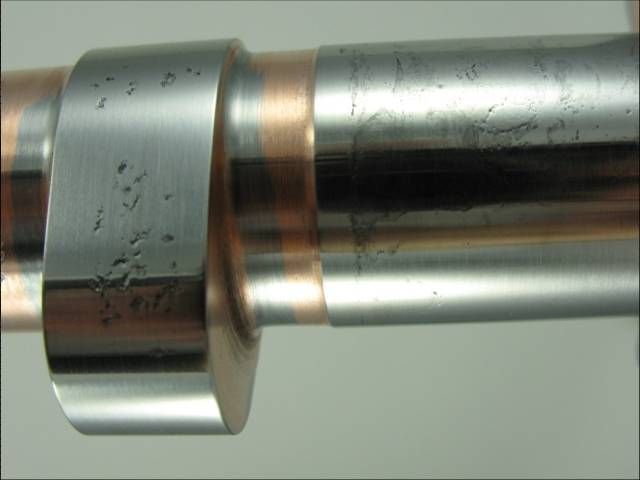
I bought a new (to me) plane a few years back, an M-5-235C. It's absolutely fantastic and everything I could want. However, it was making metal in the same way as this one (same amount, same appearance) and we pulled a cylinder to check. Yep, sure enough, the camshaft was wearing itself apart:

Image

After a year of working on it when I can (and saving up to buy replacement parts), I'm just now getting into the final stretches of the overhaul. So far, aside from the camshaft and all the mandatory replacement parts, I've had to send both the crankshaft and the crankcase out for repair (cracked oil slinger and corrosion on the journals on one and extensive fretting on the journal support webs on the other), and I've had to replace the entire oil pump, the oil filter bypass valve, the valve springs (three of which were broken due to corrosion), a crankshaft idler gear (the expensive one with two gears and a cam on one assembly), all camshaft followers and hydraulic tappets, and various less expensive parts and pieces.

So, while that could well be a fantastic plane (it's a Maule - of course it'll be great :D), I'd highly recommend either taking a pass on it or getting the engine overhauled as a condition of sale. It's no fun being the new owner of a plane and not being able to fly it.
JdS offline
Posts: 15
Joined: Tue Feb 22, 2011 11:10 am
Location: Independence
Aircraft: Maule M-5-235C

Re: Engine Problems

dogpilot wrote:.......Cases do corrode inside, especially if the previous owner used a lot of Mogas. The blow by is corrosive and builds up in the oil, so if they didn't use a buffered oil then it could be corroding inside. So ferrous or nonferrous is a good place to start.


Blowby is corrosive if using a lot mogas? Never heard that one before. Source of information?
hotrod180 offline
Supporter
User avatar
Posts: 10534
Joined: Wed Jan 26, 2005 11:47 pm
Location: Port Townsend, WA
Cessna Skywagon -- accept no substitute!

Re: Engine Problems

Pass pass pass pass!! Also, your list does not include main bearings and thrust bearing, Does somebody assume that the rod bearings were damaged without any harm to the mains? Be afraid.

EB
Mister701 offline
User avatar
Posts: 2134
Joined: Thu Dec 05, 2013 11:13 pm
Location: Sparks
Aircraft: Rans S7LS

Re: Engine Problems

To be safe, you should factor the cost of a complete OH (including new cam & followers, at the very least) into your offer. Then if that still gets you the airplane, unless you have the engine OH'd where it sits, all you have to worry about is the engine puking in-flight on the way home.
hotrod180 offline
Supporter
User avatar
Posts: 10534
Joined: Wed Jan 26, 2005 11:47 pm
Location: Port Townsend, WA
Cessna Skywagon -- accept no substitute!

DISPLAY OPTIONS

19 postsPage 1 of 1

Who is online

Users browsing this forum: No registered users and 0 guests

Latest Features

Latest Knowledge Base