×

Message

Please login first

Backcountry Pilot • Evaluating off-airport landing sites?

Evaluating off-airport landing sites?

Share tips, techniques, or anything else related to flying.
72 postsPage 2 of 41, 2, 3, 4

Re: Evaluating off-airport landing sites?

I swear by the 3 pass rule. After that its not going to look any better. Your only talking yourself into the fact that it does when in fact it really does not. Now contradicting myself, there are places I have looked at 50 plus times prior to landing but those spots also took months / years to finally land. Honeslty, I ask myself all the time..."Is it really worth it?" Unfortuantly, far to often I tell myself yes it is... #-o [-X But again, landing off field is about all I can think about. The harder or more challenging it is I find myself obsessed with. 90% of the places I go i generally end up saying "time to go home"...and then find myself there again the very next day trying to piece the puzzle together. If only I was flying an "experimental".

Anyhow, love all the talk about how one should do this or that. When talking ski flying folks always have an opinion about shovels, snowshoes, etc. Honestly if someone would like to have a race on shoveling I will the first to sign up. The big shovel is not your friend when moving snow. Even more so for those that are over 50...sorry thats honest. The big shovel will wear you out and run you down while my 16" blade / avalanche shovel just keeps going. No heavy loads and it gets the job done. Now, there are some really bad shovels on the market but,there are also really good ones.

My snowshoes are about 3 feet in length. Not to small and not to big. The big daddys will take you forever to walk somewhere. The small ones are worthless unless your at a resort on a snowshoe track walking your dog. The Atlas 12 series brand is bomber! Trust me.
http://atlassnowshoe.com/snowshoes/12-series-1213

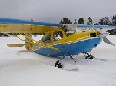
MTV- you hit the nail on the head for turning around. Small blasts of power works. First a slight right turn and then go left. When in deep snow however the small blast thing works but YOU DO NOT WANT TO LET YOUR MOMENTUM STOP! That often means that those small blasts are not so small to keep yourself going. I really like ski flying with a passenger. No one has mentioned having a rope from your wing tie down to hang onto. That also works well for turning around. Honestly, if I am planning on stopping in the snow, I will have made several passed to pack the snow down the runway so that when I do turn around I end up in a track that has been packed. Turning around on skis is like driving a tri gear.

Another thought...dont stop after running around on your skis without cooling your skis down. Come to a stop in your track and wait 30 seconds. Blast forward 6 feet and do it again. I do this about 3 times over for cooling. If not you may find yourself stuck and frozen to the snow. When you do get free you end up with a bunch still stuck to the skis. Boards and all work as well but just cooling your skis down works close to the same. If I were spending the night I would run up on some tree branches / pine bows.

Tail ski vs no tail ski. Ford or Chevy? Its pretty easy to get the tail out of the ground with power. The skis keep you from going over on the nose. I am liking the BW on the back for now but the jury is still out. Half of the K2 Aviation folks run no ski and the other half has a ski. Thinking if I was always flying at max gross the tail ski would be my choice. For the short uphill no go around landing, the no tail ski is nice for quick stopping due to drag.

My ski flying experience is growing as I still only have a few years of really getting after it with them. So yes, I do learn something new every time I fly them. I think my favorite part as of late has been high marking or leaving tracks in places that make those on the ground or flying over go hmmmm. What are those??? Its a cool feeling making a 20 degree turn and putting your skis on the ground. Kinda like a big power carve turn. No I am not crazy....

Anyhow, great thread. Nice words MTV. You should write a book. You should also post some more pictures to support all the great stories you have!!! The photos in your gallery just do not cut it. Do you still fly everyday? Post some photos please...
In fact, more of the folks on here should post more photos.

I am betting I am the only person in California with skis on. Thats kinda cool...

AKT
aktahoe1 offline
User avatar
Posts: 2052
Joined: Sun Jul 13, 2008 8:22 am
Location: Alaska and Lake Tahoe = aktahoe
If it looks smooth, it might be. If it looks rough, it is...www.bigtirepilot.com ...www.alaskaheliski.com

Re: Evaluating off-airport landing sites?

Wow this turned into a great thread. I've been going off airport for almost 20 years and have learned a few things. I really like MTV's idea for judging length of a landing area by flying a drag at a known airspeed and timing it. Seems so simple, why didn't I think of it before? Duh!

I think the safest way to do it if you know you're planning on or wanting to go somewhere specific is a ground recon. I have also found many potential off airport sites while hunting / fishing / camping / hiking, etc... made a mental note and then later went back and looked from the air.
Cub271 offline
User avatar
Posts: 113
Joined: Mon Dec 24, 2012 1:21 pm
Location: Yakima, WA

Re: Evaluating off-airport landing sites?

Another way to measure a potential landing spot is by using the ruler on Google Earth. It's not perfectly accurate but I've used it several times and it's close enough.

I also use a free IPhone app called Map-o-meter. Similar to Google Earth. Just drop a pin in one spot, then drop a pin in another and it gives you the distance in yards between the two pins.
SkySteve offline
User avatar
Posts: 258
Joined: Mon May 12, 2008 11:20 am
Location: Huntsville
FindMeSpot URL: http://share.findmespot.com/shared/face ... ognaNo67qS
Aircraft: Kitfox

Re: Evaluating off-airport landing sites?

X2 on google earth, I use "measure your land" app.
Terry offline
User avatar
Posts: 1365
Joined: Sat Nov 10, 2007 9:11 pm
Location: Willamette Valley
FindMeSpot URL: http://share.findmespot.com/shared/face ... 4GzPHI6t1d

Re: Evaluating off-airport landing sites?

There are a few things I can think of that I didn't see here.

If you see airplane tracks on the ground it must be safe right?? :(
Do those tracks end in the water, did the river take away a few feet of strip? Maybe those tracks lead right up to the crash site where they hooked up the recovery chopper. Maybe he had shitloads of power and you don't. [-X A few years back there was a young feller with a cub that just loved to touch and go on the river bars, there were plane tracks on every more or less flat sand bar in the valley but none of them would actually work to land on, stop, and take off again.

Try to stay absolutely in the tracks of any bush strip you use, it is a common practice to "brush out" strips by cutting the alders and scrub with machetes and saws which leave really sharp, hard stakes coming out of the root wad. These will go right through the sidewall of a tire really easy. :shock:

Years ago a friend of mine landed on top of a ridge that he had looked at for a long time, it was long enough, smooth enough, it just had too much vegetation on it. finally one day in the fall after a hard freeze he flew up and checked his spot. Behold all the shrubbery was dead and laying down flat, it looked great. After a few more looks he set her down and it rolled along just fine. Just as he was feeling great he lightly touched the brakes, well the frost killed brush was pea vine, the wheels stopped turning, the vines were super slick and they started piling up in front of the wheels. He came to a rather abrupt stop with a huge pile of this crap wrapped up around the mains most of the way up the gear legs.
Many hours of cold wet labor later he had slipped, fallen, crawled, cursed and cleared a narrow path of the accursed things and managed to take off again.

So, even if it looks really good and you have checked it and checked it you can get a surprise that will leave you dazed and confused. #-o In the end it's sort of like gambling ain't it? Don't bet it if you can't afford to loose it.
shorton offline
Posts: 662
Joined: Mon Mar 27, 2006 11:54 am
Location: Haines Alaska
Aircraft: Stinson 108-2

Re: Evaluating off-airport landing sites?

Another useful tool for measuring the usable "runway" at an off airport site is to get a measuring wheel. I picked one up at Harbor Freight for 8 or 9 bucks and threw it in the back of the plane. Of course it won't let you know how much room you have before you land, but it will tell you exactly what's available for takeoff. I thought I was the only one who did this, then I noticed AKT has the same thing when I ran into him up in Truckee over the weekend. I also use google earth to measure off airport sites and its a great tool. It's just not good for gravel bars as those are constantly changing.
robw56 offline
User avatar
Posts: 3263
Joined: Thu Jan 18, 2007 9:30 pm
Location: Ward
Aircraft: 1957 C-180A

Re: Evaluating off-airport landing sites?

Shovels: As noted earlier, there is snow, and there is snow.....much of the ski flying I've done was in the interior of AK, where the snow is VERY dry, light and fluffy. Attack that stuff with a small shovel, and you'll be at it for a while. A grain scoop works great in a plane like the 180/185, where cabin space is not an issue. In the Cub/Husky/Scout I always carried a small folding avalanche shovel as noted by AKT. But the take home here: DO NOT go ski flying in any snow deeper than about six inches without a shovel of SOME kind and a good set of snowshoes....

Snowshoes: See above re: Snow. MANY years ago, Dick McIntyre was selling out his sporting goods store in Fairbanks. It was a high end and GREAT store, and Dick was a great guy, but he was reducing inventory. At some point, everything in the store was reduced pretty dramatically, and they had three sets of the old Sherpa snowshoes, metal frames, plastic webbing, and almost four feet long. I bought all three sets, I think for $30 a set. Those are the best snowshoes I've ever used, and I've tried a lot of different shoes. I wound up letting co-workers use one set, which eventually got "adopted" by one of those folks who I worked with a lot, after he'd used them for ten or twelve seasons at work. Huge shoes, and they pack snow really well, but no, they wouldn't be much fun in really wet, sloppy heavy snow-been there and done that.

Three pass rule: Sounds good, and certainly applies to someone with some experience. I found that every time I get in a different airplane, I start over again, since I don't know performance yet. Also, see above re: Snow :lol: . I wrote what I wrote as a beginning. I rarely make over two or three passes in most airplanes these days, but sometimes.....and as you say, if you have to work at it too hard, it may be too hard. Finally, there is working an airplane, and there's doing this stuff for "fun". When I was working airplanes, there was never anyone yelling at me to land somewhere (except during recurrent checkrides with Tom Belleau :shock: [-o< ), but there was an expectation that you'd get it done. And, I rarely got to pick the spot. Sometimes I'd land up or down stream on a gravel bar a ways and walk back, or snowshoe a ways...but. When you're trying to change a radio collar on a bear in a winter den, you land as close to the den as possible, and that's not always real close and not always the best spot. I decided a long time ago that I can't afford to break my personal airplane for "fun" (learned that one the hard way) and so I'm pretty conservative with my own wings.

Photos: One of my great regrets in my career in AK was that I never took many pictures, in fact very few. Too busy, I reckon. I know both of Noel Wien's sons, and between them they have literally thousands, if not tens of thousands of historic photos taken by their father during the very early days of Alaska aviation....Noel Wien didn't introduce the airplane to Alaska, but he was the guy who put it to work there. Once I remarked to Richard Wien that it was amazing that his Dad had the foresight and tenacity to carry a camera around. Richard said that his Dad carried that big 4X5 Graflex (or something like that) camera around everywhere he went, even flying in open cockpit Standard biplanes. Richard said that his Dad knew he was doing something historic, and he recognized that it needed to be documented. Unfortunately, in an age where cameras were much smaller and easier to lug around, I never carried cameras much, and the vast majority of my pictures are on 35 mm film. I've had a few digitized, but they don't really come out "pretty". I've got a lot of pictures in my mind, though :roll: .

Other good points made by folks here.....Google Earth is a great tool for initial "look-see", but most often you go somewhere, THEN look for somewhere to land. Not always, though. I've used Earth a lot since it came out. Cooling the skis down is a great tip, and very important unless you really like digging and cursing. I essentially quit propping my skis up on blocks overnight, but using that technique, then in the AM, pre-flight, and give the toe of each ski a fairly gentle kick to one side, to shear the frost off the plastic bottoms. Don't try that with metal bottoms, though....and I replaced the metal wear strips (skegs) on the ski bottoms with UHMW plastic. Frost up those steel skegs, and you're not going anywhere, and metal frosts up REALLY well.

Tail skis: If its a Cessna and there's much snow, I definitely want a tail ski. In fact, if it's ANY airplane and there's much snow, I want a tail ski. When I first started ski flying in FAI, I didn't know any better, and my Aero skis for my cub came with a tailski. I put it on. I'm sure everyone was making fun of the "new guy". After a number of years, I started seeing more airplanes with tail skis. They can really help you turn around, AND, more importantly, in an airplane with a fairly heavy tail, the tail ski allows you to "float" the elevator, instead of trying to push hard on it, and if you overdo that, force the fronts of the skis into the snow, therefore creating drag. In some conditions, unless you are REALLY sharp with that airplane, you simply aren't going to get airborne without a tail ski.

Low Rider mentioned Density altitude: HUGE factor on skis especially. Most of my ski flying was near sea level, and of course in winter in the interior, temperatures are "slightly" below standard :lol: . I did do some work on Mt. McKinley, and the difference in the way a 185 performs at sea level and the way it performs at 7000 feet or so is significant. And, that's an understatement. Downhill is the only hope at that altitude, with ANY load, on a good day. And, of course, when it does warm up a little in the mountains, the flow is typically down glacier......perfect. I don't envy those guys who fly the climbers and tourists onto the mountains, let alone the guys that pioneer some of those LZs. The operators I've talked to who work McKinley tell me that typically, the Chief Pilot is the guy who does all the pioneering, everyone else lands in his tracks. LOTS of great ways to screw up on glaciers, no doubt....been there and done that #-o . Got a couple of those pictures around somewhere. I'll look. But, crevasses scare the shit outta me....losing a whole airplane, which emerges to the amusement of earthlings 2000 years from now is not my idea of a good time.

Lots of good ideas here, keep plunking them in here. Getting out and doing it is a big part of the gig.

One final thought, while I noted that I can't really afford to break airplanes for fun, you need to understand that when you operate in the off airport environment, you stand a greater chance of breaking something, and it may be in a place that's really inconvenient to retrieve and/or repair. Again, good instruction is a great way to start this process.

Most of all, have fun.

MTV
mtv offline
Knowledge Base Author
User avatar
Posts: 10514
Joined: Sat Feb 25, 2006 1:47 am
Location: Bozeman

Re: Evaluating off-airport landing sites?

shorton wrote:In the end it's sort of like gambling ain't it? Don't bet it if you can't afford to loose it.

X2
OregonMaule offline
User avatar
Posts: 6977
Joined: Fri Sep 01, 2006 9:44 pm
Location: Orygun
My SPOT page

"They who can give up essential liberty to obtain a little temporary safety, deserve neither liberty nor safety". Ben Franklin
http://en.wikiquote.org/wiki/Benjamin_Franklin

Re: Evaluating off-airport landing sites?

robw56 wrote:Another useful tool for measuring the usable "runway" at an off airport site is to get a measuring wheel. I picked one up at Harbor Freight for 8 or 9 bucks and threw it in the back of the plane. Of course it won't let you know how much room you have before you land, but it will tell you exactly what's available for takeoff. I thought I was the only one who did this, then I noticed AKT has the same thing when I ran into him up in Truckee over the weekend. I also use google earth to measure off airport sites and its a great tool. It's just not good for gravel bars as those are constantly changing.


If there's any kind of topography or trees or rocks, you can use a laser rangefinder made for hunting. They have a max range of of about 500 yards, but beyond that you're golden anyway.
Zzz offline
Janitorial Staff
User avatar
Posts: 2855
Joined: Fri Oct 08, 2004 11:09 pm
Location: northern
Aircraft: Swiveling desk chair
Half a century spent proving “it is better to be thought a fool than to open your mouth and remove all doubt.”

Re: Evaluating off-airport landing sites?

This is a great thread!!
Here are some pics from "measure my land" app.
This first one in the Oregon coast range. Myself and another plane made 5 or 6 approaches here and neither of us were game for landing.
The logging road is 12ft wide at best with big drop offs on both sides and a nice uphill grade. After looking up the length on the map, its doable. But not worth the gamble for me.
Image

This one I have thought about before, but never made an approach thinking it was just to short.
After looking at the map, this one is on my list when the water recedes, along with a few others on the river that I have not been paying attention to.
Robw56, good thought on the bars changing over time.
Image

This one just to show the accuracy of the measuring tool.
Image
Terry offline
User avatar
Posts: 1365
Joined: Sat Nov 10, 2007 9:11 pm
Location: Willamette Valley
FindMeSpot URL: http://share.findmespot.com/shared/face ... 4GzPHI6t1d

Re: Evaluating off-airport landing sites?

I'm not into apps at all but that one actually looks cool! I'm downloading that now.
robw56 offline
User avatar
Posts: 3263
Joined: Thu Jan 18, 2007 9:30 pm
Location: Ward
Aircraft: 1957 C-180A

Re: Evaluating off-airport landing sites?

I don't know nuthin bout snow, but I like rivers. Decades ago, I did search and rescue flying in a J3. Been years since I last did it, but because of it, to this day, the majority of my landings and takeoffs have been on the sandbars, islands, and levee tops of the Mississippi and White Rivers. I like to visit a site first, when time permits. If no time, then drag the site from several directions, fixing it in your mind. No rock around here, but unlike ocean beaches, the wet sand can be quick, so you land on the soft dry, powdery stuff.
Do not use the brakes.
Keep an eye peeled for buried logs and snags.
The dunes and ripples are sawtoothed shaped and range from 3 inches to 3 feet high, so you land down river and not into the wind. Same for takeoff.
JimC offline
Posts: 110
Joined: Wed Jun 16, 2010 9:05 pm
Location: Collierville TN

Re: Evaluating off-airport landing sites?

aktahoe1 wrote:I am betting I am the only person in California with skis on. Thats kinda cool...
AKT


Not for long. One of the Lemoore F/A-18 guys with a J-3/11 cub just had a pair of straight skis shipped. Sounds like he is planning on stashing them somewhere up hill from there where he can do a quick changeout and take off on a snow field adjacent to a landing area. Not sure what area he was going to use, but I was amazed at how easy it was to change the tire on the J-3 when I had a flat this summer. Just lift up on the strut and kick a block of wood under the axle. So should work for a quick change out.
Matt 7GCBC offline
User avatar
Posts: 330
Joined: Fri Feb 11, 2005 11:12 pm
Location: Northwest
FindMeSpot URL: http://share.findmespot.com/shared/face ... vXLMMuZOv7

Re: Evaluating off-airport landing sites?

robw56 wrote:Another useful tool for measuring the usable "runway" at an off airport site is to ......


Fly over with a stopwatch-- at 60 knots groundspeed you're doing 100 feet per second. Line up a ways out & figure what airspeed equals 60 knots groundspeed on your GPS to compensate for winds aloft-- I find that it's a lot easier to pin the airspeed indicator on s specific number than it is the GPS readout.
hotrod180 offline
Supporter
User avatar
Posts: 10534
Joined: Wed Jan 26, 2005 11:47 pm
Location: Port Townsend, WA
Cessna Skywagon -- accept no substitute!

Re: Evaluating off-airport landing sites?

I have to add to the earlier post about following tracks to "nowhere". When I first put the full lotus floats on my plane I had to test them out on every thing I could think of. When the lakes first started freezing up I would get out on them to see how much ice I needed to hold me up. I didnt care if I broke through cause I was on floats. Many times I would (and still do) land on frozen lakes then taxi into open leads, drive around in the water then back onto the snow/ice. When flying over looking at the tracks I leave, I have often hoped some poor soul would not follow my tracks when he was on skis.

I am in the Avy shovel crowd. I would rather take two small bites than one big one after digging for a couple hours trying to get the plane out of overflow etc. (when I am on ski's not the floats).

The 60 knot flyby trick was taught to me on day 2 of my flight training. The instructor knew that 99% of my flying would be off airport and the entire flight training syllabus was directed at that. I wish now I had spent more time going into towered airports but that only happens a couple times a year for me.

Tall grass... watch out for logs that hide in the grass, folding the gear is no fun!

Start small then go big! Steps that is..
akavidflyer offline
User avatar
Posts: 521
Joined: Sat Nov 20, 2010 7:36 pm
Location: Soldotna AK

Re: Evaluating off-airport landing sites?

robw56 wrote:Another useful tool for measuring the usable "runway" at an off airport site is to get a measuring wheel. I picked one up at Harbor Freight for 8 or 9 bucks and threw it in the back of the plane. Of course it won't let you know how much room you have before you land, but it will tell you exactly what's available for takeoff. I thought I was the only one who did this, then I noticed AKT has the same thing when I ran into him up in Truckee over the weekend. I also use google earth to measure off airport sites and its a great tool. It's just not good for gravel bars as those are constantly changing.


I'm a competitive shooter, and often carry a laser rangefinder with me on backcountry hikes to measure out some places for long range precision rifle work. I'd imagine that a rangefinder would work well for the purposes you described. More expensive than a measuring wheel, to be sure, but something that a lot of the fly-in hunter types might already own!
coloradokevin offline
Posts: 37
Joined: Mon Apr 01, 2013 4:22 pm
Location: Arvada, CO

Re: Evaluating off-airport landing sites?

MTV,
Your 05 Jan chapter on off airport landing was very thorough and helpful. I would add to considering an escape route that we need to always consider which way is downhill and how we might get there is ground effect, if necessary. You are a good writer and should write a book. Lots of my readers like my techniques but say I write like I talk: garbled.
contactflying offline
Posts: 4972
Joined: Wed Apr 03, 2013 7:36 pm
Location: Aurora, Missouri 2H2
Download my free "https://tinyurl.com/Safe-Maneuvering" e-book.

Re: Evaluating off-airport landing sites?

By MTV: "A small bush on the approach end, a big rock at the far end,..."

DEFINITION: SMALL BUSH
THE EXACT SPOT WHERE A LARGE ROCK STOPPED A SEED.
Fresno offline
User avatar
Posts: 50
Joined: Sat Apr 06, 2013 8:58 pm
Location: Fresno

Re: Evaluating off-airport landing sites?

Great old thread and good info. Have a question on "dragging" a landing area. Whether this be a known backcountry strip early spring for instance or a wide open hill top area testing the surface. General consensus to use full flaps and get nice and slowed down to have a look right off the surface? Or when deciding to touch the mains and feel the surface use full flaps again?

Ill give an example: I was going to land at a nice wide long "backcountry" strip here in Idaho this winter, not much snow in the area at all but was flying up to see what the conditions of it looked like. Expected it to be wet at least, if not muddy at the west end. Going east it is in to rising terrain but again this is a 5000' long strip. I flew over the top, looked at the strip and it looked fine from pattern or so height. Decided to set up like a normal approach finishing it out with 40* of flaps in my 170. As I got down to surface and gently touch mains on surface it seemed ok but was flinging some mud on wings etc. I decided I was going to go around and think it over.....well I was starting to run out of runway and basically decided it was safer at that point to just set it down and it all worked out. Made me think maybe I should have been say 30* or maybe even 20* of flaps and been faster so I could have more easily popped off surface and started the climb out. The O-300 doesnt have that much umph.

So other than all the good advice previously mentioned, whats the consensus on flaps and checking out or dragging and area you plan to land?
kygreen229 offline
User avatar
Posts: 130
Joined: Mon Aug 26, 2013 10:43 am
Location: Boise, ID

Re: Evaluating off-airport landing sites?

kygreen229 wrote:Great old thread and good info. Have a question on "dragging" a landing area. Whether this be a known backcountry strip early spring for instance or a wide open hill top area testing the surface. General consensus to use full flaps and get nice and slowed down to have a look right off the surface? Or when deciding to touch the mains and feel the surface use full flaps again?

Ill give an example: I was going to land at a nice wide long "backcountry" strip here in Idaho this winter, not much snow in the area at all but was flying up to see what the conditions of it looked like. Expected it to be wet at least, if not muddy at the west end. Going east it is in to rising terrain but again this is a 5000' long strip. I flew over the top, looked at the strip and it looked fine from pattern or so height. Decided to set up like a normal approach finishing it out with 40* of flaps in my 170. As I got down to surface and gently touch mains on surface it seemed ok but was flinging some mud on wings etc. I decided I was going to go around and think it over.....well I was starting to run out of runway and basically decided it was safer at that point to just set it down and it all worked out. Made me think maybe I should have been say 30* or maybe even 20* of flaps and been faster so I could have more easily popped off surface and started the climb out. The O-300 doesnt have that much umph.

So other than all the good advice previously mentioned, whats the consensus on flaps and checking out or dragging and area you plan to land?


The answer to your question it depends on the airplane. But, with most Cessnas, and certainly with a 170, I evaluate with 20 degrees of flap. That gives you the easiest acceleration if you need to get going. An example might have been like the situation you described, but where the mud started to suck you in. In that case, you need to get moving NOW, and that little extra time to reset the flaps won’t help.

Twenty flaps just gives you more flexibility, and the stall speed reduction between 20 and 40 isn’t that much....you’re evaluating, not landing. One other reason for me is at 20 flaps, I’m not yet ready to land, so the temptation to just go ahead and land out of an eval. pass is gone. Finish the eval., go out, configure to land, THEN land.

Be careful on uphills, too. It’s pretty amazing how fast a plane decelerates on an uphill landing surface.

But, evals I do with 20 flap. Just too much drag.

Does your 170 have the stock engine?

MTV
mtv offline
Knowledge Base Author
User avatar
Posts: 10514
Joined: Sat Feb 25, 2006 1:47 am
Location: Bozeman

DISPLAY OPTIONS

PreviousNext
72 postsPage 2 of 41, 2, 3, 4

Who is online

Users browsing this forum: No registered users and 2 guests

Latest Features

Latest Knowledge Base