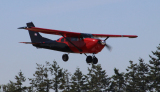
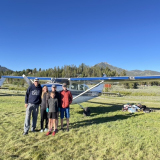
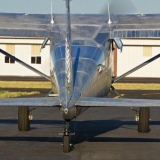
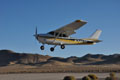
I lost my airplane on 7/22/11 while flying from Johnson Creek to Chamberlain. I know a lot of you are flying older airplanes
like I had (1963 Cessna) and my inflight engine failure is something that could happen to any of us.
What started out as a day adventure to do some fishing in Chamberlain turned out to be a very difficult situation. We left JC
to get some fuel at Salmon, and then departed for Chamberlain. A TFR for firefighting was in effect at the Nort Fork of the Salmon
River so I proceeded North to ensure that I stayed clear of the firefighting activity. I thought about going through the Selway Canyon
but decided against it 'just in case'. I proceeded further North before turning West.
I turned in a Westerly direction around Votler Creek and things went very bad and literally downhill around Hells Half Acre. I heard
an unusual metal to metal sound from the engine compartment and immediately turned toward West Fork, MT. The engine began to run
very rough, the EGT's & CHT's were all over the place and I thought the seats were going to come off the rails.
My initial thought was that I had thrown a propellor blade due to the rodeo ride we were getting. I thought I was uptight with all
the unusual sounds, but in about 4 minutes everything went quiet over the Painted Rock Lake in Montana. It was now commitment time
as I knew I would not make it to West Fork. I did a 180 and headed back to a wide spot in the canyon with a visible dirt road. As
a side note, it is true that the prop keeps us pilots cool. You should have seen me sweat when it quit turning.
 :)
:)I got it down and we got out of the plane, but my ship was damaged beyond repair. I was lucky because the Forest Service Rd I landed on had an emergency response team
conducting an exercise. My wheels were on the ground when I passed them sitting in the bushes eating lunch. The plane was foamed down within 10 minutes of impact and
the EMT's were treating us immediately. The Fire Chief thanked me profusely for improving their response time. I can tell you we were both happy about that idea.
The NTSB has issued a preliminary report and released the airplane and here is what they found.
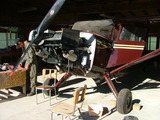
The engine is an IO470S with 520 hrs since factory new. I have put 7200+ hrs on the plane. The airbox failed on the inboard bottom side right behind the air filter and began feeding the engine metal. It didn't take long for for a complete shutdown since the airbox fed the engine enough metal to leave a hole around 1.5" x 4". The airbox
had been repaired at the failed area in 1985. It seems to have started where a crack was welded.
Lessons Learned:
Communicate:
I was enroute with another aircraft who communicated my lat/long on 121.5 (Thanks Brent & Bob N952WK). An airliner picked it up, communicated it to Salt Lake Center who notified the FAA & NTSB the location of a downed aircraft. Search & Rescue was initiated and I called it off about 10 minutes later when talking with the FAA/NTSB
after getting out of the plane.
Aging aircraft:
I have been tuned into the idea of an 'aging aircraft' and have modified my preflights to look for symptoms. I even looked at the inside of the airbox with a flashlight and mirror about 10 hrs before this incident happened when I changed the oil, filter & air filter. I didn't see any evidence of a problem. AOPA has a nice short online course about aging aircraft. It would be a good 30 minutes of your time to review the obvious.
Landing:
Make every landing as if it is your last. Pick the spot and hit it everytime. This idea was pounded into me during flight training and I make every landing as 'dead
stick' as I can. Pick your point, get to pivot altitude over the point and make a normal landing for the circumstances. It will be second nature to you when you need it and
with fewer distractions.
Fly the airplane:
Fly it to the scene. Stay on the controls until the plane stops. I surprised myself how I was able to dodge obstacles and get through
cattle guards up to point of impact. BEWARE of the OVERWHELMING desire to get those wheels on the ground when you are close. DO NOT RUSH THOSE LAST FEW SECONDS SINCE A HARD BOUNCE WILL DEFINITELY ADD TO THE PROBLEM! AVIGATE, AVIGATE AVIGATE even when the wheels are on the ground.
Checklist:
I had a checklist, and I referred to it. But I still missed a few things and really don't know why. I have now put another copy of emergency check list in the
co-pilot pocket of my replacement plane and explain to the right seat passenger what they need to do in the event of an emergency (READ ME THE FRIGGIN LIST ONE ITEM AT A TIME UNTIL I ACKNOWLEDGE THE ITEM).
So guys & gals, if you are flying older aircraft pay attention to the critical things like wheels, fuel systems, intake systems and exhaust systems. It may make a difference.
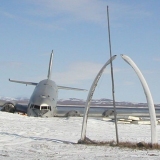
Final Resting Place for 27Z


The airbox


The spark plugs. Think they chewed up some metal??? Look at the fine wire position.

The last 8 mins of flight




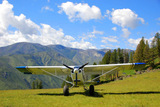


 I just hope all of us can remain calm and clear headed enough to do this should we ever encounter the same situation.