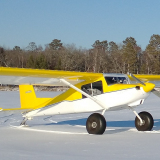
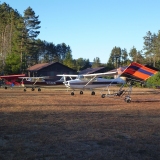
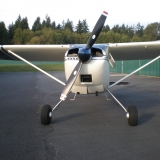
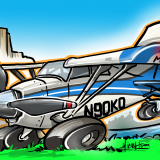
Flew my first pacer the other day. Had a big smile the whole time. It was a PA-22/20 150. Slight wing extension as mentioned. Skylight! Flew with half tanks. 60 gal capacity. Ground handling was solid with no need for brakes. It is clearly short coupled and required attention to detail, but didn't have any poor handling characteristics. I have a Citabria and a PPonk 180. I have flow Cessna 170s, Maule 7s and 4s and Luscombe 8 (thanks John!) as well as many other tail wheel aircraft. Of all these, it seemed the Pacer was the more responsive in yaw on the ground and likely the least tolerant of poor skills. While the skywagon may require more "effort" to control in some aspects, the short coupled pacer would have more problems with over control and quick oscillations on the runway. I wouldn't recommend it as a tail wheel trainer. I didn't feel it was poorly rigged or twitchy, but as was said earlier, I think you would quickly see if the pilot was twitchy! Recency may have some effect on my comparison with the other aircraft.
The OP was asking about the trigear and the plane itself was nice. The left front door would be high on the list of desires, but I understand it requires replacement of the fuselage structure which would be the front door post. This plane had the hinge above the door and swung up to the wing, which I also really liked for ease of entry.
Handles BEAUTIFULLY in the air. The roll rate was great, but likely less than standard for the type, in this plane with the wing tip extensions. The skylight may have contributed, but visibility was good. In the Maules I always feel like the windshield is short and I'm sitting too far back from it, looking through a slot. If the windshield isn't any taller in the Pacer? I certainly felt like the seat was closer and vis was better. Again, the skylight was a plus.
Power off stalls were not possible as the wing only mushed with no shudder. I couldn't even get it to break with full aft yoke and full rudder. Application of a larger PA-18 tail would change this characteristic. Addition of some power gives the tail force enough to get the wing stalled, barely, and still there were no poor qualities and recovery was a non event.
At 2500 elevation with 400lbs of pax and 200lbs fuel we were able to land in 275 ft and take off in 300ft. Wind was ~4-6 knots sweeping around,but usually directly across runway, so no help there. Use of the flap handle to goose the take off did not really help at all like with the Cessna's.
My brother has been wanting a tail wheel he can get his wife and 2 kids into. He has been looking at Maules and 180s but I feel this would be a good economical and capable alternative to consider.