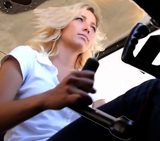
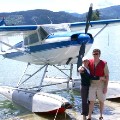
I'm also not sure that her having that thumb out and holding to the strap while looking out the window counts as a thumbs up.
 Congratulations on your purchase. Congratulations on your purchase.
dirtstrip wrote:I have no Cessna 180 time but one thing I found that helps me is to trim just a little forward pressure on to the stick so instead of using forward pressure to pin it on (two wheeler) you just release back pressure.
I'm also not sure that her having that thumb out and holding to the strap while looking out the window counts as a thumbs up.


 Never attempt to dissuade a fellow who thinks you're good...


 .
.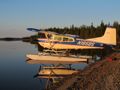
We all need that, even when our airplanes (like mine) have the little wheel in the front.Practice, practice, practice.....
hicountry wrote:....forgot about the the gear alignment I had to do on the C-170..glad someone mentioned it. I had to experiment with wedges to get the gear aligned..tough to do because when taking the plane on and off the jacks, the wheels don't align right until the weight is square on the landing gear (hope I said this right). If I remember right this took several days and seven or eight trials to find the right combination.
With the power off stall landings to three point my input to the elevators was always a pull back..never from foreward stick through neutral to pull.
Example:
Kinda hard to see the elevators...but...
I touched down within a couple feet of the white flag line.
Another thing to do Matt....video your landings. Sometimes watching what you are doing feels different than what you are doing. I have many hours of my landings with the C-170.

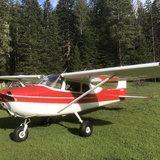 . It really helped me cement the sight picture at landing, as well as tune my stick and rudder skills maintaining centerline and aligned (the flying that is, not the whacks). the bounce in cessnas spring gear is put there to save you time and gas money. You can 3-5 touch n go's in on each landing. Lessens your go arounds.
  Just takes time and feel. It will just click one day. And then you will still bounce it when someone's watching. Have fun feeling it out. Cool plane man. Hope to get to meet some of you guys one day.
 Can't wait to see it.
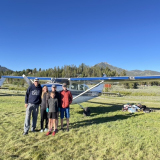 And for what it's worth, ya done good at the Skywagon Ranch before burnishing your landing and takeoff technique.
 I dig retro, but I see room for improvement....
Users browsing this forum: No registered users and 0 guests