A moderate side slip is a bit cheaper than these airbrakes, and will get you out of the sky like a Simonized manhole cover.
Without shock cooling.
Of course, lots of people have mentioned they read somewhere or were told by their CFI that those things are dangerous and reckless. Air brakes may prove to be a real asset for them.
Speed Brakes on a 180
Mon Jul 18, 2016 10:32 am
Tue Jul 19, 2016 2:53 pm
Re: Speed Brakes on a 180
I never thought a forward slip was dangerous. I don't particularly like them, but for sure passengers don't like them. When I was "coached" prior to becoming a 135 SE charter pilot, I was told that smooth ops were what passengers expected--no really steep banks, no slips, greasy landings, etc. That being said, a forward slip is a great way to make an approach a lot steeper--it's just uncomfortable, whopper-jawed like it must be.
Cary
Cary
"I have slipped the surly bonds of earth..., put out my hand and touched the face of God." J.G. Magee
Tue Jul 19, 2016 3:55 pm
Re: Speed Brakes on a 180
No. I forgot the /s in the post.Cary wrote:I never thought a forward slip was dangerous.
Even small slips in a Cessna that are barely noticeable yield sizable changes to the glide path. And especially nervous passengers don't like the rumble that goes along with flap application any more than they don't like to feel a slight tilt from a slip. I plan to avoid slips when it is convenient when I have pax too though.
Tue Jul 19, 2016 11:34 pm
Re: Speed Brakes on a 180
The Cessnas are placarded against slips ("avoid Slips") with flaps out.
Maybe one of our high time greybeard Cessna drivers can expain the details of when flapped slips are OK and when theyr'e not.
So in order to use a slip in a Cessna legally, you would retract the flaps, then do your slip, then extend the flaps. Quite a bit of workload on short final
Maybe one of our high time greybeard Cessna drivers can expain the details of when flapped slips are OK and when theyr'e not.
So in order to use a slip in a Cessna legally, you would retract the flaps, then do your slip, then extend the flaps. Quite a bit of workload on short final

.
Wed Jul 20, 2016 9:42 am
Re: Speed Brakes on a 180
EZFlap wrote: The Cessnas are placarded against slips ("avoid Slips") with flaps out.
Not necessarily. I seem to recall that the POH or placards for some Cessnas caution about slipping with full flaps, but I don't recall anything about not slipping with flaps with my 1948 C170 or 1964 C150. Here's what my 1957 C180 owner's manual has to say: "The approach is steep with full wing flaps, but slips are permissible with wing flaps extended if necessary."

Cessna Skywagon -- accept no substitute!
Wed Jul 20, 2016 9:45 am
Re: Speed Brakes on a 180
EZFlap wrote:The Cessnas are placarded against slips ("avoid Slips") with flaps out.
Maybe one of our high time greybeard Cessna drivers can expain the details of when flapped slips are OK and when theyr'e not.
So in order to use a slip in a Cessna legally, you would retract the flaps, then do your slip, then extend the flaps. Quite a bit of workload on short final
It's only the 170 and 172. It had to do with lack of rudder authority. The 180s and 185s have no restriction on slips with flaps, AFAIK. My 56 doesn't anyway.
- soyAnarchisto offline

- Posts: 1975
- Joined: Fri Aug 19, 2011 1:23 pm
- Location: Boulder, CO
- Aircraft: 1955 Cessna 180
Wed Jul 20, 2016 12:06 pm
Re: Speed Brakes on a 180
soyAnarchisto wrote:EZFlap wrote:The Cessnas are placarded against slips ("avoid Slips") with flaps out.
Maybe one of our high time greybeard Cessna drivers can expain the details of when flapped slips are OK and when theyr'e not.
So in order to use a slip in a Cessna legally, you would retract the flaps, then do your slip, then extend the flaps. Quite a bit of workload on short final
It's only the 170 and 172. It had to do with lack of rudder authority. The 180s and 185s have no restriction on slips with flaps, AFAIK. My 56 doesn't anyway.
You are right that your 56 doesn't, but EZ is right that some 180s do. Looking at the TC it looks like starting on the Gand H models they should be placard ed to avoid slips with flaps extended.

Wed Jul 20, 2016 1:59 pm
Re: Speed Brakes on a 180
"Avoid slips with flaps extended" is not a limitation. If it were, it would read, "Slips with flaps extended are prohibited" or some such. The effect, especially with 40 hanging out, is a bobbling sensation, kind of like a phugoid stall, which is disconcerting but not dangerous at lower altitudes.
I had been taught not to slip with full flaps by several instructors. When I took my first CFI ride about 40 years ago next month, on the final approach to landing, the FAA Inspector wanted me to do a slip with full flaps. I balked, saying that I thought that was prohibited. He said, "read the placard", which of course said "avoid slips with flaps extended". Later, I also learned that required placards take precedence over POH comments. In any event, I did the full flap slip, the airplane bobbled, but as the Inspector said, "See, you won't lose control".
That's the bottom line. If the required placard is the correct one, it can be followed regardless of the language in the POH or flight manual, and in any event, the airplane won't fall out of the sky.
Cary
I had been taught not to slip with full flaps by several instructors. When I took my first CFI ride about 40 years ago next month, on the final approach to landing, the FAA Inspector wanted me to do a slip with full flaps. I balked, saying that I thought that was prohibited. He said, "read the placard", which of course said "avoid slips with flaps extended". Later, I also learned that required placards take precedence over POH comments. In any event, I did the full flap slip, the airplane bobbled, but as the Inspector said, "See, you won't lose control".
That's the bottom line. If the required placard is the correct one, it can be followed regardless of the language in the POH or flight manual, and in any event, the airplane won't fall out of the sky.
Cary
"I have slipped the surly bonds of earth..., put out my hand and touched the face of God." J.G. Magee
Wed Jul 20, 2016 2:52 pm
Re: Speed Brakes on a 180
Cary wrote:"Avoid slips with flaps extended" is not a limitation. If it were, it would read, "Slips with flaps extended are prohibited" or some such. The effect, especially with 40 hanging out, is a bobbling sensation, kind of like a phugoid stall, which is disconcerting but not dangerous at lower altitudes.
I had been taught not to slip with full flaps by several instructors. When I took my first CFI ride about 40 years ago next month, on the final approach to landing, the FAA Inspector wanted me to do a slip with full flaps. I balked, saying that I thought that was prohibited. He said, "read the placard", which of course said "avoid slips with flaps extended". Later, I also learned that required placards take precedence over POH comments. In any event, I did the full flap slip, the airplane bobbled, but as the Inspector said, "See, you won't lose control".
That's the bottom line. If the required placard is the correct one, it can be followed regardless of the language in the POH or flight manual, and in any event, the airplane won't fall out of the sky.
Cary
Agreed...but since every aircraft has it's own peculiarities, and most these old Cessna's have been bent a little (or a lot), and some of them have significant modifications like stol cuffs, gap seals, balloon tires, and different engines/propellers than when that placard was drafted, I highly recommend confirming how your particular bird reacts to flaps n' slips at altitude... NOT on short final.
My airplane doesn't fall out of the sky, but the flight characteristics of full flaps and a aggressive slip are nothing any sane person would want to deal with at a few hundred feet AGL, much less right before touch down, ESPECIALLY with a load on. What you get with you and your CFI and half tanks is not going to be the same as what you get at gross weight loaded to the aft limits, like you might have going into that short bush strip for a week of fishing n' drinking.
My conclusion, which most people seem to get to as well, is there's just no good reason to combine the two. If you need both 40 degrees of flaps and a slip you are so far behind the airplane that you might as well be sitting in the back seat. Maybe that's a little harsh, but with a reasonable approach there's simply no need to combine the two.


Wed Jul 20, 2016 2:58 pm
Re: Speed Brakes on a 180
Slipping with full flaps (40 degrees) in SOME Cessnas can blank out the horizontal stab and elevator under certain unknown and often unrepeatable circumstances. When and if it happens you will pitch down rapidly. I had it start to happen once in my 170 when I was in a full slip with full flaps. The nose pitched down quickly while I was 100-200 AGL on final, I immediatly released the slip and it recovered. That was enough for me, after that I never ever slipped with full flaps in the 170. If I felt the need to slip I would position my flaps at 20 degrees, hold a full slip to the flare, release the slip pull full flaps and flare to land all at the same time.
If you read about this topic on the 170 site you'll find a lot of pilots have had the same thing happen flying in their 170s.
There was a BCP and 170 club member that had a fatal accident a few years ago on approach to land at the Auburn airport in California. It's suspected by many he slipped with full flaps, blanked out the tail, and went straight into the ground before he could recover.
I haven't experimented with slipping my 180 with flaps yet. I don't see the need with my particular plane. Full flaps and an 86" 3 blade in fine pitch allow for steeper approaches than anything I've flown before.
If you read about this topic on the 170 site you'll find a lot of pilots have had the same thing happen flying in their 170s.
There was a BCP and 170 club member that had a fatal accident a few years ago on approach to land at the Auburn airport in California. It's suspected by many he slipped with full flaps, blanked out the tail, and went straight into the ground before he could recover.
I haven't experimented with slipping my 180 with flaps yet. I don't see the need with my particular plane. Full flaps and an 86" 3 blade in fine pitch allow for steeper approaches than anything I've flown before.
Thu Jul 21, 2016 8:50 am
Re: Speed Brakes on a 180
Not applicable to a cruise-speed descent, but I don't see the need to slip on final because my 180 comes down like an elevator with flaps 40 & the nose pulled up to about 5-10 mph over stall speed. But do NOT hold this into the flare because there isn't enough energy left to arrest the sink without a shot of power or pushing the nose down to get that energy back..
Cessna Skywagon -- accept no substitute!
Thu Jul 21, 2016 11:52 am
Re: Speed Brakes on a 180
hotrod180 wrote: But do NOT hold this into the flare because there isn't enough energy left to arrest the sink without a shot of power or pushing the nose down to get that energy back..
Excellent point, I think that's potentially one of the advantages that you can create from using spoilers. You can set up that same kind of a descent rate with the flaps and spoilers out, carrying a touch of power, with the machine coming downhill steeply. When you need to arrest the descent (and would otherwise not have enough energy left in the airplane), you close the spoilers, which instantly makes some of that unused energy available again, and you use all of that extra little bit of energy to perform a safe flare. The descent rate mostly goes away for a second or two, expending that energy, and you touch down on the mark at minimum speed.
I'm pretty sure that is the same principle for why navy carrier based aircraft have these giant speed brakes. You can slam them back and forth open and shut, making large instant changes in the descent rate, without being "behind the curve" and not having the energy to go around. The speed brakes on the jets allow the pilot to keep the engine spooled up at high power. So you use the speed brakes to overcome the power and "Drag" the airplane down onto the deck, knowing that if you have to go around you just slam the brakes closed and you're already at go-around power. Even modern military jet engines can't spool up fast enough to go around from a missed carrier approach
Anyone here who has personal experience with carrier ops feel free to correct me if that description is incorrect.
So in a 180, instead of using the speed brakes/spoilers to overcome a spooled up turbine headed toward a boat deck, you could potentially be using the spoilers to overcome (and instantly "throttle") the extra energy you are carrying for the flare into a small airstrip. This technique would certainly not be something for a low time pilot to be fooling with, and it's pretty exotic/extreme. But if the spoilers/speed brakes shown in the OP's photos provide a significant enough amount of drag on demand, that feature can definitely be used as a tool to achieve a more precise STOL arrival.
This may be a different use for the spoilers than the manufacturer had envisioned
.
Thu Jul 21, 2016 12:57 pm
Re: Speed Brakes on a 180
Unless they act as lift spoilers I doubt you get much affect at approach speeds. Flaps create induced drag, which increases as airspeed decreases, while speed brakes create parasitic drag, which decreases with airspeed. Have I got that right?
I've only flown one aircraft with speed brakes (T-28 Navy) and it had remarkably little affect below about 120 knots, if I recall correctly.
I've only flown one aircraft with speed brakes (T-28 Navy) and it had remarkably little affect below about 120 knots, if I recall correctly.
Fri Jul 22, 2016 11:37 am
Re: Speed Brakes on a 180
Sadly, I ain't got no time in T-28, F-18, A-4, etc. 
My experience is limited to slow speed aircraft that had rather large and effective devices on them.
The Mini-Nimbus and Ventus sailplanes had exceptionally powerful speed-limiting "dive brakes" (combination upper surface trailing edge spoiler and lower surface flap) which functioned as both airbrakes and de facto glidepath spoilers. Aircraft would not exceed Vne in a vertical dive. Glide ratio about 2.5 or 3 to 1 at approach speeds.
The AS-W20A and AS-W20B sailplane had large flaps and separate spoilers, not speed limiting. You could damage the huge flaps in a dive. But extending both flaps and spoilers gave you 3 to 1 glide angle.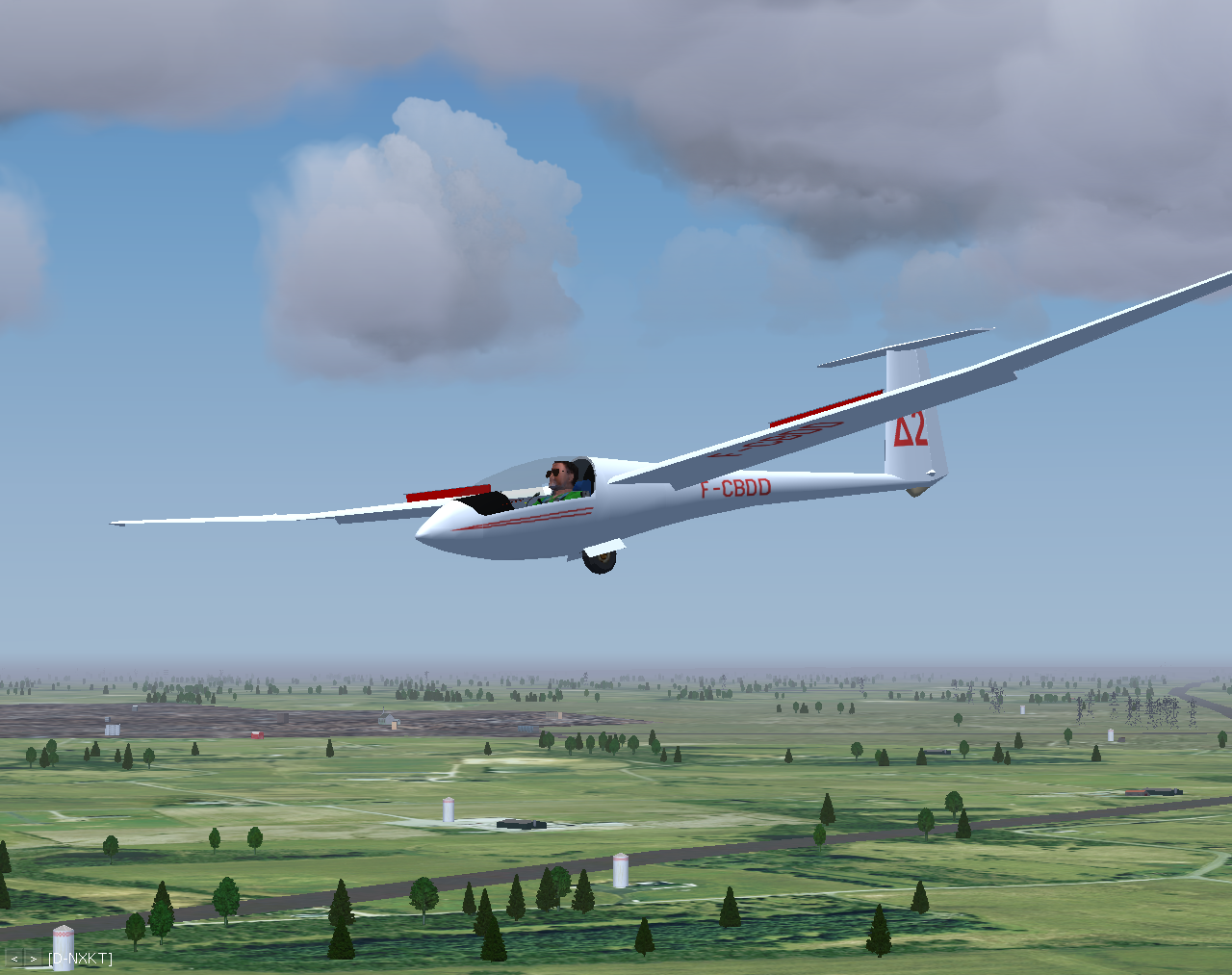
Although far far far from being the same type of aircraft as the 180, rest assured that properly sized and located airbrakes/spoilers/dive brakes like the ones used in sailplanes would provide a very useful effect on slow speed STOL operations in a 180. But the Precise Flight product does not look like it was designed to improve STOL ops, it looks like it was to improve descent out of cruise altitude.
It is noteworthy that the spoilers or speed brakes by Precise Flight say that it "doubles" aircraft drag. But they don't mention at what speed this occurs... I guarantee you that it is at high speed and not approach speed
My experience is limited to slow speed aircraft that had rather large and effective devices on them.
The Mini-Nimbus and Ventus sailplanes had exceptionally powerful speed-limiting "dive brakes" (combination upper surface trailing edge spoiler and lower surface flap) which functioned as both airbrakes and de facto glidepath spoilers. Aircraft would not exceed Vne in a vertical dive. Glide ratio about 2.5 or 3 to 1 at approach speeds.
The AS-W20A and AS-W20B sailplane had large flaps and separate spoilers, not speed limiting. You could damage the huge flaps in a dive. But extending both flaps and spoilers gave you 3 to 1 glide angle.
Although far far far from being the same type of aircraft as the 180, rest assured that properly sized and located airbrakes/spoilers/dive brakes like the ones used in sailplanes would provide a very useful effect on slow speed STOL operations in a 180. But the Precise Flight product does not look like it was designed to improve STOL ops, it looks like it was to improve descent out of cruise altitude.
It is noteworthy that the spoilers or speed brakes by Precise Flight say that it "doubles" aircraft drag. But they don't mention at what speed this occurs... I guarantee you that it is at high speed and not approach speed
.
Wed Aug 03, 2016 4:04 pm
Re: Speed Brakes on a 180
I had speed brakes on a T210 and they worked very well for descending without shock cooling the engine. As some one pointed out, the slower you fly, they less well they work, so at 180/185 approch speeds they would not be too effective. In fact, in the 210 you could go around with the speed brakes extened, according to the manufacturer
Wed Aug 03, 2016 6:52 pm
Re: Speed Brakes on a 180
Speed brakes on a Cessna are only installed for quick decent from altitude without shock cooling. You all can beat the dead horse but they only serve one purpose. They don't make landings shorter or anything else you all think they do, or guess they do. They simply cause massive drag at higher speeds to increase decent rate. they are ineffective at pattern and approach speeds. Any 180 or 182 that has speed brakes installed was used for skydiving or other high altitude work such as photography. I have heard of pressurized turbo charged 210's using them to be able to keep up with controllers requested decent rate while flying IFR with less chance of shock cooling. I have never flown a cessna with speed brakes, but I have jumped out of several and have witnessed how quickly they get down after dropping their meat bombs. They cut decent times in half.
DISPLAY OPTIONS
Who is online
Users browsing this forum: No registered users and 5 guests
Latest Features
-
Live to Tell
A Minnesota pilot is surprised to learn that the sudden asymmetric drag of an out-of-rig ski can…Read More -
Creators
Working in some of the Yukon's most beautiful and remote environments, photographer Simon Blakesley captures aircraft in…Read More -
Aircraft Ownership and Maintenance
Upgrading to big tires can make a huge difference in backcountry performance, but with those gains come…Read More -
Tales from Yesteryear
In this tale from bush flying yesteryear, Don Cogger signs up to help Atlee Dodge Jr recovery…Read More


Latest Knowledge Base
-
Destinations
A regional guide with ideas for winter camping destinations in California, Nevada, New Mexico, and Arizona.Read More -
Aircraft
Finding an affordable aircraft that can handle the backcountry for $80K or less? A challenge for sure, but with the…Read More -
Aircraft
01.29.2018 - Zane - Updated tire diameter graphic to add 8.50x10 Guide to tires for use in the backcountry and off-airport landing…Read More -
Pilots
12.22.2013 - Initial article format Operating aircraft on skis and negotiating a snow-covered landscape is an entirely unique skillset and environment.…Read More


