I ordered my R44 without an ELT. Legally not required in helicopters. Used the extra bread to fund on body beacons and radios: InReach, PLB EPIRB, ICOM VHF.
ADSB is my half ass ELT replacement...squawk 7700 instead of pushing the ELT switch.
SPOT did NOT work for this guy
Wed Mar 06, 2019 1:42 pm

CFII, MEI, CFISES, ATPME, IA/AP, RPPL, Ski&Amphib ops, RHC mechanic cert, RHC SC— 3000TT
Wed Mar 06, 2019 1:53 pm
Re: SPOT did NOT work for this guy
Hammer wrote:I do believe that the PLB's are more reliable. For starters, they go directly to SARSAT, not to a private company that then reports to SARSAT. They also have a much more massive lithium battery pack which hasn't been depleted by pinging out position reports for who knows how long, and mine at least is more robustly constructed than the SPOT. Finally, for the SPOT to ping out your location they have to be in view of the sky, making it more likely that they will be damaged or missing after a crash.
One of the things I do at my job is risk assessment, and I'm looking for hard, non subjective data, that represents a real possible failure point, not simply a theoretical failure point. In line with that, I'm trying to really think about the reliability difference between the spot/inreach and a PLB. In line with that:
Do you think there is a chance that the private company would fail to report an emergency to SARSAT? The fact that things are going directly to SARSAT really that much better?
Do you think the massive lithium battery pack without any kind of battery capacity indication is better than a continuously charged battery (assuming ship power) with capacity remaining indication?
How do you quantify that the PLB is more robustly constructed? Is it more water proof or something?
I think these points can be argued either way, and that's fine....
The last point you bring up, the fact that the spot/inreach requires a view of the sky (and I'll add, GPS signal) raises a very valid technical point.
SARSAT should be able to find a 406mhz signal even without GPS working, and from a mobilized search team. In the case of spot/inreach, if the gps tracking doesn't work, or if it can't send that position to the satellite, then it isn't going to help you, even if search teams are within a few miles and actively searching.
As for the aircraft 406mhz not working, I specifically located the antenna in a way where the vertical stab should protect it should I flip. I think putting the ELT antenna on top of the wing is a terrible idea.
I think these are good conversations to have. It's good to think about modes of failure with rescue gear.


Wed Mar 06, 2019 2:28 pm
Re: SPOT did NOT work for this guy
FWIW, I don’t think ADSB is picked up by anything but ground stations. If that’s true, it won’t provide anything in terms of back country location if you go missing.
Feel free to correct if inaccurate.
Feel free to correct if inaccurate.
- flyingzebra offline

- Posts: 479
- Joined: Sat Jan 24, 2009 4:53 am
- Location: Northwest Washington state
- Aircraft: Cessna Skylane 182 N3440S, Aviat Husky N2918L
Wed Mar 06, 2019 2:58 pm
Re: SPOT did NOT work for this guy
akschu wrote:Do you think there is a chance that the private company would fail to report an emergency to SARSAT? The fact that things are going directly to SARSAT really that much better?
I think there is a MUCH greater chance of a private company bungling the hand-off than there is of SARSAT bungling the received transmission. I think that going through a private company also adds time...maybe a little, maybe a lot...but time is something you probably don't have an excess of if you're activating a PLB. From a risk management point of view, I can see ZERO upside for going through a private company and trusting them to then contact SARSAT in a timely fashion.
akschu wrote:Do you think the massive lithium battery pack without any kind of battery capacity indication is better than a continuously charged battery (assuming ship power) with capacity remaining indication?
How do you quantify that the PLB is more robustly constructed? Is it more water proof or something?
PLB's have a battery test function that tells you whether the battery pack still has minimum power...which if I recall correctly is enough battery life for continuous operation for 24 hours. They are also marked with a mandatory battery replacement date to ensure the 24 hours of continuous opps.
And, yes, I trust a lithium batter pack MUCH more than a rechargeable battery pack. Lithium batteries have a very long shelf life and they are minimally affected by cold. Rechargeable batteries, good as they are for everyday use, are not something I trust for emergency safety-of-life operations, especially as they age.
My PLB is built from thicker plastic, with larger o-rings and more space between the electrical components and the housing than my SPOT. The PLB also has fewer buttons and a much larger antenna, and signals on 121.5 in addition to 406. I don't know for a fact that it is mechanically more reliable, but it's definitely stouter.
And I agree entirely that all these points can be argued both ways...do what makes sense to you and live with the up and down sides of your decisions.
That said, considering how inexpensive PLB's are, and considering that there is no subscription fee, it's pretty silly to fly without one in your vest, regardless of what else you have on board. I consider a PLB mandatory, and a SPOT/InReach more of a convenience. I mean...you can get a PLB for less than two tanks of gas, and it costs you nothing for ten years, at which point you have to change the batteries. I think it's probably the single best deal in aviation.


Wed Mar 06, 2019 3:05 pm
Re: SPOT did NOT work for this guy
flyingzebra wrote:FWIW, I don’t think ADSB is picked up by anything but ground stations. If that’s true, it won’t provide anything in terms of back country location if you go missing.
Feel free to correct if inaccurate.
Not a correction, just my observation...
It recorded me everywhere in the remote coastal mountains of Oregon (no ATC RADAR), better than InReach. Opinion.
I’m willing to bet satellites are used also. I just got the thing and know little about.
CFII, MEI, CFISES, ATPME, IA/AP, RPPL, Ski&Amphib ops, RHC mechanic cert, RHC SC— 3000TT
Wed Mar 06, 2019 3:39 pm
Re: SPOT did NOT work for this guy
flyingzebra wrote:FWIW, I don’t think ADSB is picked up by anything but ground stations. If that’s true, it won’t provide anything in terms of back country location if you go missing.
Feel free to correct if inaccurate.
It's also picked up by ADS-B receivers in nearby aircraft, but not relayed back to ATC by them. Unless you're within line of sight of a ground station, your 7700 won't do anything unless that nearby aircraft notices and calls it in before your blip disappears. The FAA services are all ground-based today. Satellite ADS-B receivers do exist, but they are privately operated and pay to play to my knowledge. They're also geared towards oceanic commercial traffic to start (e.g. to prevent another Malaysia Air, Air France, and so on), and I don't know if they'd relay some random aircraft's 7700 squawk. The good news is ADS-B ground coverage is generally fantastic, especially compared to legacy RADAR. The bad news is if you're in between the hills, it still probably won't see you some of the time.
ADS-B is also not a replacement, legal or otherwise, for an ELT which would be seen by SAR satellites. If you have the time then by all means turn it all on. 7700, ELT activation, PLB, beacon SOS, all of it. If you're too close to the ground to get that done then you get what you get and deal with the rest when the motion stops.
I feel now is a pertinent time to mention that I'm writing an article for BCP on this subject, so stay tuned. Should have some good things in there. Some great points are being made in this thread too, which I think all boil down to having options now that just didn't exist previously. With those options come varying degrees of complexity, functionality, and risk tolerance, and that's a decision everyone must make.
One more note on the InReach/SPOT beacons, which I will cover in more detail later. You can link these to your flight plan (if you open one) such that breadcrumbs can be viewed by SAR if you go missing. Even if the ELT burns up and the beacon is smashed to bits on impact, that little once-per-10 minute ping will give them a last known position and trend. If the beacon still pings post-crash that will put them right on top of you. If that's too big-brother for you or you haven't filed a plan because that's hard to do in the backcountry, give your SO/buddy a link to the page and just turn on tracking when you fly so that someone can at least assist in locating when you fail to show up. That's an easily-verifiable task that increases the number of eyes able to find you, and doesn't even require a SOS activation.

Wed Mar 06, 2019 4:14 pm
Re: SPOT did NOT work for this guy
All of these things have their ups and downs. I've chosen to stick with the "direct to SARSAT" method, with a 406 ELT in the airplane for the last 12 years and two different PLBs, one in my survival vest, one in the large survival pack in the baggage compartment. I also have an old 121.5/243.0 ELT which still works, in the large survival pack. But not totally trusting anything electronic, both my survival vest and survival pack have flares and mirrors.
When I went to renew my ACR test link subscription, I couldn't get the renewal to work, so I notified Artex. Their answer was that they were having website problems and that I should try again soon, but that in the meanwhile, my subscription would be extended free gratis for another 3 months. So I did try again a few weeks later, with the same result. I tried again a few weeks after that, with still the same result. So at this point, my extra 3 months have run out. But when I did the tests in the past, they worked. I haven't tried it recently to see if they still work in spite of my non-renewal.
If I remember in my panic, if I'm going down, I'll activate the ELT in the air with the panel switch, and if I still have time, the PLB in my vest, too. But having had an "I'm going down" emergency, I also know that the first rule is fly the airplane all the way to the scene of the crash (per Bob Hoover's recommendations), and that's what I expect to do. That's what I did when my engine threw a rod 15 years ago this month, and I still had time to get off a Mayday call (had no panel switch for the ELT at the time). Of course, that wasn't really a crash--it was a no power, off airport soft field landing!
Cary
When I went to renew my ACR test link subscription, I couldn't get the renewal to work, so I notified Artex. Their answer was that they were having website problems and that I should try again soon, but that in the meanwhile, my subscription would be extended free gratis for another 3 months. So I did try again a few weeks later, with the same result. I tried again a few weeks after that, with still the same result. So at this point, my extra 3 months have run out. But when I did the tests in the past, they worked. I haven't tried it recently to see if they still work in spite of my non-renewal.
If I remember in my panic, if I'm going down, I'll activate the ELT in the air with the panel switch, and if I still have time, the PLB in my vest, too. But having had an "I'm going down" emergency, I also know that the first rule is fly the airplane all the way to the scene of the crash (per Bob Hoover's recommendations), and that's what I expect to do. That's what I did when my engine threw a rod 15 years ago this month, and I still had time to get off a Mayday call (had no panel switch for the ELT at the time). Of course, that wasn't really a crash--it was a no power, off airport soft field landing!
Cary
"I have slipped the surly bonds of earth..., put out my hand and touched the face of God." J.G. Magee
Wed Mar 06, 2019 4:32 pm
SPOT did NOT work for this guy
Seems like everything has been covered, so I should follow Zs guidelines and keep my mouth shut...but that’s no fun.
That CAP fiasco in Utah several years back significantly affected me. Really made me think about how to safely fly with my kids and how to prepare myself and the kids for the post crash situation.
I’ve installed a 406 ELT linked to a gps. It’s securely mounted under the copilot seat and the antenna is in the tail. If the crash is survivable the ELT will survive too.
High on my emergency procedure is to activate the ELT via the panel mounted remote switch.
I’ll have a PLB on my person when flying unless my family is loaded in the plane. In that case my oldest kid will wear the PLB and know how and when to activate it.
This is what I’ve determined acceptable to me.
I can think of nothing worse than a kid surviving a crash only to die of exposure because they couldn’t get help. That’s the stuff nightmares are made of.
That CAP fiasco in Utah several years back significantly affected me. Really made me think about how to safely fly with my kids and how to prepare myself and the kids for the post crash situation.
I’ve installed a 406 ELT linked to a gps. It’s securely mounted under the copilot seat and the antenna is in the tail. If the crash is survivable the ELT will survive too.
High on my emergency procedure is to activate the ELT via the panel mounted remote switch.
I’ll have a PLB on my person when flying unless my family is loaded in the plane. In that case my oldest kid will wear the PLB and know how and when to activate it.
This is what I’ve determined acceptable to me.
I can think of nothing worse than a kid surviving a crash only to die of exposure because they couldn’t get help. That’s the stuff nightmares are made of.

Wed Mar 06, 2019 5:46 pm
Re: SPOT did NOT work for this guy
Hammer wrote:That said, considering how inexpensive PLB's are, and considering that there is no subscription fee, it's pretty silly to fly without one in your vest, regardless of what else you have on board. I consider a PLB mandatory, and a SPOT/InReach more of a convenience. I mean...you can get a PLB for less than two tanks of gas, and it costs you nothing for ten years, at which point you have to change the batteries. I think it's probably the single best deal in aviation.
Sure, I get it, they are cheap, but it's one more thing to maintain, manage, test, carry around, and as you know, the more stuff you need to manage, the more things that don't get maintained. If the inreach (not a spot, I would never trust one of those) does the same job AND gives you the other conveniences then why bother?
I see no reason to believe that Garmin will cause a "MUCH" greater chance of screwing up, and my in-reach has at least 3 days of battery life with 10 minute intervals. It's worked fantastic for me, and I trust it as much as a PLB because I use it all of the time, and the PLB would only be assumed to work when I need it.
Anyway, thanks for the input, it's good to think about this stuff....
Wed Mar 06, 2019 8:15 pm
Re: SPOT did NOT work for this guy
akschu wrote:Hammer wrote:That said, considering how inexpensive PLB's are, and considering that there is no subscription fee, it's pretty silly to fly without one in your vest, regardless of what else you have on board. I consider a PLB mandatory, and a SPOT/InReach more of a convenience. I mean...you can get a PLB for less than two tanks of gas, and it costs you nothing for ten years, at which point you have to change the batteries. I think it's probably the single best deal in aviation.
Sure, I get it, they are cheap, but it's one more thing to maintain, manage, test, carry around, and as you know, the more stuff you need to manage, the more things that don't get maintained. If the inreach (not a spot, I would never trust one of those) does the same job AND gives you the other conveniences then why bother?
I see no reason to believe that Garmin will cause a "MUCH" greater chance of screwing up, and my in-reach has at least 3 days of battery life with 10 minute intervals. It's worked fantastic for me, and I trust it as much as a PLB because I use it all of the time, and the PLB would only be assumed to work when I need it.
Anyway, thanks for the input, it's good to think about this stuff....
Please don't read any judgement, sarcasm, or snarky jabs into any of this, as I do not intend any. Sometimes it's hard to make that clear with the text...
If you trust the InReach with your life then that's fine. I've never used one and don't have an opinion as to whether that's prudent or not, though I see no reason to choose one or the other given how cheaply you can buy a PLB. I'm inherently leery of private companies being a liaison between my life-and-death emergency and the government agencies that have the ability and mandate to try to help me...I see no upside and many potential down sides...but if you don't have a problem with it then ok.
Regarding a $300 PLB...what's to maintain? Buy it, register it, put it in your flight vest, and once a year push the battery test button to verify that it's good to go. A decade later replace the batteries, or scrap it for whatever is being used in 2029. How much simpler can it get??
A PLB in addition to your InReach doubles your hardware, which halves your risk of hardware/software/battery failure. If you also use your InReach on the snowmobile or ATV or boat or SUV, then the PLB in your survival vest means there is no risk of going airborne with nothing but the airplane ELT because you forget to bring the InReach...assuming that you have a dedicated airplane survival vest, of course.
If you hang your InReach somewhere in the airplane so it can ping out your location, then a PLB in your vest dramatically increases the likelihood that you'll actually have a beacon on your person after a crash if you're alive enough to need one. Maybe your airplane is under water. Maybe it's on dry ground but your InReach succumbed to inertia and it's 300 feet away in a patch of devils club. Maybe your airplane and InReach is burning up while you crawl away. Maybe your airplane is hanging in a tree forty feet off the ground and you're looking up at it with a broken back, knowing someone will find you eventually, but it'd be really nice if they found you sooner rather than later. Whatever the case, if you're alive and able to manipulate one zipper and push two buttons, a PLB attached to your person is your best bet for a timely rescue when you need it the most.
Again, regardless of the convenience and utility of a InReach, I trust the PLB signal going directly to SARSAT, powered by a dedicated lithium battery pack that is unused until needed, MUCH more than any of the private-company alternatives. That you can buy a PLB for 1/3rd of a AMU, with no subscription and no maintenance for the next decade, makes it a no-brainer to me.
Nobody wants to spend money on something that will only be used in a scenario they don't want to imagine...that's a PLB (or a fire suppression system, or a heart defibrillator, or an avalanche PEEP, or...)
And on the other hand you can use an InReach for mundane things...boasting about the fish you caught while your buddies are at work, or telling your family you'll be late for dinner so don't worry, or asking a fellow pilot to fly in a new tire and tube, or gently guiding rescuers to your location because you're uninjured, but your airplane is totaled...plus it has that emergency feature, which is reassuring.
So the InReach is warm and comforting and rewarding to spend money on, while the PLB is not. The PLB is admitting that you're phucked six ways from Tuesday and all you can possibly do is beg the rescue community at large to come find you and get you back to warmth and safety before you're dead.
So I can totally see why people embrace their InReach's but are hesitant to spend $300 on a PLB...I just don't think it's logical.
Last edited by Hammer on Wed Mar 06, 2019 8:21 pm, edited 1 time in total.
Wed Mar 06, 2019 8:17 pm
Re: SPOT did NOT work for this guy
flyingzebra wrote:FWIW, I don’t think ADSB is picked up by anything but ground stations. If that’s true, it won’t provide anything in terms of back country location if you go missing.
Feel free to correct if inaccurate.
Up here in Canada they are thinking of using ADSB in lieu of ELTs. I can't figure out how they'll know if I went down or not as ADSB doesn't have a G switch or anything. If they are just watching to see if I stopped somewhere how would they know I'm not taking a leak or stretching my legs? Not to mention that I wouldnt be a big fan if having someone watching me everywhere I fly...


Wed Mar 06, 2019 8:51 pm
Re: SPOT did NOT work for this guy
Hammer wrote:And on the other hand you can use an InReach for mundane things...boasting about the fish you caught while your buddies are at work, or telling your family you'll be late for dinner so don't worry, or asking a fellow pilot to fly in a new tire and tube, or gently guiding rescuers to your location because you're uninjured, but your airplane is totaled...plus it has that emergency feature, which is reassuring.
So the InReach is warm and comforting and rewarding to spend money on, while the PLB is not. The PLB is admitting that you're phucked six ways from Tuesday and all you can possibly do is beg the rescue community at large to come find you and get you back to warmth and safety before you're dead.
So I can totally see why people embrace their InReach's but are hesitant to spend $300 on a PLB...I just don't think it's logical.
I'll summarize (logically):
tested dozens or hundreds of times per outing > unable to test, but in theory better hardware/implementation.
Breadcrumb history until point of no contact > no history.
Two way communications during rescue > one way communication without confirmation.
debating on internet < beer and campfire
Wed Mar 06, 2019 9:01 pm
Re: SPOT did NOT work for this guy
akschu wrote:Hammer wrote:And on the other hand you can use an InReach for mundane things...boasting about the fish you caught while your buddies are at work, or telling your family you'll be late for dinner so don't worry, or asking a fellow pilot to fly in a new tire and tube, or gently guiding rescuers to your location because you're uninjured, but your airplane is totaled...plus it has that emergency feature, which is reassuring.
So the InReach is warm and comforting and rewarding to spend money on, while the PLB is not. The PLB is admitting that you're phucked six ways from Tuesday and all you can possibly do is beg the rescue community at large to come find you and get you back to warmth and safety before you're dead.
So I can totally see why people embrace their InReach's but are hesitant to spend $300 on a PLB...I just don't think it's logical.
I'll summarize (logically):
tested dozens or hundreds of times per outing > unable to test, but in theory better hardware/implementation.
Breadcrumb history until point of no contact > no history.
Two way communications during rescue > one way communication without confirmation.
debating on internet < beer and campfire
Haha...
My logical summary:
$300 for a decade of redundant rescue summons in addition to your InReach for a pilot flying over hostile terrain = no brainer.
Wed Mar 06, 2019 9:13 pm
Re: SPOT did NOT work for this guy
Question: Did you guys miss the part where the guy in this particular story said the O.K. button on both his and his buddies Spot worked fine but the 911 transmission wouldn’t go out for whatever reason?
Just because your breadcrumbs are working doesn’t mean your emergency signal is going to work. The only time you know for sure that it is working is when your on the phone with SARSAT testing the signal.
Just because your breadcrumbs are working doesn’t mean your emergency signal is going to work. The only time you know for sure that it is working is when your on the phone with SARSAT testing the signal.
Wed Mar 06, 2019 10:37 pm
Re: SPOT did NOT work for this guy
Not that important to me, can’t understand why everyone is in such a froth over the eBay comment either. You’all know that you have to disclose condition on a sale, and lots of stuff gets sold that is partially working and the buyer is ok with that. Most of SOS button pushes on the SPOT have successfully called the cavalry, or so my SAR center buddies tell me, and in fact they are the ones recommending it to me. Seems more reliable than the 60% of ELTs that don’t activate on impact. And those are TSO’d and inspected routinely.
If my SOS button stopped working would I keep using it in my plane for 2 min tracking and ok/need help message? Of course. Would my flight follower send rescue to my last location, I’m sure. I can activate the ELT as easily, or instead of, the SOS function. Lawsuit sensitivity is driving the bus these days. Why poor MTV had to deal with an auto-renewal charge instead of the peaceful expiry of his plan. SPOT lawyers recon the liability risk of automatically stopping an expiring plan is higher than eating the grief of those of us were passively waiting for expiry to stop paying. Oh yeah, and Garmin InReach does the same auto-renew, those lawyers must talk to each other.
Still think the guy was a flake trying to use the well worn Internet shaming scam to get himself a freebie.
If my SOS button stopped working would I keep using it in my plane for 2 min tracking and ok/need help message? Of course. Would my flight follower send rescue to my last location, I’m sure. I can activate the ELT as easily, or instead of, the SOS function. Lawsuit sensitivity is driving the bus these days. Why poor MTV had to deal with an auto-renewal charge instead of the peaceful expiry of his plan. SPOT lawyers recon the liability risk of automatically stopping an expiring plan is higher than eating the grief of those of us were passively waiting for expiry to stop paying. Oh yeah, and Garmin InReach does the same auto-renew, those lawyers must talk to each other.
Still think the guy was a flake trying to use the well worn Internet shaming scam to get himself a freebie.

'74 7GCBC, 26" ABW, Aera 660 feeding G5 and FC-10 FF.
Wed Mar 06, 2019 10:38 pm
Re: SPOT did NOT work for this guy
whee wrote:Question: Did you guys miss the part where the guy in this particular story said the O.K. button on both his and his buddies Spot worked fine but the 911 transmission wouldn’t go out for whatever reason?
Just because your breadcrumbs are working doesn’t mean your emergency signal is going to work. The only time you know for sure that it is working is when your on the phone with SARSAT testing the signal.
No, I didn't miss that. This is the difference between operational testing and functional testing.
With operational testing you test parts like the gps, or the battery, or the satellite link, with functional testing you hit the button a verify all the way until helicopters show up.
Given that you can't really do a complete functional test these things, you are forced to trust the operational testing.
In the case of the spot/inreach sending an "okay" and verifying it got to the recipient should be enough as it tests the device, gps, and satellite, however in this case, there was apparently enough difference between how the device worked in "okay" mode and "SOS" mode that okay wasn't enough of an operational test.
This and a long list of other reasons is why I would never trust a spot. Heck, their satellite network isn't really all that reliable.
In the case of the in-reach I have more trust that the Garmin got it right (both hardware and implementation) and that if I can send a message, the SOS will work, and even if it doesn't, I'll send the SOS to a phone number, then get an indication that it worked.
This is why I'm slow to just say PLB's are better. You can't really test them all the way to the satellite, and apparently I value testing a lot more than most.
406mhz is a better frequency, and a PLB is 5 watts which is way more than an in-reach, and there is a fresh battery always ready to go, so in that way they are nicer, but you get no confirmation, and no real way to test them. So pick your poison.
Thu Mar 07, 2019 7:15 am
Re: SPOT did NOT work for this guy
For an honest-to-goodness emergency, there’s no denying that a PLB is better than a tracker. Where trackers shine is fixable problems that don’t require SAR. If you can send a text saying, “Send Bob here with a new tailwheel,” that’s better than operating the SAR apparatus.
Of course, the Gen 3 SPOT doesn’t allow that, so it’s not much better than Find My Friends on the iPhone.
I have a Gen 3 SPOT, and let the service expire last year. Thinking about an inReach, but I’m sick of subscriptions.
Of course, the Gen 3 SPOT doesn’t allow that, so it’s not much better than Find My Friends on the iPhone.
I have a Gen 3 SPOT, and let the service expire last year. Thinking about an inReach, but I’m sick of subscriptions.
Thu Mar 07, 2019 9:49 am
Re: SPOT did NOT work for this guy
whee wrote:Seems like everything has been covered, so I should follow Zs guidelines and keep my mouth shut...but that’s no fun.
That CAP fiasco in Utah several years back significantly affected me. Really made me think about how to safely fly with my kids and how to prepare myself and the kids for the post crash situation.
What was the issue with CAP?
Thu Mar 07, 2019 10:45 am
Re: SPOT did NOT work for this guy
This discussion motivated me into a fact finding mission about ELTs. In regards of comparing 121.5 to 406 ELT’s, the 121.5 ELT’s activated properly only in 12% of all crashes. Not sure about 406 ELT’s.
Here is an interesting fact sheet by NOAA-SARSAT.
https://www.sarsat.noaa.gov/406vs121.pdf
What caught my eye is the position accuracy of the 406 ELT with no GPS input. It is 1-3 NM.
Where I fly it is extremely hard to spot a crashed airplane due to tall trees and the nature of terrain. Most of the time you have to be right above the crashed airplane to spot it.
For my situation, I still believe a personal device able to communicate via Satellite (text or voice) and which provides GPS position is the best choice to be rescued in an emergency situation or crash, with the aircraft mounted 406 ELT as a secondary device for those situations when unable to operate the personal device.
Sent from my iPad using Tapatalk
Here is an interesting fact sheet by NOAA-SARSAT.
https://www.sarsat.noaa.gov/406vs121.pdf
What caught my eye is the position accuracy of the 406 ELT with no GPS input. It is 1-3 NM.
Where I fly it is extremely hard to spot a crashed airplane due to tall trees and the nature of terrain. Most of the time you have to be right above the crashed airplane to spot it.
For my situation, I still believe a personal device able to communicate via Satellite (text or voice) and which provides GPS position is the best choice to be rescued in an emergency situation or crash, with the aircraft mounted 406 ELT as a secondary device for those situations when unable to operate the personal device.
Sent from my iPad using Tapatalk
Thu Mar 07, 2019 11:04 am
Re: SPOT did NOT work for this guy
More data:
From https://cospas-sarsat.int/en/system-ove ... sat-system
LEOSAR
GEOSAR
Here is a map of the LEOSAR system:
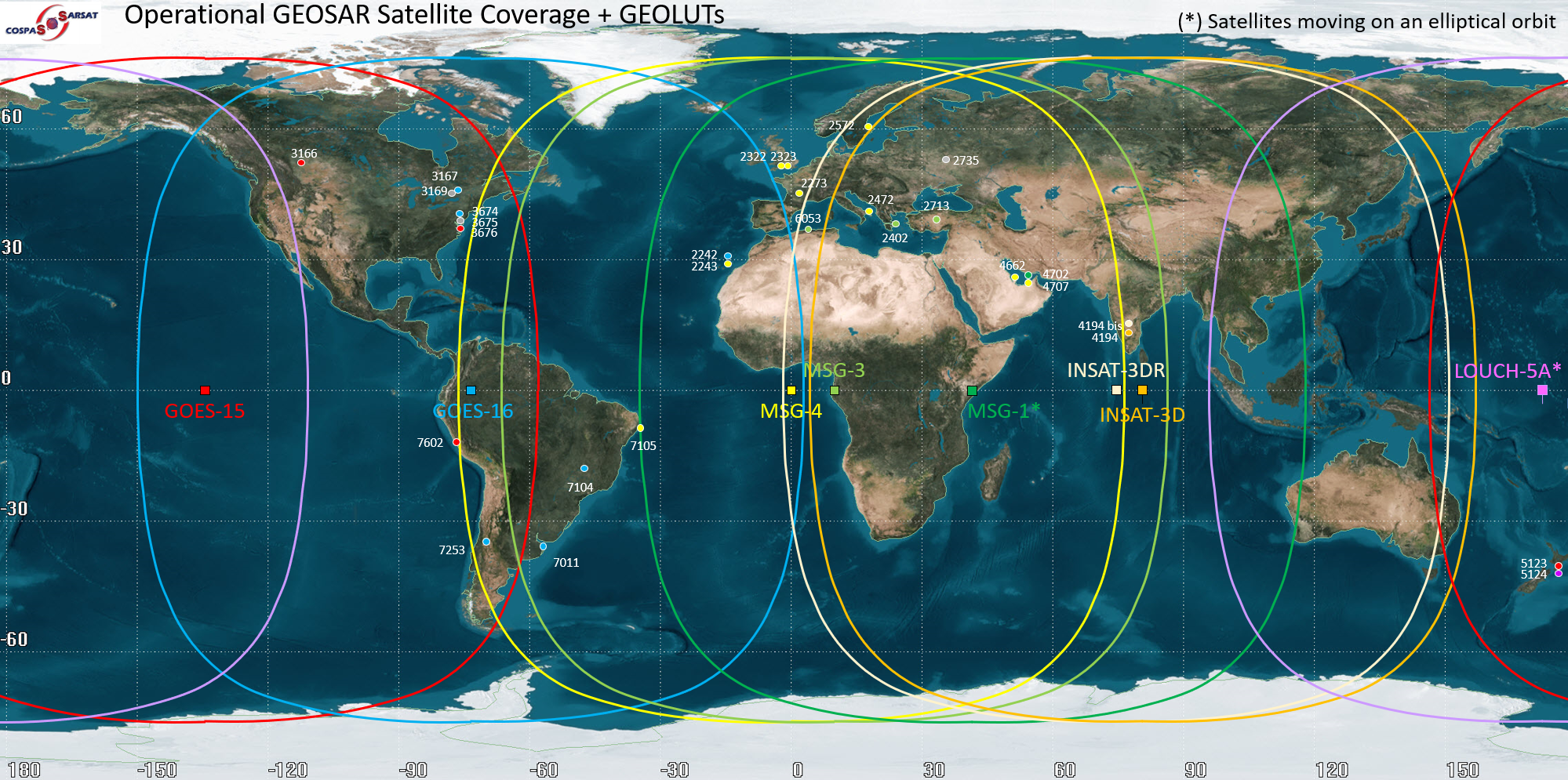
So what I gather from this:
1. If you are using a 406mhz ELT and it's not GPS fed, then you will need to wait for one or more LEOSAR satellite passes as there are only 4 of them, and they need to pass over head to start to calculate where you are.
2. If you are using a 406mhz ELT and it is GPS fed, then either a LEOSAR or GEOSAR will work, and it looks like there are 7 GEOSAR satellites in addition to the 4 LEOSAR satellites.
3. They are looking to add medium earth orbit satellites (MEOSAR) which should address the current issues with GEOSAR not having good reception on the poles, and LEOSAR not able to see the entire earth at the same time thus causing possible delays.
In contrast, the Iridium network used by in-reach has 76 satellites in service now, with 6 spares. All of the satellites are the newer next gen units that they started deploying in 2017. They work like the LEOSAR satellites in that they are constantly moving, but because there are 19x more of them, they can see the entire earth all of the time. Interestingly, the new Iridium satellites also have an ADS-B receiver.
From https://cospas-sarsat.int/en/system-ove ... sat-system
The Cospas-Sarsat System includes two types of satellites:
satellites in low-altitude Earth orbit (LEO) which form the LEOSAR System
satellites in geostationary Earth orbit (GEO) which form the GEOSAR System
LEOSAR
Cospas-Sarsat has demonstrated that the detection and location of 406 MHz distress beacon signals can be greatly facilitated by global monitoring based on low-altitude spacecraft in near-polar orbits. Complete, yet non continuous coverage of the Earth is achieved using simple emergency beacons operating on 406 MHz to signal a distress. The coverage is not continuous because polar orbiting satellites can only view a portion of the Earth at any given time (see figure at left). Consequently the System cannot produce distress alerts until the satellite is in a position where it can "see" the distress beacon. However, since the satellite onboard 406 MHz processor includes a memory module, the satellite is able to store distress beacon information and rebroadcast it when the satellite comes within view of a LUT, thereby providing global coverage.
As described above, a single satellite, circling the Earth around the poles, eventually views the entire Earth surface. The "orbital plane", or path of the satellite, remains fixed, while the Earth rotates underneath it. At most, it takes only one half rotation of the Earth (i.e. 12 hours) for any location to pass under the orbital plane. With a second satellite, having an orbital plane at right angles to the first, only one quarter of a rotation is required, or 6 hours maximum. Similarly, as more satellites orbit the Earth in different planes, the waiting time is further reduced. The Cospas-Sarsat System design constellation is four satellites which provide a typical waiting time of less than one hour at mid-latitudes.
The LEOSAR system calculates the location of distress events using Doppler processing techniques. Doppler processing is based upon the principle that the frequency of the distress beacon, as "heard" by the satellite instrument, is affected by the relative velocity of the satellite with respect to the beacon. By monitoring the change of the beacon frequency of the received beacon signal and knowing the exact position of the satellite, the LUT is able to calculate the location of the beacon.
GEOSAR
The GEOSAR system consists of 406 MHz repeaters carried on board various geostationary satellites, and the associated ground facilities called GEOLUTs which process the satellite signal.
As a GEOSAR satellite remains fixed relative to the Earth, there is no Doppler effect on the received frequency and Doppler radio location positioning techniques cannot be used to locate distress beacons. To provide rescuers with beacon position information, such information must be either:
acquired by the beacon through an internal or an external navigation receiver and encoded in the beacon message, or
derived, with possible delays, from the LEOSAR System.
Here is a map of the LEOSAR system:
So what I gather from this:
1. If you are using a 406mhz ELT and it's not GPS fed, then you will need to wait for one or more LEOSAR satellite passes as there are only 4 of them, and they need to pass over head to start to calculate where you are.
2. If you are using a 406mhz ELT and it is GPS fed, then either a LEOSAR or GEOSAR will work, and it looks like there are 7 GEOSAR satellites in addition to the 4 LEOSAR satellites.
3. They are looking to add medium earth orbit satellites (MEOSAR) which should address the current issues with GEOSAR not having good reception on the poles, and LEOSAR not able to see the entire earth at the same time thus causing possible delays.
In contrast, the Iridium network used by in-reach has 76 satellites in service now, with 6 spares. All of the satellites are the newer next gen units that they started deploying in 2017. They work like the LEOSAR satellites in that they are constantly moving, but because there are 19x more of them, they can see the entire earth all of the time. Interestingly, the new Iridium satellites also have an ADS-B receiver.
DISPLAY OPTIONS
Who is online
Users browsing this forum: No registered users and 0 guests
Latest Features
-
-
Featured Bush Planes
As one of the undisputed legends of bush flying, the Cessna 180 hauls a…Read More -
Aircraft Ownership and Maintenance
9 modification mistakes aircraft owners make when trying to "bush out" their birds—why some…Read More -
Live to Tell
A Minnesota pilot is surprised to learn that the sudden asymmetric drag of an…Read More



Latest Knowledge Base
-
Destinations
Canada offers some of the most spectacular backcountry flying on the continent. Here's what you need to know before you go.Read More -
Safety and Survival
Hope that you never have to use your survival vest but knowing you have it and knowing how to use…Read More -
Destinations
A regional guide with ideas for winter camping destinations in California, Nevada, New Mexico, and Arizona.Read More -
Aircraft
Finding an affordable aircraft that can handle the backcountry for $80K or less? A challenge for sure, but with the…Read More