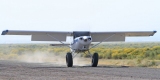
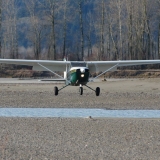
I'll add some of my thoughts (in random order for sure) to this discussion.
Unless you are doing hard core "big rock long props" off-airport flying (or are serious about STOL competition) your aircraft's stock suspension is most likely more then adequate for your needs. My comments will be directed to those few crazy pilots who get a perverse joy from using their airplane as though it was some sort of rock crawler.
All "inflight non-adjustable" aircraft suspension, be it leaf springs, stingers, single spring, bungees, AOSS, or tunable nitrogen filled shocks, are all compromises between suspending an aircraft's empty and gross weight.
Tunable nitrogen filled shocks are a clear winner because (.... [plagiarizing my friend MTV] .... wait for it .... ) they are tunable! Those obsessed with saving grams of weight can set the suspension softer then those who load the aircraft down with creature comforts. Or pressures can be adjusted for competition then changed back for rock crawling.
Notice I said nitrogen filled, not compressed air filled. Just like you would never put compressed air in your bush wheels, you don’t want to put compressed air in your nitrogen shocks. Compressed air introduces oil, particulates, and lots of moisture (which is corrosive and affects pressure with temperature change).
In addition compressed air contains 20% oxygen which is also corrosive and an oxygen molecule is four times smaller then a nitrogen molecule, so is more likely to escape past seals (or through the rubber of a tire), resulting in a decrease in pressure. Oxygen molecules are so small that it is normal for air filled tires to lose 1-3 PSI each month from "permeation" which is the normal process by which the oxygen molecules in compressed air seep through a tire's carcass. Nitrogen filled tires, on the other hand, typically lose no pressure from permeation, even over many months of use.
So how about nitrogen shock pressure changes with altitude? Not as important as you'd first believe. The air weighing down on us from the edge of space to sea level exerts 14.7 PSI. At 10,000 feet it exerts 10.1 PSI. Currently the nitrogen shocks on my front suspension are set to 210 PSI at less then 1,000 feet. If I find myself playing on a 10,000 foot high bench the nitrogen shocks go up in pressure from 210 to 214.6 PSI. Am I capable of noticing a 5 PSI difference? Not unless I'm at the edge of the shocks performance envelope - so not really.
I am capable of noticing the tire pressure difference from 4.5 PSI to 9.1 PSI, but I’d be inclined to just leave it be for the reasons to follow.
Temperature of course also affects PSI. About 1 PSI for every 10 degrees Fahrenheit change. For discussion let’s assume a 40 degree temperature swing from sea level to the 10,000 foot high bench. That’s a 4 PSI difference. But it’s going down not up. So the altitude pressure increase has been compensated for by the temperature pressure decrease. And that’s for both my bush wheels and my nitrogen shocks. Cool.
So I think we can agree that temperature and/or altitude changes affecting nitrogen shock (and bush wheel) pressures isn’t really a big deal at all. If you are still concerned carry a small paintball canister filled with nitrogen and adjust the pressure each time you land. Just don't expect me to hang around while you do it.

Zane made an important comment about the hardware that holds the suspension on. It is a weak point to be sure. So much so that once a year I change out all the bolts and nuts on both the main and tail suspension. And if I’m dropping in (like in STOL competition) I’m periodically checking the tightness of the nuts. If I find one loose I know the bolt has stretched and it gets replaced ASAP.