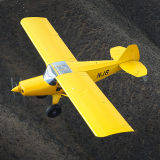
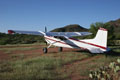
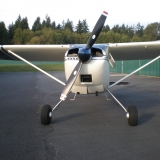
The helio courier H-295 could fly at 38 knts at 3800lbs and still be fully controllable.

highroad wrote:Decent cruise performance with Bushwheels is a must. Half wheel pants, semi retractable gear.....a big challenge, but if we are dreaming.......
Looking forward to hearing more about this.
mtv wrote:You've discussed fuselage, landing gear, doors, etc, but haven't mentioned the wing. For a good backcountry airplane, it really is all about the wing. Doors are convenience items, and important, but using the right airfoil and wing planform is essential to good performance.
Also, the design of control surfaces and wing devices are equally critical. Fowler type flaps are without doubt an important component, in my opinion. And, generally, the bigger the better. Aerodynamically balanced ailerons, with a selectable droop mechanism can provide additional lift at high AOA, while still minimizing stick forces.
Leading edge slats MAY be a good addition, though again the design of these devices may create substantial drag. The Helio slats are excellent, but complex and heavy. The Wayne Mackey slats are much simpler and lighter, but I suspect the drag coefficient on these at the speeds you're describing would be huge.
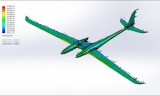
Do you go with a strut braced wing, or a cantilevered wing, like the Helio? Big differences in structures there as well. Are you considering a carbon fiber wing? That could reduce weight considerably, and offer virtually unlimited fuel tankage.
Speaking of which, I'd highly recommend incorporating larger tanks than you noted. 70 gallons will go a long ways with a diesel, no doubt, but I've never met an airplane that had too big a fuel capacity, particularly when you start exploring some of the remote parts of the world. You can always fly with partial fuel, but carrying extra fuel in cans or barrels, etc, is a huge pain in the arse, and isn't the safest way to haul fuel. Better to tanker it internally. This from a pilot who has moved a little over 1000 barrels of avgas, jet fuel, etc, as well as several hundred 100 pound propane cylinders in beavers, cessnas and a goose. Trust me, move barrels in airplanes just a little, and you'll never want to do so again.
Another notion, if you're planning on having to move fuel would be to build or have built, a separate tank that can be fitted into the cargo compartment of the airplane. I had a 110 gallon tank made for a 206 to tanker fuel to a remote fuel storage facility. It was limited to 110 gallons, since this was all done on floats, so the useful load was limiting. Nevertheless, this system was really slick, with a small electric pump and hose to transfer the fuel, etc. Of course, this requires that you have some sort of fuel storage capability in the remote area you're planning on storing fuel at, like a cabin, remote strip, lake, etc.
On the tail surfaces, you may want to consider building a horizontal tail surface that has an asymmetrical airfoil design. That and a trimmable horizontal stabilizer would help with both the slow flight and high speed capabilities of the plane. I'd adjust that horizontal stabilizer with a jackscrew....probably electrically activated.
I mostly agree with your choice of doors, etc.
As to control sticks, you might find a Cessna Skycatcher and look at the stick configuration in that little airplane. I really liked that. It has two control sticks, but instead of them being mounted to the floor, they are attached up behind the instrument panel, and extend under the bottom of the panel. The geometry almost exactly matches the action of floor mounted sticks, but the floor is flat and unencumbered by the controls. It also would be really easy to remove the right (or left) side stick to fly with single controls. I only flew the Skycatcher for an hour or so, but I was really impressed by that stick arrangement.
Good luck on your project.
MTV

Scolopax wrote:The wing volume has the potential to hold at least a hundred gallons with a wet wing arrangement. You are right that you don't need to fly full, but 7 + hours of endurance at 140knots is a huge improvement over practically any bush rated bird in existence. 75 standard and 100 long range would be really neat.
So many things to consider...


I have found wing struts to be indispensable at times for helping to turn ski planes in deep powder. Some folks here consider the cantilevered wings of the Found bush Hawk to be its main drawback during ski ops. Even so for the venerable Helio Courier. For a ski plane of the size you are proposing, give me struts.The wing will be all carbon fiber and cantilevered to eliminate wing struts.

Scolopax wrote:I will definitely not be using fixed slats, as the goal is to have the clean configuration very low drag, but we haven't ruled out retractable slats. What we have learned is that slats on the leading edge produce very high lift coefficients at high angles of attack (20 degrees or more) and double slotted fowler flaps result in pretty high lift coefficients at nearly zero angle of attack. Take a look at the Carribou in action with the double slotted flaps http://m.youtube.com/watch?v=TSjV7DQqoBA in contrast to the Mackey SQ2: http://m.youtube.com/watch?v=laFmA9bOn54 with the slats hard at work. Of course the landing speeds of these two aircraft are dramatically different, but the difference in arrangements couldn't be more obvious. The double slotted flaps will help to improve the visibility when approaching short rough stuff.
The wing volume has the potential to hold at least a hundred gallons with a wet wing arrangement. You are right that you don't need to fly full, but 7 + hours of endurance at 140knots is a huge improvement over practically any bush rated bird in existence. 75 standard and 100 long range would be really neat.
So many things to consider...
mtv wrote:Scolopax wrote:I will definitely not be using fixed slats, as the goal is to have the clean configuration very low drag, but we haven't ruled out retractable slats. What we have learned is that slats on the leading edge produce very high lift coefficients at high angles of attack (20 degrees or more) and double slotted fowler flaps result in pretty high lift coefficients at nearly zero angle of attack. Take a look at the Carribou in action with the double slotted flaps http://m.youtube.com/watch?v=TSjV7DQqoBA in contrast to the Mackey SQ2: http://m.youtube.com/watch?v=laFmA9bOn54 with the slats hard at work. Of course the landing speeds of these two aircraft are dramatically different, but the difference in arrangements couldn't be more obvious. The double slotted flaps will help to improve the visibility when approaching short rough stuff.
The wing volume has the potential to hold at least a hundred gallons with a wet wing arrangement. You are right that you don't need to fly full, but 7 + hours of endurance at 140knots is a huge improvement over practically any bush rated bird in existence. 75 standard and 100 long range would be really neat.
So many things to consider...
One of the things that many pilots fail to recognize is the difference in what the slats do versus what fowler flaps do for you,aerodynamically.
As you say, leading edge slats permit the wing to be driven to a very high AOA compared to a straight leading edge with no slats. The difference is huge: A conventional wing will stall at somewhere between 17 and 19 degrees AOA, whereas a slatted wing can be driven to over 25 degrees.
As you note, that kind of AOA is not useful in landing slower, because the deck angle is so dramatic, you're going to really beat up the tail structure trying to land at that kind of AOA.
BUT, to me, where the slats are VERY attractive is in preventing stalls in slow speed maneuvering and approaching in gusty winds, for example. In other words, I consider the slats to be a safety device, as opposed to a STOL device, though they obviously contribute to STOL performance.
Folder flaps, on the other hand, as you also noted, tend to lower the nose as they are deployed, and they ARE excellent STOL devices, because they dramatically reduce stall speed by increasing wing size and camber.
To me, the best of both worlds would be installed on the ultimate bush airplane: Retractable slats to provide safety at high AOA, and Fowler flaps to drive stall speed down and level the airplane on high AOA approaches.
FWIW.
MTV
Scolopax wrote:mtv wrote:Scolopax wrote:I will definitely not be using fixed slats, as the goal is to have the clean configuration very low drag, but we haven't ruled out retractable slats. What we have learned is that slats on the leading edge produce very high lift coefficients at high angles of attack (20 degrees or more) and double slotted fowler flaps result in pretty high lift coefficients at nearly zero angle of attack. Take a look at the Carribou in action with the double slotted flaps http://m.youtube.com/watch?v=TSjV7DQqoBA in contrast to the Mackey SQ2: http://m.youtube.com/watch?v=laFmA9bOn54 with the slats hard at work. Of course the landing speeds of these two aircraft are dramatically different, but the difference in arrangements couldn't be more obvious. The double slotted flaps will help to improve the visibility when approaching short rough stuff.
The wing volume has the potential to hold at least a hundred gallons with a wet wing arrangement. You are right that you don't need to fly full, but 7 + hours of endurance at 140knots is a huge improvement over practically any bush rated bird in existence. 75 standard and 100 long range would be really neat.
So many things to consider...
One of the things that many pilots fail to recognize is the difference in what the slats do versus what fowler flaps do for you,aerodynamically.
As you say, leading edge slats permit the wing to be driven to a very high AOA compared to a straight leading edge with no slats. The difference is huge: A conventional wing will stall at somewhere between 17 and 19 degrees AOA, whereas a slatted wing can be driven to over 25 degrees.
As you note, that kind of AOA is not useful in landing slower, because the deck angle is so dramatic, you're going to really beat up the tail structure trying to land at that kind of AOA.
BUT, to me, where the slats are VERY attractive is in preventing stalls in slow speed maneuvering and approaching in gusty winds, for example. In other words, I consider the slats to be a safety device, as opposed to a STOL device, though they obviously contribute to STOL performance.
Folder flaps, on the other hand, as you also noted, tend to lower the nose as they are deployed, and they ARE excellent STOL devices, because they dramatically reduce stall speed by increasing wing size and camber.
To me, the best of both worlds would be installed on the ultimate bush airplane: Retractable slats to provide safety at high AOA, and Fowler flaps to drive stall speed down and level the airplane on high AOA approaches.
FWIW.
MTV
I am having trouble finding any information on why Helio decided to use a Stabilator rather than a horizontal/elevator arrnagement. Do you know anything about this MTV?
I am a big fan of the trimming horizontal, hinged elevator setup on the C180 and Cub. My 180 has very nice pitch stability with plenty of pitching power. I never seem to run out of elevator in my 180 even at the most forward center of gravity. There were a lot of design decisions made on the 180 that look like pretty good starting points for this craft.
I did notice that when I installed the Sportsman STOL on my C170 that it became "aft stick limited" when trying to put it in to a spin in the Utility envelope. It would just mush away at 300 fpm rate of descent with any power above idle when the elevator was set at the up stop. The underside of the horizontal would be the best place of all for installing VGs, but my goal is to be careful enough with airfoil selection and control surface throws so that it will never need any band aid type additions. The Sportsman drooped leading edge has a similar design intent to slats in keeping the flow attached at high AOA.


Hafast wrote:I'm usually at about 55 to 60kts on short final to make a wheel landing, anything slower and you have to add power to keep the nose up, it's easy to touch the tail wheel first, but visibility goes to shit and it's usually not a pretty touch down. I've flown it at altitude indicating 30kts, wings level, lots of power, 1500 ft min decent with no stall break. The book does not have a stall speed, it just says "increased rate of descent".
I took it to Santa Fe New Mexico about a month ago for a potential buyer, at 11,500 full throttle, 19" mp 2400rpm, I was getting 127kts burning 17gph.
Battson wrote:Hafast wrote:I'm usually at about 55 to 60kts on short final to make a wheel landing, anything slower and you have to add power to keep the nose up, it's easy to touch the tail wheel first, but visibility goes to shit and it's usually not a pretty touch down. I've flown it at altitude indicating 30kts, wings level, lots of power, 1500 ft min decent with no stall break. The book does not have a stall speed, it just says "increased rate of descent".
I took it to Santa Fe New Mexico about a month ago for a potential buyer, at 11,500 full throttle, 19" mp 2400rpm, I was getting 127kts burning 17gph.
Thanks very much for that.
I have some video which I should upload from our STOL contest... the Helio (totally unloaded) was almost landing as short as the Cubs, a significantly impressive aeroplane.
I never did find a chance to talk to the pilot.

Users browsing this forum: No registered users and 0 guests