I am one of the p-ponk crowd, in a 182K, with about 1,200smoh on the p-ponk. I have been chasing down what I think might be an induction leak, but now that I've replaced most of the induction clamps and pressurized, I am still seeing one cylinder ( number one ) cooler on EGTs than all the rest, and running lean according to my lean sweep tests on TO, but then not at lower power operations.
I'm only seeing about 22 gallons per hour at full power, like on takeoff, with about 26 or 27 inches of manifold pressure. I'm wondering if anybody else that has fuel flow has numbers for how much fuel they're flowing at take off? I'm beginning to think that my carburetor needs a once over, from reading all the threads about new jets.
My P-Ponk went in in the late '90s so in the intervening time there may have been some changes to those jets. I am also thinking that lower density altitude is a factor here as well: my airfield is at about 2,000 ft, with much higher DA in the summer, but right now I'm seeing 500 and 600 ft DA's routinely.
P-ponk carb flows
Mon Mar 02, 2020 11:02 am
Mon Mar 02, 2020 3:27 pm
Re: P-ponk carb flows
You need to see around 25-26 gph at full throttle sea level. You are too low on fuel flow. Your carb needs attention.
Kurt
Kurt

Mon Mar 02, 2020 6:44 pm
Re: P-ponk carb flows
In most cases, if your #1cyl was running lean, the CHT would indicate hotter rather than cooler.
- On The Fly offline


- Posts: 199
- Joined: Wed Nov 01, 2017 4:56 pm
- Location: Hampton
- Aircraft: C`182K
Mon Mar 02, 2020 6:46 pm
Re: P-ponk carb flows
On The Fly wrote:In most cases, if your #1cyl was running lean, the CHT would indicate hotter rather than cooler.
Actually I meant EGT, not CHT.
- On The Fly offline
- Posts: 199
- Joined: Wed Nov 01, 2017 4:56 pm
- Location: Hampton
- Aircraft: C`182K
Mon Mar 02, 2020 10:24 pm
Re: P-ponk carb flows
Unless #1 is already LOP, leaner should still indicate hotter, even on the EGT.On The Fly wrote:On The Fly wrote:In most cases, if your #1cyl was running lean, the CHT would indicate hotter rather than cooler.
Actually I meant EGT, not CHT.

Tue Mar 03, 2020 6:17 pm
Re: P-ponk carb flows
Fuel flow on my Pponk is 25-26 gph on take off at sea level. Your engine needs more fuel on take off at WOT. IMHO you should have the carburetor looked at.
- rfinkle offline

- Posts: 334
- Joined: Sat Feb 21, 2009 9:27 pm
- Location: KSZP, KCCR, 18AZ
- FindMeSpot URL: http://share.findmespot.com/shared/face ... gujelTKUbh
You're never too old to learn something stupid.
Thu Mar 05, 2020 11:07 am
Re: P-ponk carb flows
Carb is arriving at lycon today.
Thanks to both of you that posted your carb flows.
I was pretty certain that it was running lean on takeoff, but what I was looking for is what other people are flowing so that I could be certain that 22 gallons per hour was too low.
I know that cylinder one three and five are all running much leaner than two four and six because I've done lean sweep tests at cruise, and they're peaking way before the other cylinders.
I'm also guessing that that cylinder is running too lean at takeoff, because the moment I pull carb heat or if I back off the throttle all the cylinders egt's come back together again. That seems like a pretty conclusive indication that number one is running lean on take off.
Thx
Thanks to both of you that posted your carb flows.
I was pretty certain that it was running lean on takeoff, but what I was looking for is what other people are flowing so that I could be certain that 22 gallons per hour was too low.
I know that cylinder one three and five are all running much leaner than two four and six because I've done lean sweep tests at cruise, and they're peaking way before the other cylinders.
I'm also guessing that that cylinder is running too lean at takeoff, because the moment I pull carb heat or if I back off the throttle all the cylinders egt's come back together again. That seems like a pretty conclusive indication that number one is running lean on take off.
Thx
Thu Mar 05, 2020 11:42 am
Re: P-ponk carb flows
You might want to borescope the inside of your cylinders and valves to check for any potential damage or overheating indications.
Kurt
Kurt
Fri Mar 06, 2020 11:11 pm
Re: P-ponk carb flows
Everything looks good inside.
Sat Mar 07, 2020 7:27 am
Re: P-ponk carb flows
FWIW, my P-Ponk, now with 300 hrs on it, has what I consider a mild carb idiosyncrasy which might have bearing on this issue. If I fully shove the the throttle in, there’s a loss of a couple tenths of manifold pressure and a slight roughness. Back off a quarter inch or so, MP goes up and smoothness returns. I’ve never checked EGT’s during full-throttle vs slightly backed off, but perhaps that’s part of it. Regarding fuel flow, mine eats 25-26 both at full-throttle and near full-throttle. I have always thought it was a throttle airflow/cavitation problem, but operationally it’s not significant. It’s been this way since the conversion.
Last edited by jrc111 on Sat Mar 07, 2020 3:31 pm, edited 1 time in total.

Sat Mar 07, 2020 11:13 am
Re: P-ponk carb flows
Here is a fuel flow formula I got from TCM years ago when having an issue with an IO 470. It applies to both injectected and carbureted engines.
Minimum take off fuel can be determined by:
(.55# fuel per HP per hour)/6# per gallon
For my 275 hp Pponk it works out to 25 gph.
.55*275=151.25/6=25 gph
I looked at my JPI data for the past few months and fuel flow on take off is consistently 25.4 and 25.7 gph.
Please keep us posted when you get the carb back.
Rich
Minimum take off fuel can be determined by:
(.55# fuel per HP per hour)/6# per gallon
For my 275 hp Pponk it works out to 25 gph.
.55*275=151.25/6=25 gph
I looked at my JPI data for the past few months and fuel flow on take off is consistently 25.4 and 25.7 gph.
Please keep us posted when you get the carb back.
Rich
- rfinkle offline
- Posts: 334
- Joined: Sat Feb 21, 2009 9:27 pm
- Location: KSZP, KCCR, 18AZ
- FindMeSpot URL: http://share.findmespot.com/shared/face ... gujelTKUbh
You're never too old to learn something stupid.
Sun Mar 15, 2020 2:58 pm
Re: P-ponk carb flows
So I got the plane back from annual, having done a lot of stuff:
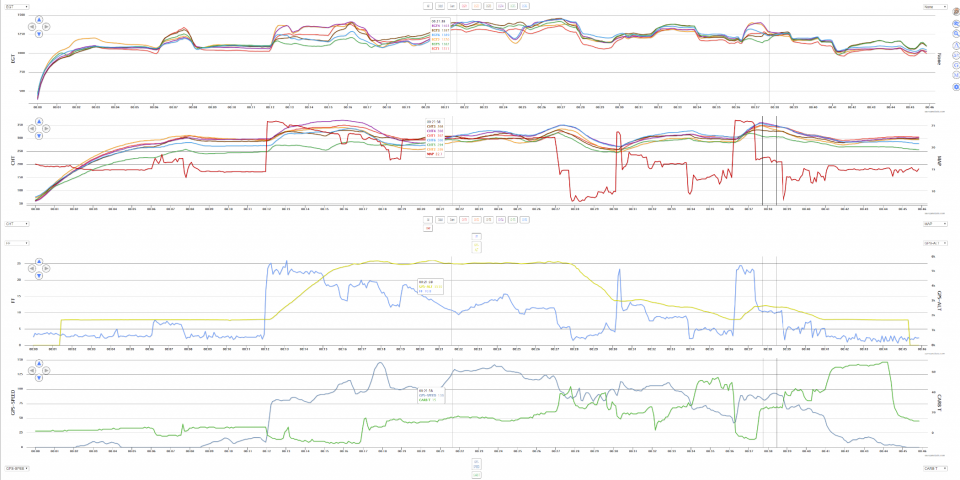
* Lycon flow tested my carb, and like I saw from my engine monitor, saw about ~22 GPH at WOT. They changed the jet and also overhauled the carb. They saw about 25 GPH and I'm seeing 25+ GPH at WOT at about sea level DA (see the screen grab from today's flight)
* I found several induction leaks, but the major one was between the Y pipe and #1 cylinder, which was a gusher. Fixed that.
* compression tested OK, and borescope didn't show anything burned.
* the prop governor was set too low, now fixed to 2700 (Pponk 0-470-50)
So I test flew the plane today (cold day - DA ranged from -400 to 800 feet) after all of that, and grabbed the data. Based on the below screen grab from Savvy Aviation's web analyzer, I can make out a few things, but have a big question mark as well.
* I went from a GAMI spread of 2-3 to 1.1 (see the part of the graph where the Fuel flow slowly decreases, and note peak EGTs of each cylinder on the way down). That means the induction leak fixing did something notable and cylinders now reach peak EGT closer together - GOOD!
* I am seeing much higher Fuel flows on takeoff, and no longer have CHTs approaching 380 right on climbout - GOOD!
And the head-scratcher: Cylinder 5 EGTs are ~250 lower than the rest during full power/takeoff? Why?
Theories I think are wrong:
* intake leak - didn't find any there, and if the cylinder had one, it would run hotter. . .
* bad sensor - it falls right into line with the others most of the time, and is dead nuts with the others during various operations on the graph.
* stuck exhaust valve - the temp falls into line when leaned, and when carb heat goes on so I don't think so?
About the only things I can tell from the graph are:
* #5 gets hotter when I add carb heat (see minute 17 in the graph below) and falls into line with the others.
* #5 is my leanest cylinder from the GAMi sweep, and all the odds are leaner than the evens, with #6 being the richest (last to peak)
I used to have the crossover pipe insulated so maybe I had better add that back? I thought I checked the crossver pipe wasn't blocked bu?
Maybe this is an atomization issue? Maybe the cylinder is way way way too lean at full power?
I don't think this could be a sticky valve. .
ideas very welcome.
*
*
* Lycon flow tested my carb, and like I saw from my engine monitor, saw about ~22 GPH at WOT. They changed the jet and also overhauled the carb. They saw about 25 GPH and I'm seeing 25+ GPH at WOT at about sea level DA (see the screen grab from today's flight)
* I found several induction leaks, but the major one was between the Y pipe and #1 cylinder, which was a gusher. Fixed that.
* compression tested OK, and borescope didn't show anything burned.
* the prop governor was set too low, now fixed to 2700 (Pponk 0-470-50)
So I test flew the plane today (cold day - DA ranged from -400 to 800 feet) after all of that, and grabbed the data. Based on the below screen grab from Savvy Aviation's web analyzer, I can make out a few things, but have a big question mark as well.
* I went from a GAMI spread of 2-3 to 1.1 (see the part of the graph where the Fuel flow slowly decreases, and note peak EGTs of each cylinder on the way down). That means the induction leak fixing did something notable and cylinders now reach peak EGT closer together - GOOD!
* I am seeing much higher Fuel flows on takeoff, and no longer have CHTs approaching 380 right on climbout - GOOD!
And the head-scratcher: Cylinder 5 EGTs are ~250 lower than the rest during full power/takeoff? Why?
Theories I think are wrong:
* intake leak - didn't find any there, and if the cylinder had one, it would run hotter. . .
* bad sensor - it falls right into line with the others most of the time, and is dead nuts with the others during various operations on the graph.
* stuck exhaust valve - the temp falls into line when leaned, and when carb heat goes on so I don't think so?
About the only things I can tell from the graph are:
* #5 gets hotter when I add carb heat (see minute 17 in the graph below) and falls into line with the others.
* #5 is my leanest cylinder from the GAMi sweep, and all the odds are leaner than the evens, with #6 being the richest (last to peak)
I used to have the crossover pipe insulated so maybe I had better add that back? I thought I checked the crossver pipe wasn't blocked bu?
Maybe this is an atomization issue? Maybe the cylinder is way way way too lean at full power?
I don't think this could be a sticky valve. .
ideas very welcome.
*
*
Mon Mar 16, 2020 9:18 pm
Re: P-ponk carb flows
The #5 & #6 cylinders of my Pponk were very cool compared to the other cylinders. I was unable to solve the problem with the silicon baffling, so I called Steve Knopp and he suggested that I make metal baffling to cover the front of the cylinders.
Here is what I did:
#5

#6

The #6 cylinder baffle originally started as a complete cover like #5 above. The complete cover caused # 6 cylinder to run too hot. I experimented by adding holes to the metal baffle until the cylinder would run close to 380. This has worked for me throughout the years.
I put the holes in 1 at a time from left to right. The 1st 3 holes are 1/2" diameter and the last two are 3/8" diameter.
I mounted both baffles with screws thinking I would have to remove them in the Summer. As it turned out, I have no reason to remove them in the Summer. I am able to control the CHT's with cowl flap adjustments.
Just my $0.02 worth of what has worked for me.
Rich
Here is what I did:
#5
#6
The #6 cylinder baffle originally started as a complete cover like #5 above. The complete cover caused # 6 cylinder to run too hot. I experimented by adding holes to the metal baffle until the cylinder would run close to 380. This has worked for me throughout the years.
I put the holes in 1 at a time from left to right. The 1st 3 holes are 1/2" diameter and the last two are 3/8" diameter.
I mounted both baffles with screws thinking I would have to remove them in the Summer. As it turned out, I have no reason to remove them in the Summer. I am able to control the CHT's with cowl flap adjustments.
Just my $0.02 worth of what has worked for me.
Rich
- rfinkle offline
- Posts: 334
- Joined: Sat Feb 21, 2009 9:27 pm
- Location: KSZP, KCCR, 18AZ
- FindMeSpot URL: http://share.findmespot.com/shared/face ... gujelTKUbh
You're never too old to learn something stupid.
Tue Mar 17, 2020 8:22 pm
Re: P-ponk carb flows
tried adding insulation to the balance tube, have no change.
Why would #5 be 250 degrees EGT lower at full power, then, come into line if I either:
1) add carb heat
2) lean
3) reduce power
?
Why would #5 be 250 degrees EGT lower at full power, then, come into line if I either:
1) add carb heat
2) lean
3) reduce power
?
Wed Apr 08, 2020 5:41 pm
Re: P-ponk carb flows
I just replaced my carburetor on my Texas Skyways O-520 UTS engine. The engine has 875 SFRM and I started seeing fuel flows in the 21-22 GPH over the last couple of years. In 2007, after the engine replacement I was only able to see at most 24 gph but the engine stayed cool enough to keep the EGTs below 1300 running full rich max power on take off. I sent my old carb to marvel schebler and they sent me back a freshly overhauled replacement. I flew today - I was seeing worse fuel flow and higher EGTs 19.5-20 gph and EGTs 1400 or greater on several cylinders. I have assumed this is an issue with the carburetor. I will contact marvel schebler tomorrow. Any thoughts on trouble shooting this issue would be much appreciated.
Josh
Josh
- Dog is my Copilot offline

- Posts: 433
- Joined: Thu Apr 12, 2018 11:38 am
- Location: Portland
- Aircraft: 1958 Cessna 180A
Thu Apr 09, 2020 9:43 am
Re: P-ponk carb flows
Josh, are you sure your fuel flow gizmo is accurate?
Does the totalizer part agree with how much fuel is still in the tanks after a flight?
If your EGT's are off too, it's probably a long shot, but ya never know.
Does the totalizer part agree with how much fuel is still in the tanks after a flight?
If your EGT's are off too, it's probably a long shot, but ya never know.
Cessna Skywagon -- accept no substitute!
Thu Apr 09, 2020 11:13 am
Re: P-ponk carb flows
Doesn't the jet need to drilled bigger when going to a 520 from 470? Also, I've always wanted a O 470UTS because it is STC'd for 88% ethanol fuel. That requires more fuel flow so the jet is quite a bit bigger and then when 100LL is used the mixture is pulled out to lower fuel flow for correct mixture. An aside-----114 octane ethanol is 93 cents a gallon today and the ethanol plants I'm invested in are either shut down or just barely operating.

Thu Apr 09, 2020 2:26 pm
Re: P-ponk carb flows
I agree that a diminishing fuel flow is concerning, but as someone pointed out - are you sure the fuel flow transducer is operating accurately?
Also, what are your CHT’s during takeoff and climb out compared to before? Those are more relevant to engine damage than EGT’s.
Per Savvy Analysis https://www.savvyanalysis.com/articles/ ... ht-and-egt
High CHTs generally indicate that the engine is under excessive stress for its own good. That's why it's so important to manage the powerplant in a fashion that limits CHTs to a tolerable value. For Bonanzas and Barons, a reasonable rule-of-thumb is that optimum engine longevity is achieved by limiting CHTs to 380°F. CHTs above 400°F should be considered abusive, and grounds for "doing something right now" to bring them down.
By contrast, high EGTs do not indicate that the engine is under excessive stress. They simply indicate that a lot of energy from the fuel is being wasted out the exhaust pipe rather than being extracted in the form of mechanical energy sent to the propeller. High EGTs do not represent a threat to engine longevity. The engine is simply not capable of producing EGTs that are high enough to harm anything. Therefore, attempting to limit EGTs in an attempt to be kind to the engine is simply wrongheaded.
Also, what are your CHT’s during takeoff and climb out compared to before? Those are more relevant to engine damage than EGT’s.
Per Savvy Analysis https://www.savvyanalysis.com/articles/ ... ht-and-egt
High CHTs generally indicate that the engine is under excessive stress for its own good. That's why it's so important to manage the powerplant in a fashion that limits CHTs to a tolerable value. For Bonanzas and Barons, a reasonable rule-of-thumb is that optimum engine longevity is achieved by limiting CHTs to 380°F. CHTs above 400°F should be considered abusive, and grounds for "doing something right now" to bring them down.
By contrast, high EGTs do not indicate that the engine is under excessive stress. They simply indicate that a lot of energy from the fuel is being wasted out the exhaust pipe rather than being extracted in the form of mechanical energy sent to the propeller. High EGTs do not represent a threat to engine longevity. The engine is simply not capable of producing EGTs that are high enough to harm anything. Therefore, attempting to limit EGTs in an attempt to be kind to the engine is simply wrongheaded.
Dog is my Copilot wrote:I just replaced my carburetor on my Texas Skyways O-520 UTS engine. The engine has 875 SFRM and I started seeing fuel flows in the 21-22 GPH over the last couple of years. In 2007, after the engine replacement I was only able to see at most 24 gph but the engine stayed cool enough to keep the EGTs below 1300 running full rich max power on take off. I sent my old carb to marvel schebler and they sent me back a freshly overhauled replacement. I flew today - I was seeing worse fuel flow and higher EGTs 19.5-20 gph and EGTs 1400 or greater on several cylinders. I have assumed this is an issue with the carburetor. I will contact marvel schebler tomorrow. Any thoughts on trouble shooting this issue would be much appreciated.
Josh

Thu Apr 09, 2020 7:32 pm
Re: P-ponk carb flows
hotrod180 wrote:Josh, are you sure your fuel flow gizmo is accurate?
Does the totalizer part agree with how much fuel is still in the tanks after a flight?
If your EGT's are off too, it's probably a long shot, but ya never know.
Eric - My IA is trouble shooting the fuel flow transducer. The EDM 900 came with a new fuel transducer and my IA thinks this could be the problem, but I still think it is a jet issue with the carburetor. When the engine was zero time it showed fuel flows of 24 gph and the engine stayed cool on take off. I agree EGT is a relative issue but I am using the same probes and placement that I had with my old JPI 700. The readings are going to be really close and the only variable will only be from instrument error between the two units. I do not want to know what my peak EGT would be with take off settings. It is probably around 1600 to 1625 - so 1450 may not be hurting the engine. I believe I need to see high fuel flow near 25 gph to keep the engine cool - especially in the summer. The CHTs have been cool < 350 but I didn't fly it for more than 10 minutes. My CHTs have never been an issue - even on hot days the engine has run cool the whole life of the engine.
My IA thinks the new transducer is made for a fuel injected engine and could be limiting the fuel flow because it is dependent on an engine driven pump. JPI is shut down for the COVID crisis so now I am trying to track down a transducer. It really sucks because the pacific northwest is just starting to get nice and this social distancing makes solo flying appealing.
I will tell you - having an engine monitor with fuel flow is a must with a big bore engine. There is no way I would know this problem existed without the JPI data. I appreciate the feedback.
Josh
- Dog is my Copilot offline
- Posts: 433
- Joined: Thu Apr 12, 2018 11:38 am
- Location: Portland
- Aircraft: 1958 Cessna 180A
Thu Apr 09, 2020 8:26 pm
Re: P-ponk carb flows
K factor adjusted right? Not sure there are two types of transducers.
DISPLAY OPTIONS
Who is online
Users browsing this forum: No registered users and 0 guests
Latest Features
-
Live to Tell
A Minnesota pilot is surprised to learn that the sudden asymmetric drag of an out-of-rig ski can…Read More -
Creators
Working in some of the Yukon's most beautiful and remote environments, photographer Simon Blakesley captures aircraft in…Read More -
Aircraft Ownership and Maintenance
Upgrading to big tires can make a huge difference in backcountry performance, but with those gains come…Read More -
Tales from Yesteryear
In this tale from bush flying yesteryear, Don Cogger signs up to help Atlee Dodge Jr recovery…Read More


Latest Knowledge Base
-
Destinations
A regional guide with ideas for winter camping destinations in California, Nevada, New Mexico, and Arizona.Read More -
Aircraft
Finding an affordable aircraft that can handle the backcountry for $80K or less? A challenge for sure, but with the…Read More -
Aircraft
01.29.2018 - Zane - Updated tire diameter graphic to add 8.50x10 Guide to tires for use in the backcountry and off-airport landing…Read More -
Pilots
12.22.2013 - Initial article format Operating aircraft on skis and negotiating a snow-covered landscape is an entirely unique skillset and environment.…Read More


