The apparent speed up in rate of closure occurs well before the apparent widening of the base of the runway edge. It is suttle at first but increases rapidly unless we begin to slow down. If we have slowed to keep the apparent brisk walk from appearing to speed up, we will not need to round out when the base appears to widen. We will simply continue to pitch up, continue to add power to control the sink, and need only to protect the nose and pull power on touchdown.
Bart had some cancellations and Mike was able to get 3.5 hours in. We covered low ground effect takeoff, Dutch rolls at 45 degree bank, energy management turns, pipeline patrol, the apparent brisk walk rate of closure approach, and hover taxi. Bart and Mike both did a great job. Mike uses this site, but I forget to get his callsign.
Contact Flying w/contact flying.
Fri Aug 25, 2017 6:03 pm
- contactflying offline
- Posts: 4972
- Joined: Wed Apr 03, 2013 7:36 pm
- Location: Aurora, Missouri 2H2
Download my free "https://tinyurl.com/Safe-Maneuvering" e-book.
Sat Aug 26, 2017 6:52 am
Re: Contact Flying w/contact flying.
"Dutch rolls at 45 degree bank" Could you please elaborate a bit on this? Thanks
Tom
Tom
Sat Aug 26, 2017 7:49 am
Re: Contact Flying w/contact flying.
Most modern wings have some bungee, wing warping, or other system to mitigate adverse yaw. The only airplane to completely counter adverse yaw was Fred Weick's Ercoupe, what Wolfgang called "the safety airplane."
The problem with the mitigation, but not elimination, of adverse yaw is that modern airplanes poorly teach the pilot how to eleminate adverse yaw with rudder. Older airplanes don't turn very well at all without lots of rudder. Pilots of modern airplanes tend to allow adverse yaw to cause slipping in steep turns. Pilots of modern airplanes tend not to be willing to push the nose around to target with lots of rudder. This is a dangerous sleeper problem that shows up in maneuvering flight, especially around the airport.
There are times when maneuvering rapidly with 45 degree or more bank is necessary. My thinking is that all pilots should be proficient and current in doing this. If you can hold a distant target between your legs while making 45 degree banks left and right repeatedly, you are proficient and current in steep bank turning.
A tip: lead rudder to bring the wing back up.
The problem with the mitigation, but not elimination, of adverse yaw is that modern airplanes poorly teach the pilot how to eleminate adverse yaw with rudder. Older airplanes don't turn very well at all without lots of rudder. Pilots of modern airplanes tend to allow adverse yaw to cause slipping in steep turns. Pilots of modern airplanes tend not to be willing to push the nose around to target with lots of rudder. This is a dangerous sleeper problem that shows up in maneuvering flight, especially around the airport.
There are times when maneuvering rapidly with 45 degree or more bank is necessary. My thinking is that all pilots should be proficient and current in doing this. If you can hold a distant target between your legs while making 45 degree banks left and right repeatedly, you are proficient and current in steep bank turning.
A tip: lead rudder to bring the wing back up.
- contactflying offline
- Posts: 4972
- Joined: Wed Apr 03, 2013 7:36 pm
- Location: Aurora, Missouri 2H2
Download my free "https://tinyurl.com/Safe-Maneuvering" e-book.
Sat Aug 26, 2017 8:04 am
Re: Contact Flying w/contact flying.
What makes slipping around so dangerous, what makes pushing the nose around so necessary in the low level energy management turn is that we must get the turn finished and the wing level before crossing wires, trees, and such. Trying to maintain altitude, rather than use the energy management turn, is even more dangerous. Falling into wires, trees, and such is rougher than flying into them.
- contactflying offline
- Posts: 4972
- Joined: Wed Apr 03, 2013 7:36 pm
- Location: Aurora, Missouri 2H2
Download my free "https://tinyurl.com/Safe-Maneuvering" e-book.
Sat Aug 26, 2017 1:43 pm
Re: Contact Flying w/contact flying.
Thanks; I get it fully on the 45 degree bank Dutch rolls. I guess I was half asleep earlier this morning.
Blue skies,
Tom
Blue skies,
Tom
Sun Sep 24, 2017 12:47 pm
Re: Contact Flying w/contact flying.
There is a good explanation of the value of energy management by Brian in the latest Tailwheeler'sJournal.
- contactflying offline
- Posts: 4972
- Joined: Wed Apr 03, 2013 7:36 pm
- Location: Aurora, Missouri 2H2
Download my free "https://tinyurl.com/Safe-Maneuvering" e-book.
Mon Oct 16, 2017 2:22 pm
Re: Contact Flying w/contact flying.
There has been some concern with the ability of the FAA to require equipment that will allow them to track us everywhere. First the equipment has to be installed and on to work. I expect the non-electric and never had electrical system aircraft will stay exempt as with the transponder requirement. I expect it will again make them desirable. I cringe when I see a new pilot installing the back case and putting starter, alternator, radio and such in fine old aircraft that was operating so well.
Regardless of requirements, I expect they will be mainly interested in IFR and high VFR traffic and in tracking down complaints. I taught crop dusting many years with very few complaints. I simply did not overfly people unless actually spraying crops and avoided it as much as possible when working.
Those flying rivers and mountains at low AGL don't have the legal coverage of Part 137 but avoiding people on the ground should prevent most complaints. If there are complaints, "Wilco" works best. I hear you and I will comply.
Regardless of requirements, I expect they will be mainly interested in IFR and high VFR traffic and in tracking down complaints. I taught crop dusting many years with very few complaints. I simply did not overfly people unless actually spraying crops and avoided it as much as possible when working.
Those flying rivers and mountains at low AGL don't have the legal coverage of Part 137 but avoiding people on the ground should prevent most complaints. If there are complaints, "Wilco" works best. I hear you and I will comply.
- contactflying offline
- Posts: 4972
- Joined: Wed Apr 03, 2013 7:36 pm
- Location: Aurora, Missouri 2H2
Download my free "https://tinyurl.com/Safe-Maneuvering" e-book.
Mon Nov 20, 2017 12:32 pm
Re: Contact Flying w/contact flying.
The psychology of being in a hurry is fairly simple: we humans like to feel important. I learned it from my Dad. I learned to dress, eat,and get going faster at home than in the Army. Once my foot was on the running board, he hit the accelerator.
We learn this hurry up behavior in aviation as well. Experienced civilian pilots land long, use the brakes to stop quickly, and turn off well down the runway. Vietnam veterans still stand helicopters on their tail for unnecessary quick stops when they could have made the safer slow apparent brisk walk rate of closure approach.
There are times when fast is energy efficient but slow is always energy efficient and generally much safer for approach and landing.
When working low or during takeoff and landing, we have much less potential gravity thrust to use in an emergency. Except for the base and final approach, we need to keep sufficient kinetic energy for safety. The higher load factor of the climbing turn to get to 1,000' on downwind is dumb enough, but working in the field like that is ridiculous. Airspeed is altitude and without it there is no zoom reserve. Only the energy management turn provides the zoom reserve of airspeed when on the deck, the safety of the 1g steep turn, and the zoom reserve of altitude to trade back for airspeed as we complete the turn. Unless we keep airspeed up down low, we don't have the initial kinetic energy to make the safer no load factor turn. We are limited to engine power sufficient to leave an approved field only. Not a comfortable situation.
The Army shut down the cowboy combat assault approach, except for combat. Civilians kept adding airspeed to the approach until they finally realized they had created a problem. In 2013 the Practical Test standards were changed to limit approach speed to no more than 1.3 Vso. This is a step in the right direction.
A slow power pitch approach not only reduces airspeed, but it reduces the apparent rate of closure in close where we sort out what is there. By giving us more time to see, we can make more informed decisions. And landing slowly and softly on the numbers is not such a bad thing. If we want to hurry to the end, we can add more power before touchdown and hover taxi in low ground effect.
We learn this hurry up behavior in aviation as well. Experienced civilian pilots land long, use the brakes to stop quickly, and turn off well down the runway. Vietnam veterans still stand helicopters on their tail for unnecessary quick stops when they could have made the safer slow apparent brisk walk rate of closure approach.
There are times when fast is energy efficient but slow is always energy efficient and generally much safer for approach and landing.
When working low or during takeoff and landing, we have much less potential gravity thrust to use in an emergency. Except for the base and final approach, we need to keep sufficient kinetic energy for safety. The higher load factor of the climbing turn to get to 1,000' on downwind is dumb enough, but working in the field like that is ridiculous. Airspeed is altitude and without it there is no zoom reserve. Only the energy management turn provides the zoom reserve of airspeed when on the deck, the safety of the 1g steep turn, and the zoom reserve of altitude to trade back for airspeed as we complete the turn. Unless we keep airspeed up down low, we don't have the initial kinetic energy to make the safer no load factor turn. We are limited to engine power sufficient to leave an approved field only. Not a comfortable situation.
The Army shut down the cowboy combat assault approach, except for combat. Civilians kept adding airspeed to the approach until they finally realized they had created a problem. In 2013 the Practical Test standards were changed to limit approach speed to no more than 1.3 Vso. This is a step in the right direction.
A slow power pitch approach not only reduces airspeed, but it reduces the apparent rate of closure in close where we sort out what is there. By giving us more time to see, we can make more informed decisions. And landing slowly and softly on the numbers is not such a bad thing. If we want to hurry to the end, we can add more power before touchdown and hover taxi in low ground effect.
- contactflying offline
- Posts: 4972
- Joined: Wed Apr 03, 2013 7:36 pm
- Location: Aurora, Missouri 2H2
Download my free "https://tinyurl.com/Safe-Maneuvering" e-book.
Fri Dec 15, 2017 9:53 pm
Re: Contact Flying w/contact flying.
Slower than 1.3Vso on approach, or better slowing below 1.3Vso on short final (apparent rate of closure), mitigates length of runway concerns. Slowing to near in ground effect power stall speed before touchdown doesn't eliminate ground loop, but it marginalizes it.
- contactflying offline
- Posts: 4972
- Joined: Wed Apr 03, 2013 7:36 pm
- Location: Aurora, Missouri 2H2
Download my free "https://tinyurl.com/Safe-Maneuvering" e-book.
Sat Dec 16, 2017 7:56 am
Re: Contact Flying w/contact flying.
I had an epiphany while working yesterday on why some may struggle with your landing concept. Compared to an Ag plane, most GA planes are a very clean airframe, and you have to fly in a completely foreign manner than what is previously trained. Personally in my 182, it took a while to get where I was comfortable with this technique. The airframe is very clean and with factory tires I don’t have much drag to help in slowing down, so you have to plan way ahead and use quite a bit of pitch and power to slow up on final. This was much easier in the Cub as draggy as it is.
I compare that to working yesterday, flying a 450 Cat dragging a swathmaster spreader, there is a very large amount of drag and your technique is very easy. The strip is an old railroad bed and fairly rough, throw in a 15 mph crosswind and you want zero energy on touchdown. You can practically make your approach at any speed you want, pull the power to 25”, and bleed off excess energy in the last 50’ of the approach.
I compare that to working yesterday, flying a 450 Cat dragging a swathmaster spreader, there is a very large amount of drag and your technique is very easy. The strip is an old railroad bed and fairly rough, throw in a 15 mph crosswind and you want zero energy on touchdown. You can practically make your approach at any speed you want, pull the power to 25”, and bleed off excess energy in the last 50’ of the approach.
- CenterHillAg offline

- Posts: 204
- Joined: Sun Nov 09, 2014 3:13 pm
- Location: Texas Coast
- Aircraft: J3 Cub
'56 182
Sat Dec 16, 2017 10:19 am
Re: Contact Flying w/contact flying.
CenterHillAg,
I have always flown in a completely foreign manner to what is taught at the airport nowdays. I'm glad the apparent brisk walk rate of closure is working out in the Ag Cat.
Use full flaps in the 182. That second twenty degrees is mostly drag, as designed to be. Spreader, flaps, extra wing, drag chute; it doesn't matter. It is nice to be able to pull lots of air when landing. Not so nice with a full load of fertilizer spreading uphill.
Seriously, full flaps make the 182 a pussycat.
Contact
I have always flown in a completely foreign manner to what is taught at the airport nowdays. I'm glad the apparent brisk walk rate of closure is working out in the Ag Cat.
Use full flaps in the 182. That second twenty degrees is mostly drag, as designed to be. Spreader, flaps, extra wing, drag chute; it doesn't matter. It is nice to be able to pull lots of air when landing. Not so nice with a full load of fertilizer spreading uphill.
Seriously, full flaps make the 182 a pussycat.
Contact
- contactflying offline
- Posts: 4972
- Joined: Wed Apr 03, 2013 7:36 pm
- Location: Aurora, Missouri 2H2
Download my free "https://tinyurl.com/Safe-Maneuvering" e-book.
Tue Jan 16, 2018 3:06 pm
Re: Contact Flying w/contact flying.
Reading Margaret Lamb's excellent text, "Flying Colorado Mountain Weather," I realized that two things make orograraphic or hydraulic up valley to pass flying relatively safe: using the valley to maintain potential gravity trust of altitude and the energy management turn (descending turn when already at Vy just to maintain altitude.)
In the high pass attempted crossings resulting in accidents, the lack of having a hole to turn too and knowledge of 1g steep turn techniques result in flying to the crash being the only viable alternative.
In the high pass attempted crossings resulting in accidents, the lack of having a hole to turn too and knowledge of 1g steep turn techniques result in flying to the crash being the only viable alternative.
- contactflying offline
- Posts: 4972
- Joined: Wed Apr 03, 2013 7:36 pm
- Location: Aurora, Missouri 2H2
Download my free "https://tinyurl.com/Safe-Maneuvering" e-book.
Tue Jan 16, 2018 4:20 pm
Re: Contact Flying w/contact flying.
Like Margaret Lamb, I use paper sectionals. I know electronic ones show contour lines as well but I wouldn't be comfortable shooting artillery with them and I wouldn't be comfortable knowing which way is downhill with them.
I want to put the valley/pass system on and wear it. I want to hold it in one hand with the way I am going up (orientation top of map to true North.) I don't want something to happen because I touched it somewhere. I don't want to have to turn it on or reboot it. I want to be able to see the part I want to see (folded small or large) in the light of day. I want to be able to write on it.
I want to put the valley/pass system on and wear it. I want to hold it in one hand with the way I am going up (orientation top of map to true North.) I don't want something to happen because I touched it somewhere. I don't want to have to turn it on or reboot it. I want to be able to see the part I want to see (folded small or large) in the light of day. I want to be able to write on it.
- contactflying offline
- Posts: 4972
- Joined: Wed Apr 03, 2013 7:36 pm
- Location: Aurora, Missouri 2H2
Download my free "https://tinyurl.com/Safe-Maneuvering" e-book.
Thu Jan 18, 2018 8:58 pm
Re: Contact Flying w/contact flying.
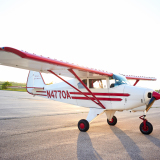
Evan, callsign N4770A, came down from Chicago yesterday and we put in about four hours in his beautifully restored Tri-Pacer today. He now has his low ground effect takeoffs down to a consistent two feet. He picked up the required rudder, especially to bring a wing back up, of steep Dutch rolls quicker than any I remember. He did very good energy management turns of all degrees from shallow to course reversal. We flew several miles of Shell Ozark Pipeline. He executed many pattern altitude (I got a nosebleed) steep apparent brisk walk rate of closure approaches touching down softly on the numbers 90% of the time. We had enough strong gusty crosswind to touchdown on the downwind corner and get stopped halfway to the upwind big airplane touchdown marking without any braking. He had no problem with hover taxi. We were able to simulate some downwind ridge of valley to pass flying in the very vertically limited Ozark Mountains.
While low time, Evan has had good training and is a natural pilot. He even did fine wiggling the tail with dynamic proactive rudder movement to beat the temptation to wag the wings in the gusty air. He did have to politely ask me to not talk so much when he was working.
Good flight. Good time.
While low time, Evan has had good training and is a natural pilot. He even did fine wiggling the tail with dynamic proactive rudder movement to beat the temptation to wag the wings in the gusty air. He did have to politely ask me to not talk so much when he was working.
Good flight. Good time.
- contactflying offline
- Posts: 4972
- Joined: Wed Apr 03, 2013 7:36 pm
- Location: Aurora, Missouri 2H2
Download my free "https://tinyurl.com/Safe-Maneuvering" e-book.
Thu Jan 18, 2018 9:18 pm
Re: Contact Flying w/contact flying.
You're the best Contact...hard to convey over the internet what a great experience it is flying with you. Sounds like you guys had a great session!
Sat Jan 20, 2018 12:23 pm
Re: Contact Flying w/contact flying.
I asked Evan what his callsign was and he gave me his airplane number which I mentioned above. Old people don't know how to spell completely new, to them, words. His avatar is evanr42.
He sent me a video of a 70 year old crop duster in an Air Tractor in South Africa. https://www.youtube.com/watch?v=i64uvNziAsg On takeoff at the end of the video, he is using dynamic proactive rudder movement aggressively to keep a million dollar airplane on a very narrow strip. He had absolutely no interest in waiting until it veered off and then reacting in a static reactive way. Notice the dynamic proactive rudder movement.
Also notice, toward the end, the rudder turns down a crooked road with poles while in low ground effect. He doesn't want to mess with adverse yaw and he doesn't want to put a wing into the crop.
He sent me a video of a 70 year old crop duster in an Air Tractor in South Africa. https://www.youtube.com/watch?v=i64uvNziAsg On takeoff at the end of the video, he is using dynamic proactive rudder movement aggressively to keep a million dollar airplane on a very narrow strip. He had absolutely no interest in waiting until it veered off and then reacting in a static reactive way. Notice the dynamic proactive rudder movement.
Also notice, toward the end, the rudder turns down a crooked road with poles while in low ground effect. He doesn't want to mess with adverse yaw and he doesn't want to put a wing into the crop.
- contactflying offline
- Posts: 4972
- Joined: Wed Apr 03, 2013 7:36 pm
- Location: Aurora, Missouri 2H2
Download my free "https://tinyurl.com/Safe-Maneuvering" e-book.
Sat Jan 20, 2018 8:20 pm
Re: Contact Flying w/contact flying.
I met Wayne Handley many years ago at an ICAS convention in Las Vegas. I've seen him fly his show though he's retired now. I stumbled on this video after watching the one in Contact's last post. I think it's good basics even though it's in a flight region that almost none of us get ourselves into. The canyon turn is sorta like the ag turn isn't it?
Sat Jan 20, 2018 10:34 pm
Re: Contact Flying w/contact flying.
Mr701,
Yes! Exactly! The Ag turn is the canyon turn is the gunnery turn. It is just as Wayne says, the smart turn. And like any good thing, it can be overdone. The slower we go, the faster we turn. We could safely get the Pawnee around in twenty seconds and thirty three is just fine in the much faster Air Tractor. We weren't in the acrobatics business. Intentionally going out of envelope never made sense to me. Like Wayne said, it didn't save enough time to mess with to push up against the envelope.
The Ag stuff you see in farm country and when pipeline aircraft come over and make an energy management turn looks like a wingover but generally is not. It would make for a really long day even after saving a few minutes.
The push the nose around with rudder I emphasize is when the nose is well down in the turn part of the energy management or Ag or gun or canyon turn. Two things: the rudder in the direction of bank will help get the nose down (we should not be holding back pressure in the turn part) and we need to get around before impact.
True canyon turns are mostly just guys playing. When using orograraphic ridge lift on the ridge downwind of the valley in a ride the ridge up the valley to the pass situation, things are much more serious. In Ag we can level the wing to bail out early when we see we will not make the crop row. In the valley to pass system, we are limited both laterally and vertically. We have to make the drainage going back down drainage. If we need the twenty second turn, we need it. It is imperative to start early, pitch up wings level only with sufficient kinetic energy, release back pressure when we begin to bank, and push the nose around with rudder.
Ag guys use the rudder. With non Ag, trained not to exceed twenty degrees of bank, I have to fuss about pushing the nose around with rudder.
Yes! Exactly! The Ag turn is the canyon turn is the gunnery turn. It is just as Wayne says, the smart turn. And like any good thing, it can be overdone. The slower we go, the faster we turn. We could safely get the Pawnee around in twenty seconds and thirty three is just fine in the much faster Air Tractor. We weren't in the acrobatics business. Intentionally going out of envelope never made sense to me. Like Wayne said, it didn't save enough time to mess with to push up against the envelope.
The Ag stuff you see in farm country and when pipeline aircraft come over and make an energy management turn looks like a wingover but generally is not. It would make for a really long day even after saving a few minutes.
The push the nose around with rudder I emphasize is when the nose is well down in the turn part of the energy management or Ag or gun or canyon turn. Two things: the rudder in the direction of bank will help get the nose down (we should not be holding back pressure in the turn part) and we need to get around before impact.
True canyon turns are mostly just guys playing. When using orograraphic ridge lift on the ridge downwind of the valley in a ride the ridge up the valley to the pass situation, things are much more serious. In Ag we can level the wing to bail out early when we see we will not make the crop row. In the valley to pass system, we are limited both laterally and vertically. We have to make the drainage going back down drainage. If we need the twenty second turn, we need it. It is imperative to start early, pitch up wings level only with sufficient kinetic energy, release back pressure when we begin to bank, and push the nose around with rudder.
Ag guys use the rudder. With non Ag, trained not to exceed twenty degrees of bank, I have to fuss about pushing the nose around with rudder.
- contactflying offline
- Posts: 4972
- Joined: Wed Apr 03, 2013 7:36 pm
- Location: Aurora, Missouri 2H2
Download my free "https://tinyurl.com/Safe-Maneuvering" e-book.
Mon Jan 22, 2018 2:18 pm
Re: Contact Flying w/contact flying.
contactflying wrote:Evan, callsign N4770A, came down from Chicago yesterday and we put in about four hours in his beautifully restored Tri-Pacer today. He now has his low ground effect takeoffs down to a consistent two feet. He picked up the required rudder, especially to bring a wing back up, of steep Dutch rolls quicker than any I remember. He did very good energy management turns of all degrees from shallow to course reversal. We flew several miles of Shell Ozark Pipeline. He executed many pattern altitude (I got a nosebleed) steep apparent brisk walk rate of closure approaches touching down softly on the numbers 90% of the time. We had enough strong gusty crosswind to touchdown on the downwind corner and get stopped halfway to the upwind big airplane touchdown marking without any braking. He had no problem with hover taxi. We were able to simulate some downwind ridge of valley to pass flying in the very vertically limited Ozark Mountains.
While low time, Evan has had good training and is a natural pilot. He even did fine wiggling the tail with dynamic proactive rudder movement to beat the temptation to wag the wings in the gusty air. He did have to politely ask me to not talk so much when he was working.
Good flight. Good time.
Jim was an incredible host - thank you sir!
It was an all too brief trip - due to work constraints had to spend 8 hrs getting to/from Contactflying, but only 4 hours in the air with him. Lots of learning though. I was lucky to have recently received my certificate with a fantastic CFI - brisk rate of walk approach had lots of similarities to what I saw in initial PPL training vs. what others describe as the "hold it to bleed energy for the next 3000ft approach). But the list is long of things the PPL test standards neglect that we need in real life.
The canyon turn/ag turn/energy management turn chief among them. Never before did I understand just how quickly my TP can turn.
Airframe differences on AG vs GA also came into play for energy management turns. I had to back off throttle in 180 turns because our steep angle caused us to build speed close to VNE in such a clean/light plane - probably not an issue in Ag, nor an issue on my plane with shallow banks. Can only imagine doing it all in a Mooney.
On final Conctactflying was base to final at about 120, touching down at about 55MPH (stall in my Tri Pacer with Stewarts tips and VGs is about 46MPH). I usually fly downwind at more like 115, final starting at 75, getting down to 60 short final, but he started faster and ended slower - fascinating to see how different pilot technique is, and even for a similar sub-500ft landing in the same plane and same wind conditions. But, he didn't know those were the #s, because of course it was all by touch. He was effectively on 1.3 VSO at short final (65), but just by feel and without ever asking me what the plane stalled at - he just knew what it felt like at that point in the envelope. Incredible.
He bled speed beautifully with AOA, but thought we'd be at flap speed sooner than was the case b/c the Tri Pacer (not known as a clean airframe) still couldn't bleed off the speed!
The Tri Pacer leaving KENW for 2h2
 _ECR0266 by evan
View (too high for Contact Flying, over 1,000' AGL!) en route back home!
 _ECR0246 by evan
Low ground effect take off was the practical highlight of the experience. I'd read about, and tried this before, but seeing how Jim does it, and having his eye correct my technique, was invaluable - I'll be employing this method constantly. Much safer in the event of engine failure on takeoff - we are just 2 ft off the ground. The air cushion is so sturdy that the prop strike I always feared seams difficult to pull off in the event of a gust during the takeoff.
The 180s and bombing runs were the most enjoyable part of the flying - I learned a lot about the rudder from Jim during these maneuvers.
Highly recommend the trip out to 2h2, hoping I'll have Jim along as well for an upcoming trip into the west coast mountains for continued learning.

Mon Jan 22, 2018 10:05 pm
Re: Contact Flying w/contact flying.
Thanks Evan and Shannon (CFOT) and MsPirate and Tangowaud and Blackwater and all the BCP guys who have chanced flying with an old, short, bald, and partially crippled ex crop duster. It has made my heart proud. It is almost all the flying I get now.
I do go out to the airport and fly with every new instructor. Bart has been there six months now. The pilot shortage is giving local instructors decent pay now, which is a good thing. I think Bart is getting tired of me, but he knows all my stuff. We mostly go to Kingsley's for a meal now.
Come on over. It'll be fun.
I do go out to the airport and fly with every new instructor. Bart has been there six months now. The pilot shortage is giving local instructors decent pay now, which is a good thing. I think Bart is getting tired of me, but he knows all my stuff. We mostly go to Kingsley's for a meal now.
Come on over. It'll be fun.
- contactflying offline
- Posts: 4972
- Joined: Wed Apr 03, 2013 7:36 pm
- Location: Aurora, Missouri 2H2
Download my free "https://tinyurl.com/Safe-Maneuvering" e-book.
DISPLAY OPTIONS
Who is online
Users browsing this forum: No registered users and 0 guests
Latest Features
-
Live to Tell
A Minnesota pilot is surprised to learn that the sudden asymmetric drag of an out-of-rig ski can…Read More -
Creators
Working in some of the Yukon's most beautiful and remote environments, photographer Simon Blakesley captures aircraft in…Read More -
Aircraft Ownership and Maintenance
Upgrading to big tires can make a huge difference in backcountry performance, but with those gains come…Read More -
Tales from Yesteryear
In this tale from bush flying yesteryear, Don Cogger signs up to help Atlee Dodge Jr recovery…Read More


Latest Knowledge Base
-
Destinations
A regional guide with ideas for winter camping destinations in California, Nevada, New Mexico, and Arizona.Read More -
Aircraft
Finding an affordable aircraft that can handle the backcountry for $80K or less? A challenge for sure, but with the…Read More -
Aircraft
01.29.2018 - Zane - Updated tire diameter graphic to add 8.50x10 Guide to tires for use in the backcountry and off-airport landing…Read More -
Pilots
12.22.2013 - Initial article format Operating aircraft on skis and negotiating a snow-covered landscape is an entirely unique skillset and environment.…Read More


