albravo wrote:Hammer wrote:
They don't track like a canoe, but I wouldn't call them hard to paddle by any means. They're sure a lot more forgiving than any hardshell boat.
Hammer, I'm tempted. But they seem designed for floating downhill. I imagine they would be ok to paddle uphill on calm water but how do you think they would be on a lake against wind and waves? Those pontoons look like they would catch wind and wave rather than slice through them.
I think you're right in that they were primarily designed to float with the current. How well they'd do on a lake against wind would have a lot more to do with the skill of the boaters than anything else, but I agree that other designs would be more
efficient in that scenario, though not necessarily better. They're a lot more efficient than they look, but they're no kevlar sea kayak.
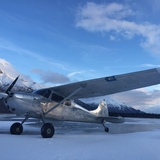
I guess it really depends on how you envision using the boat. Are you anticipating a five-mile open water crossing every morning just to get to your hunting ground, or does a boat just give you more access to the five-mile radius around your airplane where you'll be hunting, and hopefully a way to get the meat back to the plane?
There are advantages to a traditional canoe like the PakCanoe...more efficient against the wind and waves on a long crossing, and probably easier to get in and out of if you're doing that dozens of times a day. But there are some disadvantages, too. I guess for starters, regardless of efficiency, unless you're an accomplished canoeist I would strongly advise NOT being out on a lake when there's enough wind to bring up whitecaps. (After a decade working as a class V expedition kayaker in the Himalayas, the closest I ever came to drowning in my kayak was on a lake in a thunder storm.)
Unless you deck the PakCanoe (more weight, more expense, more time) you run the risk of swamping, especially in a heavily loaded boat. The built in floatation
might save the boat, but it won't let you paddle it to shore if it swamps.
Alpacka rafts cannot swamp, and they have a considerably higher load capacity than the PakCanoes until you get up to the 170. The Alpacka Raft will also take a small fraction of the time to set up and break down, thought that might not be a huge deal in your case.
The PakCanoe 170:
Weight: 56lbs
Size folded: 35x18x14 inches
Capacity: 910 lbs.
Price: $2,380, plus accessories and shipping. (A deck and bench-type seat will add $570)
Alpacka Forager:
Weight 14 lbs with two seats
Size folded: 23x9.5 inches
Capacity: Two adults plus 500+ lbs cargo
Price: $1,595 (nylon) to $2,300 (Vectran), plus shipping
That right there would be the determining factor for me, but maybe the 42 lbs and extra bulk aren't deal killers for you.
Looking at the PakBoat website, they do say that you can test-drive one of their boats for a couple weeks and then return it if you're not enthralled. All you'd be out is the shipping both ways.
If Alpacka Raft has a Forager in their demo fleet they'd probably offer you the same option...try their demo, and if you like it send it back and order a new one. You'd have to ask.
If you were doing a several hundred mile flat water trip I don't think there'd be much competition between the two boats...the PakCanoe would be the hands-down winner. But for hunting out of a float plane where so many other things are competing for limited load capacity (like fuel...and moose meat on the way out), the Alpacka Raft seems like the better choice to me.
If you're looking for any other ways to shed ounces while spending money, I'm full of good ideas!