After muddling over it for years I finally bought a fatbike…two fatbikes, actually. I’ve been lusting over them for a while, but most of the terrain I ride really doesn’t call for the ridiculously large, high-floatation tire that they sport. A glaring exception to that is our fairly frequent trips to the desert, where the surface conditions make a regular mountain bike tire very inefficient or flat-out useless.
Fat tires are to bicycle travel what Bushwheels are to small planes…you can go places in complete control and safety that would be impossible other wise. And in both cases, you get to pay for it in cost and efficiency. Fatbikes are less efficient than mountain bikes UNTIL the surface conditions get to where regular mountain bike tires don’t provide enough flotation or traction. Sand, mud, snow, loose gravel, moss covered baby-head’s, etc..
After putting about 1,000 miles on mine, I’ve got to say that they are a pretty different experience than any other bicycle I’ve ever ridden. You can ride a fatbike places you simply could never ride a regular mountain bike, and the worse the surface conditions are, the more fun it is. It’s just strange to roll over deep sand, loose gravel, helter-skelter salt formations, packed snow and mud bogs without a change in flotation or traction. The size of the rocks you can ride over is essentially only limited by how much peddle-strike you want to put up with.
The hysterical, 5” wide tires are run at low psi…below 10 psi for dirt and rocks, and down to 1~3 psi for snow. Half a psi actually makes a noticeable difference in how the tires behave. You need a very accurate low-pressure tire gage and the willingness to do a lot of experimentation when you start out. If you just put in 10 psi and call it good you won’t get a fraction of the available performance out of your bike.
Salsa Mukluk fatbike next to a 26" Goodyear.

Properly inflated for the conditions, the traction and flotation the fat tires provide really has to be experienced to be believed. Riding across sand dunes is pretty novel, but you can actually side-hill across sand dunes in complete control. On a smooth plowed snow-floor road that will let you ski on your boots, there’s enough traction to break hard without slipping. Slimy rocks, wet tree roots, wet clay…the tires get traction. The only time I’ve lost traction is on pure, featureless ice, and there are studded ice tires available for folks that want them.
Riding on snow is surprisingly fun. Basically, if you can walk on the snow, you can ride on it. Riding on snow is often even slower than riding on sand, but vastly faster than walking or cross country skiing. You just have to remember that your not biking, you’re snow-biking, and adjust your mental picture of how fast the terrain should be flying by. Groomed ski trails are super-easy, and snowmobile tracks are generally fine. The only real problem with snowmobile tracks is sometimes the ski ruts get iced over and can cause problems for non-studded tires. You can’t plow through a lot of unpacked snow, but if there’s a few inches of powder on a trail it’s great. A frozen lake with hard snow drifts is just a playground for a fatbike.
The available studded ice tires are reported to be simply amazing, as well they should at $250 a piece. While that’s a staggering amount for a bicycle tire, a non-studded 5” tire will still run you $130, and the studs are sophisticated, mating a hollow tungsten carbide stud into aluminum base to reduce weight. I haven’t used them yet, but if I were regularly riding on ice I’d happily pony up the money. If you only run them on ice and snow they should last many years.
This is a groomed ski trail in Montana, but snowmobile trails work equally well. There's four feet of snow under the cyclist.

Some general considerations: While you can ride these places a regular bike could never go, you still have to peddle them, and the combination of large tires, low tire pressures and soft surfaces make them significantly slower than riding a mountain bike on hardpack. If you’re not in shape or don’t regularly ride a bike, a fatbike isn’t going to make you feel like you’re a super star. You really notice the extra drag while climbing. If you’re a cyclist and enjoy a workout they are super-fun and will take you VASTLY further than you could ever hike in a day over the right terrain. If your idea of bicycling is renting a beach cruiser on the mile-long boardwalk once a year, you will probably be less than enthralled. Like a lot of things, you will get out of them exactly what you’re willing and able to put into them.
This really is as fun as it looks...

Not that long ago fatbikes were relegated to the small group of hard-core fanatical bikers who thought cycling the entire length of the Iditarod, self-supported, was a great way to train for riding the entire length of the Baja Peninsula, self supported. Now fatbikes are a bit more mainstream, which is good and bad. You can buy a fatbike at Sprawllmart, but you probably don’t want to. Assuming that you’re riding a fatbike in the terrain they excel in: rugged, remote, soft surfaced and wild, the consequences of a mechanical failure are somewhat different than that time when your chain broke on the ride to elementary school back in Maybery. Two hours of biking can easily equal five or six hours of walking, and fatbikes ridden through arroyos and across gravel bars endure much more physical stress than a bike ridden on pavement. Given that a set of decent tires alone will run $260, it’s hard to see where a $500 Chinese fatbike is a good choice for remote exploration.
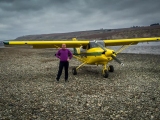
Don't break down! A easy morning of peddling puts you a couple days walk from the airplane in terrain like this.

There are a couple full-suspension fatbikes on the market, but the vast majority of them are rigid frames. That’s because the tires provide a reasonable amount of cushion to begin with, and most people who ride these are riding them places where the added weight and complexity of suspension is a detriment rather than an attribute. If you’re a mountain biker that grew up in the age of full-suspension, there might be a learning curve to a rigid bike…you need a lot more body english, a lot more weight transfer. You can still ride damn near everything a full suspension bike can ride (more in the case of a fatbike), but you work a little harder for it. I started out riding rigid mountain bikes, then eventually progressed to full suspension bikes. My two newest bikes are rigid frames and I honestly really enjoy riding without suspension again. For those that want to split the difference there are a couple manufactures of fatbike suspension forks on the market, and most higher-end frames will accommodate a suspension fork if you so desire.
There are also a couple electric fat bikes in production (Felt makes the Lebowsk-e, and I think Specialized makes one now, too), as well as the option of retrofitting to electric. These are good options for some people, though they come with an increase in weight, complexity, and cost, and of course you have to figure some way of charging them in the field if you’re out for more than a day or two. Because of the weight they also eliminate the ability to hike your bicycle around obstacles or across stretches of unridable terrain, which really limits them for any sort of rugged exploration. The ones I’m aware of are limited to 4” tires…wide, but not wide enough for snow or soft sand.
If you really push into trail-less country you're going to have to cary your bike every now and again. While electric bikes are brilliant for some applications, they're too heavy to cary for any distance.

While I run clipless peddles on all my other bikes, I opted for flat peddles on my fatbike. The reason is that where I ride my fatbike, I want to be in boots. Lots of great fatbiking terrain has some hiking involved, so good boots are my preferred footwear. Folding or quick-release peddles are worth a look if you don’t have monster feet that make them uncomfortable. Being able to fold or remove a peddle makes hiking the bike a LOT easier.
The 1x11 drivetrains which are all the rage now have always seemed like a joke to me. Now that I have a fat bike with that drive train, I think they’re a bad joke at that. But, they are probably all you’re going to find, and they have one advantage for fat bikes in that the crank can be a little narrower than it would be with a 2x drivetrain. A Rohloff internally geared hub is the ultimate fatbike drivetrain, but they’re over a thousand dollars, and then you have to get a wheel custom built around it.
As far as frames go, I opted for carbon for a variety of reasons, primarily that I wanted a Salsa bike and they come in carbon. Steel is also a popular frame choice, and better in some ways. It’ll take more abuse, and since these bikes aren’t particularly light to begin with, a little extra weight doesn’t matter. Not recommended if you’re around salt water, however. For those with high standards and deep pockets, titanium is still the ultimate frame material. A titanium bare frame will cost about as much as high-end complete carbon bike.
Basic mechanical ability and tools are a prerequisite for exploring away from the plane, as are the tools and ability to spend a night out if things don’t go according to plan. Fatbikes can get you a LONG way from your airplane, and if they quit working and you can’t fix it, you might not make it back before dark. There are a plethora of bicycle bags made to fit the frame of fat bikes that makes it easy to load several days worth of gear, food and water on a bike, so there’s no excuse for not carrying the basics. For those that invest in the bags and a little bit of specialized gear, a fatbike will cary you and your camp miles and days away from your tied-down airplane and back again. It’s a whole new world compared to just camping under the wing.
This is more than enough cargo space to cary a multi-day camp, plus beer.

Camping at the airplane is good, but this is better...if you're confident in how you tied your airplane down, anyway. A minute after taking the picture the dust storm overran us with impressive ferocity.

Thermal regulation is a bit easier on a fatbike than on a regular bike, as you rarely reach the high forward speeds that makes dressing for regular cycling somewhat challenging. The low speeds also make form-fitting, low-drag cycling clothing unnecessary.
Getting two fatbikes and camping gear into our Cessna 170 (with extended baggage) wasn’t very difficult. I removed the peddles, front tires and handle bars, and instead of a large duffel bag with the camping gear inside, I just fit the camping gear loose around the bikes.
Some assembly required: It takes about twenty minutes to break down or reassemble two bikes in the field, and they fit in the airplane a lot better with some minor disassembly.

For a pilot who visits beaches, deserts, or frozen lakes, a fatbike will increase the terrain available to explore by a factor of 10. Of course there are places you could ride them, but shouldn’t. The cross-country ability of the bikes makes it easy to go riding places that were never meant to be ridden on. Go fat-biking through a wet meadow or across some salmon redds and it’ll be nothing but justice if someone shoots you.
Of course all bicycles are prohibited in designated wilderness areas, though some wilderness areas have road corridors carved out of them that are fair game for bikes. Whether you agree with the wilderness prohibition or not, honor it for the sake of others. Pilots landing on wilderness airstrips and then violating the wilderness act by cycling is just going to be bad for the future of cycling, and the airstrip. Technically I don't think you are allowed to even ride ON a wilderness airstrip in the Frank Church…the exemption from the wilderness rules is for aircraft only.
As fatbikes get more popular and people figure out the fantastic mobility they offer, some folks will abuse them and scar the land, impact vulnerable game populations, and generally piss everybody off. Let's try hard not to tie any of that behavior to backcountry pilots!