This has been an interesting thread. I know when it comes, I will subscribe, at least for a time. I'm fascinated by the thecnology much like Cary and others are. I know when I have it I will turn it on in VFR conditions to verify in my own head how accurate it is. In the event I find it not extremely accurate I will discontinue the subscription. In the event it does prove to be accurate I will only turn it on occassionally to verify its accuracy and would only use it otherwise, in an emergent situation as a last resort.
I'm living in the mountains now, I am a very beginning mountain pilot. One of my biggest fears is getting caught in lowering ceilings, while down in the mountains. While this hasn't ever happened yet, because I'm very careful about watching conditions, I'm not naive enough to think it could never happen. And if it ever happened th SV could be a handy tool.
Marty
Foreflight Synthetic Vision
Sun Dec 21, 2014 4:52 pm
Tue Dec 23, 2014 7:13 am
Re: Foreflight Synthetic Vision
Like mentioned above, it's a tool, and like any tool, there is a time and place for it to be used. Similar to the Hazard Advisor, it can be turned on when needed...and could be of great use in certain situations. My friend who flies behind the Dynon Skyview has said the same thing, that in the beginning it was more of a distraction because it was so pretty you just wanted to stare at it. Now, after a couple hundred hours behind it, the novelty has worn off and he rarely even notices it. I'm surprised that they didn't include it with the pro subscription and, as the novelty wears off, hope that it will be included.
- Grassstrippilot offline

- Posts: 3536
- Joined: Wed May 31, 2006 6:17 am
- Location: Syracuse, UT
- FindMeSpot URL: https://share.garmin.com/WolfAdventures
- Aircraft: Cessna 205
Tue Dec 23, 2014 7:19 am
Re: Foreflight Synthetic Vision
mtv wrote:
In the proper context, synthetic vision is a fantastic tool. But, that context, at least in my opinion, is in a two pilot cockpit, operating under IFR. Alaska Airlines has been using it for several years, and it's allowed them to safely complete tough approaches in difficult conditions.
MTV
Alaska has synthetic vision? I wasn't aware of any transport category (airline anyway) aircraft that had that capability. What are they using and on what aircraft?
- Grassstrippilot offline
- Posts: 3536
- Joined: Wed May 31, 2006 6:17 am
- Location: Syracuse, UT
- FindMeSpot URL: https://share.garmin.com/WolfAdventures
- Aircraft: Cessna 205
Tue Dec 23, 2014 9:19 am
Re: Foreflight Synthetic Vision
Grassstrippilot wrote:mtv wrote:
In the proper context, synthetic vision is a fantastic tool. But, that context, at least in my opinion, is in a two pilot cockpit, operating under IFR. Alaska Airlines has been using it for several years, and it's allowed them to safely complete tough approaches in difficult conditions.
MTV
Alaska has synthetic vision? I wasn't aware of any transport category (airline anyway) aircraft that had that capability. What are they using and on what aircraft?
Well, sorta....I think technically speaking, what they're using is a form of "Enhanced Vision" technology. Here's a short article on the "Fogbuster" that Horizon is using:
"In-flight Technology
Satellite Flight Guidance Systems: GPS, EGPWS and RNP/WAAS
In 1996, Alaska became the first airline in the world to integrate the satellite Global Positioning System (GPS) with the latest in Enhanced Ground Proximity Warning System (EGPWS) technology. In 1997, Horizon began using GPS, and in 2000, it began integrating EGPWS.
GPS employs a network of 24 orbiting satellites to triangulate a plane's position in three dimensions. EGPWS takes that information, compares it to an onboard computer database of contour maps from around the world, and then continuously updates the pilot on the aircraft's location relative to nearby terrain.
Using GPS and EGPWS, Alaska pioneered Required Navigation Performance (RNP) to fly contoured approaches and departures with pinpoint accuracy into and out of rugged Alaskan airports. Today, RNP technology is used at numerous airports in Alaska and is also spreading to airports in the contiguous states and throughout the world.
In 2009, Horizon became the first scheduled-service passenger carrier to operate a flight using Wide Area Augmentation System (WAAS) technology, which builds on previous advances like RNP and GPS. WAAS uses additional satellites that monitor GPS satellite signals, correcting any errors in GPS satellite position. The technology allows for safe approaches to airports during very adverse weather conditions.
Head-up Guidance System (HGS®)
In 1989, Alaska became the first airline to use the Head-Up Guidance System during a passenger-carrying flight to reduce disruptions in scheduled service caused by fog. In 1995, Horizon became the first turboprop operator to use the HGS "Fogbuster." The system uses a head-up display that superimposes a holographic image of the approaching runway on a transparent screen positioned between the pilot and the cockpit windshield. Flight data from the instrument panel also is displayed on the screen."
Here's another from a forum post by an AS pilot, with respect to AS use of RNP to get into Juneau in poor weather:
" RNP 101
To understand RNP we need to first talk about basic instrument flight. Since the 50s the standard instrument navigation, that is navigation by reference to instruments only has been conducted using ground based radio beacons called VOR, VORTAC, TACAN and NDB. Instrument approaches to airports were also conducted using these navaids and one additional navaid call the ILS. If you don't know what they are; well it’s not important for this discussion. Extended overwater navigation was conducted with LORAN and believe it or not up until the 70s with celestial navigation. In the 70s INS (Inertial Navigation System) navigation came into wide use. An INS is a navigation aid that uses a computer and motion sensors (accelerometers) to continuously calculate via dead reckoning the position, orientation, and velocity (direction and speed of movement) of a moving object without the need for external references. So for you pilots it’s a gyroscope or a combonation of 2 or 3 of them hooked to a computer commonly called a FMS or flight mangement system. INS navigation ushered in the age of RNAV or Area Navigation by use of onboard computer systems. Initially it was accomplished with INS. RNAV brought important capabilities to aviation navigation. RNAV aircraft can fly directly between waypoints rather than flying to/from ground-based radio beacons or relying on vectors from air traffic control. Maneuvering directly to distant waypoints rather than zigzagging over a scattered course of ground-based radio beacons significantly improves efficiency. So eventually this technology moved from oceanic navigation to navigation over the land as well.
RNP can be seen as the evolution of RNAV. It increases the precision of aircraft position using GPS. Now in addition to the INS feeding information to the FMS you have a GPS unit feeding position updates to the computer. It allows aircraft to stay on track using direct legs from even longer point to point legs and calculates turn radius from point to point for detailed flight navigation. Rather than having to monitor radio aids to see if they go off the air this combination of computer, gyro, and GPS monitors actual navigation performance and alerts the crew if tolerances are exceeded.
Now as I said RNP was originally developed for use by aircraft flying transoceanic routes where ground-based navigation aids are not available. Without radar or radio beacons, aircraft flying over oceans are required to meet specific navigation performance (ergo the name Required Navigation Performance, RNP) criteria to ensure that they do not conflict with one another. For example, operating RNP-10 requires that an aircraft establish with a high degree of certainty its location within 10 nautical miles.
Steve Fulton, a pilot at Alaska Airlines who used to work for Honeywell, realized that the airline could solve operational difficulties it was having in Juneau, Alaska using a more precise form of RNP. It was not uncommon for 10% of the airline's flights there to be diverted due to the mountainous terrain and poor weather. Fulton developed a procedure that began with Alaska aircraft using multiple GPS units in the same aircraft to establish their location with a high degree of accuracy. It also included the addition of enhanced GPWS (Ground Proximity Warning System) installation on all of our aircraft. EGPWS loaded a ground map of the entire globe into the aircraft’s computer. With certainty of location, the Alaska aircraft could follow narrow, pre-programmed paths between mountains in good weather or bad. In addition to guiding planes toward the runway, RNP procedures included terrain-avoiding directions away from the airport in case of a missed approach or for departures. Alaska's first landing using RNP occurred in 1996 at Juneau, Alaska. Alaska was the first airline to be certified to use RNP for approaches and departures, the first to train all there pilots to use the system and is using the system more widely than any other airline."
It was my understanding that AS was also using HUD in their 737s as part of the RNP procedures, and that the HUD displays terrain in the form of synthetic vision....or enhanced vision. They are flying curved approaches literally through passes to reduce minimums into JUN.
Horizon is operating Dash 8 aircraft and Alaska is now exclusively operating 737 aircraft.
MTV

Tue Dec 23, 2014 11:06 am
Re: Foreflight Synthetic Vision
Thx MTV...
I am finishing up my Instrument Rating (put on hold while I move from SoCal to Monterey for work unfortunately), but that is a great explanation of the background of the GPS/RNAV systems.
I am finishing up my Instrument Rating (put on hold while I move from SoCal to Monterey for work unfortunately), but that is a great explanation of the background of the GPS/RNAV systems.
- Mojave Flyer offline
- Posts: 168
- Joined: Sat Sep 27, 2014 2:06 pm
- Location: Newport
- Aircraft: Piper PA-28-180
Tue Dec 23, 2014 9:52 pm
Re: Foreflight Synthetic Vision
mtv wrote:Grassstrippilot wrote:mtv wrote:
In the proper context, synthetic vision is a fantastic tool. But, that context, at least in my opinion, is in a two pilot cockpit, operating under IFR. Alaska Airlines has been using it for several years, and it's allowed them to safely complete tough approaches in difficult conditions.
MTV
Alaska has synthetic vision? I wasn't aware of any transport category (airline anyway) aircraft that had that capability. What are they using and on what aircraft?
Well, sorta....I think technically speaking, what they're using is a form of "Enhanced Vision" technology. Here's a short article on the "Fogbuster" that Horizon is using:
"In-flight Technology
Satellite Flight Guidance Systems: GPS, EGPWS and RNP/WAAS
In 1996, Alaska became the first airline in the world to integrate the satellite Global Positioning System (GPS) with the latest in Enhanced Ground Proximity Warning System (EGPWS) technology. In 1997, Horizon began using GPS, and in 2000, it began integrating EGPWS.
GPS employs a network of 24 orbiting satellites to triangulate a plane's position in three dimensions. EGPWS takes that information, compares it to an onboard computer database of contour maps from around the world, and then continuously updates the pilot on the aircraft's location relative to nearby terrain.
Using GPS and EGPWS, Alaska pioneered Required Navigation Performance (RNP) to fly contoured approaches and departures with pinpoint accuracy into and out of rugged Alaskan airports. Today, RNP technology is used at numerous airports in Alaska and is also spreading to airports in the contiguous states and throughout the world.
In 2009, Horizon became the first scheduled-service passenger carrier to operate a flight using Wide Area Augmentation System (WAAS) technology, which builds on previous advances like RNP and GPS. WAAS uses additional satellites that monitor GPS satellite signals, correcting any errors in GPS satellite position. The technology allows for safe approaches to airports during very adverse weather conditions.
Head-up Guidance System (HGS®)
In 1989, Alaska became the first airline to use the Head-Up Guidance System during a passenger-carrying flight to reduce disruptions in scheduled service caused by fog. In 1995, Horizon became the first turboprop operator to use the HGS "Fogbuster." The system uses a head-up display that superimposes a holographic image of the approaching runway on a transparent screen positioned between the pilot and the cockpit windshield. Flight data from the instrument panel also is displayed on the screen."
Here's another from a forum post by an AS pilot, with respect to AS use of RNP to get into Juneau in poor weather:
" RNP 101
To understand RNP we need to first talk about basic instrument flight. Since the 50s the standard instrument navigation, that is navigation by reference to instruments only has been conducted using ground based radio beacons called VOR, VORTAC, TACAN and NDB. Instrument approaches to airports were also conducted using these navaids and one additional navaid call the ILS. If you don't know what they are; well it’s not important for this discussion. Extended overwater navigation was conducted with LORAN and believe it or not up until the 70s with celestial navigation. In the 70s INS (Inertial Navigation System) navigation came into wide use. An INS is a navigation aid that uses a computer and motion sensors (accelerometers) to continuously calculate via dead reckoning the position, orientation, and velocity (direction and speed of movement) of a moving object without the need for external references. So for you pilots it’s a gyroscope or a combonation of 2 or 3 of them hooked to a computer commonly called a FMS or flight mangement system. INS navigation ushered in the age of RNAV or Area Navigation by use of onboard computer systems. Initially it was accomplished with INS. RNAV brought important capabilities to aviation navigation. RNAV aircraft can fly directly between waypoints rather than flying to/from ground-based radio beacons or relying on vectors from air traffic control. Maneuvering directly to distant waypoints rather than zigzagging over a scattered course of ground-based radio beacons significantly improves efficiency. So eventually this technology moved from oceanic navigation to navigation over the land as well.
RNP can be seen as the evolution of RNAV. It increases the precision of aircraft position using GPS. Now in addition to the INS feeding information to the FMS you have a GPS unit feeding position updates to the computer. It allows aircraft to stay on track using direct legs from even longer point to point legs and calculates turn radius from point to point for detailed flight navigation. Rather than having to monitor radio aids to see if they go off the air this combination of computer, gyro, and GPS monitors actual navigation performance and alerts the crew if tolerances are exceeded.
Now as I said RNP was originally developed for use by aircraft flying transoceanic routes where ground-based navigation aids are not available. Without radar or radio beacons, aircraft flying over oceans are required to meet specific navigation performance (ergo the name Required Navigation Performance, RNP) criteria to ensure that they do not conflict with one another. For example, operating RNP-10 requires that an aircraft establish with a high degree of certainty its location within 10 nautical miles.
Steve Fulton, a pilot at Alaska Airlines who used to work for Honeywell, realized that the airline could solve operational difficulties it was having in Juneau, Alaska using a more precise form of RNP. It was not uncommon for 10% of the airline's flights there to be diverted due to the mountainous terrain and poor weather. Fulton developed a procedure that began with Alaska aircraft using multiple GPS units in the same aircraft to establish their location with a high degree of accuracy. It also included the addition of enhanced GPWS (Ground Proximity Warning System) installation on all of our aircraft. EGPWS loaded a ground map of the entire globe into the aircraft’s computer. With certainty of location, the Alaska aircraft could follow narrow, pre-programmed paths between mountains in good weather or bad. In addition to guiding planes toward the runway, RNP procedures included terrain-avoiding directions away from the airport in case of a missed approach or for departures. Alaska's first landing using RNP occurred in 1996 at Juneau, Alaska. Alaska was the first airline to be certified to use RNP for approaches and departures, the first to train all there pilots to use the system and is using the system more widely than any other airline."
It was my understanding that AS was also using HUD in their 737s as part of the RNP procedures, and that the HUD displays terrain in the form of synthetic vision....or enhanced vision. They are flying curved approaches literally through passes to reduce minimums into JUN.
Horizon is operating Dash 8 aircraft and Alaska is now exclusively operating 737 aircraft.
MTV
That is a very interesting read, MTV
Marty
Tue Dec 23, 2014 11:48 pm
Foreflight Synthetic Vision
I'm a right seater at Horizon Airlines. The "Heads up guidance system" (HGS) or "Green TV" is a remarkable thing. Our synthetic vision is very crude compared to what is showing on the G1000 and other like systems. It's just a very precise flight director using 2 waas gps, an IRS and software to create very accurate flight guidance. There is even "flare guidance". First time I watched a hand flown approach down to 600 RVR with indefinite ceiling was very exciting to say the least.
RNP .1 is also amazing, watching the airplane make fairly steep turns inside the final approach fix is pretty fun. We now have Cat 1 mins at airports where a traditional 3 degree ILS glide slope wouldn't work, very cool.
RNP .1 is also amazing, watching the airplane make fairly steep turns inside the final approach fix is pretty fun. We now have Cat 1 mins at airports where a traditional 3 degree ILS glide slope wouldn't work, very cool.

Wed Dec 24, 2014 9:44 am
Re: Foreflight Synthetic Vision
It has really made a huge difference in Juneau. When I first move to SE AK, there were still quite a few MD80's as well as the -200 combi's that didn't have the RNP capability. AK Air quickly saw the benefit of the RNP equipped -400's and pretty soon the old stuff was gone. These days it's extremely rare they miss Juneau due to vis...maybe 7-8 times all year.
The approach from the west is really no biggie, but man if they come from the SE through the channel it's downright sexy! It's good not to be able to see out the window as a passenger for that one. The occasional miss is a little sporty too.
AS has some damned fine equipment and pilots in my opinion.
The approach from the west is really no biggie, but man if they come from the SE through the channel it's downright sexy! It's good not to be able to see out the window as a passenger for that one. The occasional miss is a little sporty too.
AS has some damned fine equipment and pilots in my opinion.
Wed Dec 24, 2014 10:02 am
Re: Foreflight Synthetic Vision
The first time I flew into Juneau was from the SE approach.. that will pucker up the passenger that does not know whats coming. Watching that approach from the ground for the first time is pretty cool too. It's not every day you see a 737 fly a supercub pattern 
- akavidflyer offline

- Posts: 521
- Joined: Sat Nov 20, 2010 7:36 pm
- Location: Soldotna AK
Wed Dec 24, 2014 10:13 am
Re: Foreflight Synthetic Vision
Back when I could jumpseat on AS, it was always so cool to sit directly behind the Captain and get the view through the HUD. I'd sit there and think, "If only I had this in my Sled, I could....."
Gump
Gump
Wed Dec 24, 2014 10:40 pm
Re: Foreflight Synthetic Vision
Yeah that's what I figured. RNP, EGWPS, and HUDs in transport category aircraft, while really capable, are a far cry from the synthetic vision we are talking about here. EGWPS is essentially the Hazard Advisor on FF and just areas of the moving map in various colors. HUDs essentially just display the info that is on the PFD in front of you so you don't have to look down. RNP are very cool in that they can give very precise, curved lateral and vertical guidance as needed. They are life savers especially in 3rd world countries with unreliable ground based navaids. But none of this is 3D terrain on the MFD.
Some corporate and GA aircraft have FLIR which looks pretty cool, but none of that has made it to the 121 world.
Some corporate and GA aircraft have FLIR which looks pretty cool, but none of that has made it to the 121 world.
- Grassstrippilot offline
- Posts: 3536
- Joined: Wed May 31, 2006 6:17 am
- Location: Syracuse, UT
- FindMeSpot URL: https://share.garmin.com/WolfAdventures
- Aircraft: Cessna 205
Thu Dec 25, 2014 1:38 am
Foreflight Synthetic Vision
Love my ff, also have played with Xavion... But I fly a Wilga.... So the big windows have always been more attractive to me. The ole Garmin seems to get the most use still.
I wonder how many pilots even know how to navigate or aviate old school anymore.
Wonder if some 'terrorist' jammed GPS signal, how many of us would be toast?
Love the geekery though. But it scares me sometimes.... We learn skills to get the ticket, but for me, that was 20 years ago. I haven't had a flight reviewer ever ask me old school pilotage or dead reckoning stuff.
Love this flying stuff. LOVE it.
You are all fun to lurk and follow. I am thankful to tag along.
I wonder how many pilots even know how to navigate or aviate old school anymore.
Wonder if some 'terrorist' jammed GPS signal, how many of us would be toast?
Love the geekery though. But it scares me sometimes.... We learn skills to get the ticket, but for me, that was 20 years ago. I haven't had a flight reviewer ever ask me old school pilotage or dead reckoning stuff.
Love this flying stuff. LOVE it.
You are all fun to lurk and follow. I am thankful to tag along.
- WilgaBeast offline

- Posts: 254
- Joined: Sat Mar 24, 2012 7:54 am
- Location: Riverton, Utah
- FindMeSpot URL: http://share.findmespot.com/shared/face ... OvNBuHnxKg
Thu Dec 25, 2014 6:26 am
Re: Foreflight Synthetic Vision
When I do primary instruction, I insust on learning the old school way. I tell students that they have to have a foundation of the basics.
Regarding RNP, some of you might find this interesting. The A320, amd I'm sure most other similar aircraft are the same, has 3 inertial navs, 2 GPSs, 2 VORs, and DME. It takes all this info and mixes it to come up with a location, using a hierarchy giving priority to the most accurate. RNP approaches require either .3 or .1 NM accuracy. The Bus usually has .03 NM accuracy. Very accurate!
Regarding RNP, some of you might find this interesting. The A320, amd I'm sure most other similar aircraft are the same, has 3 inertial navs, 2 GPSs, 2 VORs, and DME. It takes all this info and mixes it to come up with a location, using a hierarchy giving priority to the most accurate. RNP approaches require either .3 or .1 NM accuracy. The Bus usually has .03 NM accuracy. Very accurate!
- Grassstrippilot offline
- Posts: 3536
- Joined: Wed May 31, 2006 6:17 am
- Location: Syracuse, UT
- FindMeSpot URL: https://share.garmin.com/WolfAdventures
- Aircraft: Cessna 205
Thu Dec 25, 2014 7:22 am
Re: Foreflight Synthetic Vision
Grassstrippilot wrote:When I do primary instruction, I insust on learning the old school way. I tell students that they have to have a foundation of the basics.
Regarding RNP, some of you might find this interesting. The A320, amd I'm sure most other similar aircraft are the same, has 3 inertial navs, 2 GPSs, 2 VORs, and DME. It takes all this info and mixes it to come up with a location, using a hierarchy giving priority to the most accurate. RNP approaches require either .3 or .1 NM accuracy. The Bus usually has .03 NM accuracy. Very accurate!
We've got Proline 21 in the C-12V, which is similar but not as accurate. .03? Dang!
- CamTom12 offline

- Posts: 3705
- Joined: Sun Jul 08, 2012 1:08 pm
- Location: Huntsville
- FindMeSpot URL: https://share.delorme.com/camtom12
- Aircraft: Ruppe Racer
Experimental Pacer
home hand jam "wizard"
Thu Dec 25, 2014 2:18 pm
Re: Foreflight Synthetic Vision
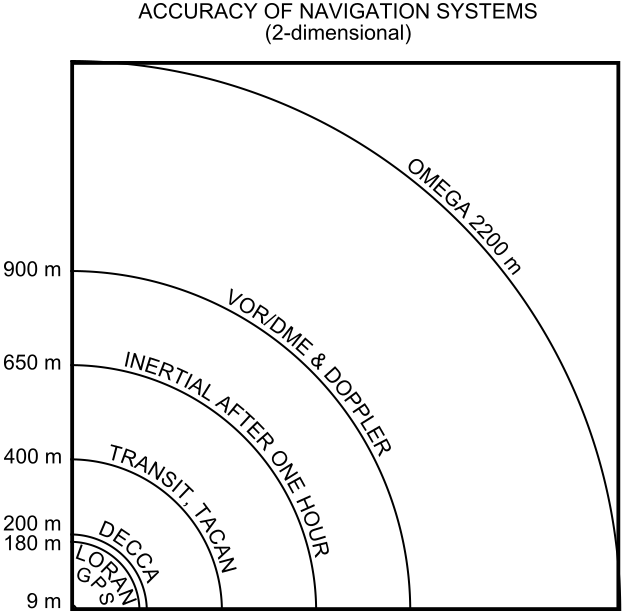
Our iPad EFBs need 17m accuracy to drive the JeppFD airport diagram ownship position. That's 0.009nm, and I've never seen it not work, even sitting in a side pocket without a $50k STC'd external antenna. LPV approaches and WAAS RNP .1 are here.
FMS RNP discussion on all the different inputs to verify position is nice, but in the real world it is irrelevant except as maybe a statistical backup. You're more likely to lose a second engine on a 777 over the North pole on an ETOPS than lose GPS signal. Next to GPS is DME/DME probably, but it is a poor cousin.
Here's a diagram that might help. Sorry that all your dual VOR/ILS/INS/DME/ Marker Beacon panels so coveted in the 70's are now history. FMS direction is to now accommodate non-US military GPS systems for redundancy and WAAS equivalent capability.
FMS RNP discussion on all the different inputs to verify position is nice, but in the real world it is irrelevant except as maybe a statistical backup. You're more likely to lose a second engine on a 777 over the North pole on an ETOPS than lose GPS signal. Next to GPS is DME/DME probably, but it is a poor cousin.
Here's a diagram that might help. Sorry that all your dual VOR/ILS/INS/DME/ Marker Beacon panels so coveted in the 70's are now history. FMS direction is to now accommodate non-US military GPS systems for redundancy and WAAS equivalent capability.
'74 7GCBC, 26" ABW, Aera 660 feeding G5 and FC-10 FF.
Tue Dec 30, 2014 2:51 pm
Re: Foreflight Synthetic Vision
Who all upgraded to SV??? I think it's amazing!
- piperpainter offline
- Posts: 968
- Joined: Sat Nov 29, 2008 10:57 pm
- Location: Auburn, WA
- Aircraft: C-205
Was Backcountry Mooney M20C
Tue Dec 30, 2014 10:58 pm
Re: Foreflight Synthetic Vision
I think SV would be a great addition to any IR pilots panel and is just really cool in general. For a Vfr guy however, especially a lower time one I think it is unnecessary in most circumstances and is just asking for bad habits (staring in the cockpit instead of looking out the big window). I always tell my students that technology in the cockpit is great and when properly used adds an incredible amount of safety, but you need to have basic navigational skills to fall back on when shit enevidably hits the fan, or when you forgot to charge the damn iPad  . Just my .02
P.s. Must be nice to have gps, fanciest thing we have in our Cherokee 140s is a good ole king KX170b
. Just my .02 P.s. Must be nice to have gps, fanciest thing we have in our Cherokee 140s is a good ole king KX170b
Wed Dec 31, 2014 12:47 am
Re: Foreflight Synthetic Vision
I find it somewhat amusing that RobW56 has posted a synthetic vision overlaid with weather of someplace in Tennessee. He's based in Reo Vista of all places. His Tennessee view shows a couple of 700' towers coming up. Take a look at the SF sectional around his home town there. Just a couple of miles North East of his home base there is a cluster of towers labeled at 2030 above the ground and 2051 feet above the ground. All the more remarkable is that those elevations are also MSL because the whole area is a wetlands (swamp to you old timers). If it's not a hazy day there then the wind is blowing out of the North West at 25-30 with gusts to 50. So, how far do those guy wires extend out from the bases of those big friggin' towers? Does the display show that? To make matters worse, those aren't the only tower sites in the area. The whole delta is a forrest of towers and other aeronautical hazards. It's good to know the towers are there but a whole lot more local knowledge is required to fly low and slow in that area.robw56 wrote:Call me crazy but I'd rather have this in my panel:

And as long as we're horsing around on SkyVector take a look down south of there on Monterey Bay at the Watsonville airport. Now draw a line heading kinda North East of there towards South County and Reid-Hillview. See that sucker? That thing sticks 1000' above the ridge line and has guy wires heading out in all directions. It's got a light on it but on a hazy day it's only there to let you know to say your prayers. That's why I like Nevada so much.
Wed Dec 31, 2014 7:42 am
Re: Foreflight Synthetic Vision
That picture was straight from foreflights website.
Regarding the 2000ft towers east of town here. You can measure on Google earth how far the guy wires spread out. You can see the big concrete blocks they are secured to. The furthest ones are about 1000ft from the base of the tower if I remember right.
Regarding the 2000ft towers east of town here. You can measure on Google earth how far the guy wires spread out. You can see the big concrete blocks they are secured to. The furthest ones are about 1000ft from the base of the tower if I remember right.
Wed Dec 31, 2014 8:30 am
Re: Foreflight Synthetic Vision
I looked through their FAQ's and couldn't tell where the data came from. If this was an overlay of current VFR charts, that would be incredible. I'll probably get it anyway to try. I found out the difference between the cool but unreliable weather on foreflight and the not so cool but reliable XM weather on the 396 last Summer. Ipads don't work everywhere.
- Nosedragger offline
- Posts: 975
- Joined: Fri Dec 31, 2010 6:40 am
- Location: SE Idaho
- FindMeSpot URL: http://share.findmespot.com/shared/face ... ACzcbTgqlT
DISPLAY OPTIONS
Who is online
Users browsing this forum: No registered users and 31 guests
Latest Features
-
Live to Tell
A Minnesota pilot is surprised to learn that the sudden asymmetric drag of an out-of-rig ski can…Read More -
Creators
Working in some of the Yukon's most beautiful and remote environments, photographer Simon Blakesley captures aircraft in…Read More -
Aircraft Ownership and Maintenance
Upgrading to big tires can make a huge difference in backcountry performance, but with those gains come…Read More -
Tales from Yesteryear
In this tale from bush flying yesteryear, Don Cogger signs up to help Atlee Dodge Jr recovery…Read More


Latest Knowledge Base
-
Destinations
A regional guide with ideas for winter camping destinations in California, Nevada, New Mexico, and Arizona.Read More -
Aircraft
Finding an affordable aircraft that can handle the backcountry for $80K or less? A challenge for sure, but with the…Read More -
Aircraft
01.29.2018 - Zane - Updated tire diameter graphic to add 8.50x10 Guide to tires for use in the backcountry and off-airport landing…Read More -
Pilots
12.22.2013 - Initial article format Operating aircraft on skis and negotiating a snow-covered landscape is an entirely unique skillset and environment.…Read More


