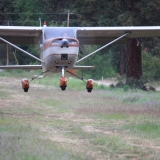
My first video with a GoPro. Previously I have strapped a camera to the strut and pushed record in the video mode, prior to takeoff. I'm excited about the possibilities.
This is the Home Strip, first landed in 1990. Originally it was less than 900, but now just over 1000'.
I filmed a landing and takeoff yesterday with some captions added for training purposes. I'm not sure if I'm doing everything by the book, but with 400+ landings here, it's what works for me.
Richard
Landing Short in a Cessna Tricycle
Sun Nov 20, 2016 1:58 pm

Sun Nov 20, 2016 3:10 pm
Re: Landing Short in a Cessna Tricycle
Nice!
Sent from my iPhone using Tapatalk
Sent from my iPhone using Tapatalk
- CamTom12 offline

- Posts: 3705
- Joined: Sun Jul 08, 2012 1:08 pm
- Location: Huntsville
- FindMeSpot URL: https://share.delorme.com/camtom12
- Aircraft: Ruppe Racer
Experimental Pacer
home hand jam "wizard"
Sun Nov 20, 2016 4:01 pm
Re: Landing Short in a Cessna Tricycle
Nice apparent rate of closure approach. Nice low ground effect takeoff.
- contactflying offline
- Posts: 4972
- Joined: Wed Apr 03, 2013 7:36 pm
- Location: Aurora, Missouri 2H2
Download my free "https://tinyurl.com/Safe-Maneuvering" e-book.
Sun Nov 20, 2016 4:02 pm
Re: Landing Short in a Cessna Tricycle
Good job on the video!
- tedwaltman offline


- Posts: 345
- Joined: Sat May 17, 2014 7:51 pm
- Location: Lakewood
- FindMeSpot URL: https://share.delorme.com/tedwaltman
- Aircraft: Experimental Super Cub
Sun Nov 20, 2016 4:06 pm
Re: Landing Short in a Cessna Tricycle
CamTom12 wrote:Nice!
Sent from my iPhone using Tapatalk
Yup, other than the warped view from the camera!
Cary
"I have slipped the surly bonds of earth..., put out my hand and touched the face of God." J.G. Magee
Sun Nov 20, 2016 5:28 pm
Re: Landing Short in a Cessna Tricycle
Pretty damn good job with a 150. You got any extra go-go juice in it, or is it a stock O-200?
If that's your home strip, why is that trailer or out building right there next to the runway? Shouldn't it be closer to the house and further away from the tree? Looks like it creates a narrow spot "pinch" between the tree and the building?
If that's your home strip, why is that trailer or out building right there next to the runway? Shouldn't it be closer to the house and further away from the tree? Looks like it creates a narrow spot "pinch" between the tree and the building?
.
Sun Nov 20, 2016 6:39 pm
Re: Landing Short in a Cessna Tricycle
Move the trailer and cut down the tree, you WILL eventually hit one or the other.
Mr Murphy
Mr Murphy
Sun Nov 20, 2016 6:43 pm
Re: Landing Short in a Cessna Tricycle
Good job!
Sun Nov 20, 2016 6:55 pm
Re: Landing Short in a Cessna Tricycle
Nice, looks fun.
Sent from my iPad using Tapatalk
Sent from my iPad using Tapatalk
- Troy Hamon offline
- Posts: 913
- Joined: Tue Apr 06, 2010 8:27 am
- Location: King Salmon
- FindMeSpot URL: http://share.findmespot.com/shared/face ... 04iX0FXjV2
- Aircraft: Piper PA-22
Sun Nov 20, 2016 7:53 pm
Re: Landing Short in a Cessna Tricycle
EZFLAP
I first landed the field in a stock 1966 Cessna 150G I bought to build time in back in 1990. I flew it back and forth to work in Stevensville, Mt for four years, building hours. One year I flew 100 days.
The aircraft I flew for the video is a stock engine 1964 Cessna 150D, 5's all around. While not a Sportsman, it does have a STOL kit. It belongs to a non pilot friend. It does have heart.
While I call it the "Home Strip", I don't actually own the property. My home is in the trees directly above the airstrip. I built there to be as close as possible.
Its one of three strips the Flying Hawkes and I call the "Bitterroot Home School Course". I have referred to it many times here. If you are comfortable in them, you can safely land anything that Fly Idaho has to offer. One of the strips was featured in a video I posted on AOPA advocating the use of flaps. I ultimately pulled it due to the firestorm of controversy it generated. Perhaps you remember it. I did receive a lot of support here, and will always remember those who piped up.
Patrick Romano wrote an excellent piece in his STOL Tips series on Tricycle gear aircraft. I was pleased he included one of my photos.
The pinch spot is not nearly as tight as it looks. The trailers have powered paraplanes in them. (Tricycle gear parachutes). They were actually closer, but for safety purposes were moved about ten feet. With the slope one can easily be stopped before reaching them.
Taildraggers are welcome, it was pretty neat to have Leigh Smith of techflying.com bring his Cessna 185 in. While a Maule or Husky has never landed Piney Field, from what I understand they are also great backcountry aircraft!
I'm not an instructor yet but hope to be in the spring. I do have Commercial and Instrument now. I'm working on a 1960 Cessna 182 and plan on using it for training purposes.
Richard
I first landed the field in a stock 1966 Cessna 150G I bought to build time in back in 1990. I flew it back and forth to work in Stevensville, Mt for four years, building hours. One year I flew 100 days.
The aircraft I flew for the video is a stock engine 1964 Cessna 150D, 5's all around. While not a Sportsman, it does have a STOL kit. It belongs to a non pilot friend. It does have heart.
While I call it the "Home Strip", I don't actually own the property. My home is in the trees directly above the airstrip. I built there to be as close as possible.
Its one of three strips the Flying Hawkes and I call the "Bitterroot Home School Course". I have referred to it many times here. If you are comfortable in them, you can safely land anything that Fly Idaho has to offer. One of the strips was featured in a video I posted on AOPA advocating the use of flaps. I ultimately pulled it due to the firestorm of controversy it generated. Perhaps you remember it. I did receive a lot of support here, and will always remember those who piped up.
Patrick Romano wrote an excellent piece in his STOL Tips series on Tricycle gear aircraft. I was pleased he included one of my photos.
The pinch spot is not nearly as tight as it looks. The trailers have powered paraplanes in them. (Tricycle gear parachutes). They were actually closer, but for safety purposes were moved about ten feet. With the slope one can easily be stopped before reaching them.
Taildraggers are welcome, it was pretty neat to have Leigh Smith of techflying.com bring his Cessna 185 in. While a Maule or Husky has never landed Piney Field, from what I understand they are also great backcountry aircraft!
I'm not an instructor yet but hope to be in the spring. I do have Commercial and Instrument now. I'm working on a 1960 Cessna 182 and plan on using it for training purposes.
Richard
Mon Nov 21, 2016 10:10 am
Re: Landing Short in a Cessna Tricycle
Nicely done.
I see no reason why, all else being equal, a trigear would not land exactly as short as a conventional geared airplane.
In takeoff performance the trigear may even have an advantage.
Cessnas, IMHO, have brilliant flaps. Much more efficent than the Maule's simple flaps. Add a Johnson bar and the Cessna really helps you hit your touchdown point.
I see no reason why, all else being equal, a trigear would not land exactly as short as a conventional geared airplane.
In takeoff performance the trigear may even have an advantage.
Cessnas, IMHO, have brilliant flaps. Much more efficent than the Maule's simple flaps. Add a Johnson bar and the Cessna really helps you hit your touchdown point.
- Mountain Doctor offline
- Posts: 641
- Joined: Fri May 01, 2015 3:33 pm
- Location: Richland
- Aircraft: Maule MXT-7 180A
Tue Nov 22, 2016 2:31 pm
Re: Landing Short in a Cessna Tricycle
Most tri-gear versions of the same airplane have the geometric capability to achieve a slightly higher AoA on the ground, which means that they can theoretically takeoff or land a little bit slower than the tailwheel versions.
This is of course offset by several factors, weight, drag, nosegear not being as impact resistant as main gear, etc.
The early (taller landing gear) Cessna 172 / 182 aircraft can put the wing several solid degrees higher AoA than the tailwheel versions. The later (short gear) Cessnas will lose some of this advantage.
This is of course offset by several factors, weight, drag, nosegear not being as impact resistant as main gear, etc.
The early (taller landing gear) Cessna 172 / 182 aircraft can put the wing several solid degrees higher AoA than the tailwheel versions. The later (short gear) Cessnas will lose some of this advantage.
.
Fri Nov 25, 2016 3:34 pm
Re: Landing Short in a Cessna Tricycle
EZFlap wrote:Most tri-gear versions of the same airplane have the geometric capability to achieve a slightly higher AoA on the ground, which means that they can theoretically takeoff or land a little bit slower than the tailwheel versions.
This is of course offset by several factors, weight, drag, nosegear not being as impact resistant as main gear, etc.
The early (taller landing gear) Cessna 172 / 182 aircraft can put the wing several solid degrees higher AoA than the tailwheel versions. The later (short gear) Cessnas will lose some of this advantage.
FWIW, my own methodology of getting off or on short doesn't rely on my airplane's ability to achieve a higher AOA, because frankly I don't think that's a good idea. I just barely get the nose gear clear of the ground, which I think is where it should be. Too much AOA adds too much aerodynamic drag rather than lift, and slows the take off process. That might be different with a whole lot more power that could theoretically overcome the aerodynamic drag effect; my experience is limited to 172s and 182s. Mine's a bit of a hot rod version with 180hp and a CS prop, but all the 182s I've flown had stock engines, either 230hp Continentals or a turbo'd 235hp Lycoming, and none of those had enough excess horsepower to overcome excessive drag by using too steep an AOA.
Sometime in the past, someone here posted a video of a 182 attempting to take off with a much too steep AOA. The video made it really clear that all that did was keep the airplane from lifting off soon enough. If I can find that video, I'll post a link.
Cary
Last edited by Cary on Fri Nov 25, 2016 3:56 pm, edited 1 time in total.
"I have slipped the surly bonds of earth..., put out my hand and touched the face of God." J.G. Magee
Fri Nov 25, 2016 3:45 pm
Re: Landing Short in a Cessna Tricycle
richpiney wrote:My first video with a GoPro. Previously I have strapped a camera to the strut and pushed record in the video mode, prior to takeoff. I'm excited about the possibilities.
This is the Home Strip, first landed in 1990. Originally it was less than 900, but now just over 1000'.
I filmed a landing and takeoff yesterday with some captions added for training purposes. I'm not sure if I'm doing everything by the book, but with 400+ landings here, it's what works for me.
[I really liked your great video! ... the link was not included in this quote!
Richard
What's the elevation of the airstrip? It looks like fall colors from the video. What was the ambient temperature/density altitude when you performed the short/soft landing and takeoff?
Thanks for posting.
- PapernScissors offline
- Posts: 419
- Joined: Sun Mar 06, 2016 8:49 pm
- Location: Spokane
- Aircraft: Cessna 172
Fri Nov 25, 2016 4:10 pm
Re: Landing Short in a Cessna Tricycle
I agree with Cary. Both a level angle of attack and low ground effect are critical and support one another. Unfortunately many allow the high pitch attitude, necessary to get up quickly, fly them into high ground effect. Now the high pitch attitude seems necessary to stay up. It is not. They now need to dive to get into low ground effect. This is hard for pilots. It is much easier to wiggle the stick fore/aft dynamically and proactively to stay in low ground effect.
Level angle of attack allows rapid acceleration and low ground effect allows below Vs flight. They enhance each other. Getting both just takes simi-aggressive control movement. Control pressure will get it only after the move becomes muscle memory
Level angle of attack allows rapid acceleration and low ground effect allows below Vs flight. They enhance each other. Getting both just takes simi-aggressive control movement. Control pressure will get it only after the move becomes muscle memory
- contactflying offline
- Posts: 4972
- Joined: Wed Apr 03, 2013 7:36 pm
- Location: Aurora, Missouri 2H2
Download my free "https://tinyurl.com/Safe-Maneuvering" e-book.
Fri Nov 25, 2016 5:25 pm
Re: Landing Short in a Cessna Tricycle
Cary wrote:
I just barely get the nose gear clear of the ground, which I think is where it should be. Too much AOA adds too much aerodynamic drag rather than lift, and slows the take off process. That might be different with a whole lot more power that could theoretically overcome the aerodynamic drag effect; my experience is limited to 172s and 182s.
If you just barely get the nose clear of the ground, you will not leave the ground at the minimum liftoff speed (for STOL "short field" operations pursuant to this thread topic)
The minimum liftoff speed is driven by the amount of lift that the wing can make (at a slow speed).
The maximum amount of lift the wing can make at a given (slow) speed is driven by the camber of the wing and the angle of attack, both of which create larger amounts of lift AND drag.
In order to get a typical Cessna 100 wing to lift off at the slowest possible speed, you need to have both a high AoA and the best camber (flap) setting for max lift. So if minimum takeoff speed is all you are trying to get, you could lower the flaps before takeoff, add power, and raise the nose as soon as you can, and just sit there and wait as long as it takes for the airspeed to come up to that minimum speed, at which point the combination of high AoA and camber will float the airplane off the runway.
However, if you also want this minimum speed liftoff to happen in the shortest possible distance, then you ALSO have to minimize the time and distance that it takes to accelerate to this magic speed.
Which puts one priority in conflict with another priority:
The drag from high AoA and the drag from camber (flap deployment) slows the acceleration down a little from what it could have been. Of course, you need both to be there at the point of liftoff. But the truth is you don't need ANY of that lift or that drag at ANY time before you reach the minimum liftoff speed.
So in order to accomplish a minimum distance/minimum speed STOL takeoff, you would want the airplane to accelerate as fast as it can possibly accelerate as the FIRST priority, but at the magic moment when the airplane has reached the minimum possible speed then the SECOND priority becomes more important... at that moment you want maximum possible AoA and the best camber (flap) setting.
The best possible way to accomplish this is to accelerate with the airplane at ZERO AoA and ZERO flaps, until the magic moment when AoA and flaps would allow the airplane to fly, and then instantly put that maximum AoA and flaps into the airplane.
Once the maximum AoA and flaps have pulled the airplane off the ground, you have met the primary objective (took off in the shortest distance).
Then the game changes again because of exactly what Cary and Contact have been saying: Trying to climb out of ground effect using high AoA is risky and not the best way. Too much drag fighting the thrust of the engine.
So at that moment, Contact's "low ground effect" (if the terrain will allow it) can be used to most expeditiously accelerate the airplane through and out of the "wallow" phase, speed up more efficiently, and THEN you can safely transition into best rate or best angle. The "low ground effect" phase is also probably the best place to retract the flaps using the "free energy" that he mentions..
.
Fri Nov 25, 2016 7:59 pm
Re: Landing Short in a Cessna Tricycle
Ezflap,
I think Cary is talking about getting the nosewheel just off as soon as possible. Until we get flying, even below Vs in low ground effect, our worst enemy is the drag of anything still in contact with the ground. The nose wheel or tail wheel is what can be gotten off first. Tail wheel off decreases angle of attack so is a win-win. Nose wheel just off increases angle of attack a bit so win-loss. The win is greater than the loss.
We again increase the angle of attack or use flaps or both to get the mains just off. Again win-loss but now the win is much greater so long as we both stay in low ground effect and level the aircraft. It is hard to math it out; it just works.
I think Cary is talking about getting the nosewheel just off as soon as possible. Until we get flying, even below Vs in low ground effect, our worst enemy is the drag of anything still in contact with the ground. The nose wheel or tail wheel is what can be gotten off first. Tail wheel off decreases angle of attack so is a win-win. Nose wheel just off increases angle of attack a bit so win-loss. The win is greater than the loss.
We again increase the angle of attack or use flaps or both to get the mains just off. Again win-loss but now the win is much greater so long as we both stay in low ground effect and level the aircraft. It is hard to math it out; it just works.
- contactflying offline
- Posts: 4972
- Joined: Wed Apr 03, 2013 7:36 pm
- Location: Aurora, Missouri 2H2
Download my free "https://tinyurl.com/Safe-Maneuvering" e-book.
Fri Nov 25, 2016 9:25 pm
Re: Landing Short in a Cessna Tricycle
PapernScissors wrote:
What's the elevation of the airstrip? It looks like fall colors from the video. What was the ambient temperature/density altitude when you performed the short/soft landing and takeoff?
Thanks for posting.
The bottom or touchdown point is roughly 4000'. The top is about 4065. The temp last Saturday morning was about 35 degrees. The slope is everything. It allows for fairly warm temps to be present and still be comfortable launching out of there.
Very good information being brought out by Cary, Contact & EZFlap. Extremely important techniques to become proficient with in order to get the most out of a low power aircraft, or in fact any airplane.
I may have posted this article by John Deakin before, if so I apologize, but perhaps there are some who have not had a chance to study and test the information.
Pelican's Perch #22:
Short- and Soft-Field Takeoffs — FAA vs. Reality
http://www.avweb.com/news/pelican/182089-1.html
Richard
Sat Nov 26, 2016 7:38 am
Re: Landing Short in a Cessna Tricycle
richpiney wrote:EZFLAP
Patrick Romano wrote an excellent piece in his STOL Tips series on Tricycle gear aircraft. I was pleased he included one of my photos.
Richard
The 150 at Simonds! Zane was the one that actually had and used that picture, but it makes me smile every time I see it. My wife and I had a scary experience there years ago there and when I showed her the picture I believe her response was F%@* THAT! Mine was I wanna buy that person a Beer! So now that we have "met" I want to buy you a beer next time I am up that way or if you are ever down Denver way.
-Patrick
- learntolandshort offline
- Posts: 82
- Joined: Wed Oct 06, 2010 1:11 pm
- Location: colorado
Sat Nov 26, 2016 8:44 am
Re: Landing Short in a Cessna Tricycle
Sometimes you can land pretty short in the Cessna tricycle, and then the problem becomes the take off.
Been there and ended having to pull tall weeds with my bare hands for an hr in the heat and humidity of the rain forest with my friend,and pushed the plane backwards to make a for a longer take off run, Im glad I did, it would have been too close .
I dont have experience with many other planes but the Cessnas tricycle can land shorter than take off run needed,and sometimes the take off can get very exciting, the way I calculate a landing in a gravel bar or very short field with obstacles first thought is, can I take off from this place?
Been there and ended having to pull tall weeds with my bare hands for an hr in the heat and humidity of the rain forest with my friend,and pushed the plane backwards to make a for a longer take off run, Im glad I did, it would have been too close .
I dont have experience with many other planes but the Cessnas tricycle can land shorter than take off run needed,and sometimes the take off can get very exciting, the way I calculate a landing in a gravel bar or very short field with obstacles first thought is, can I take off from this place?
DISPLAY OPTIONS
Who is online
Users browsing this forum: No registered users and 3 guests
Latest Features
-
Live to Tell
A Minnesota pilot is surprised to learn that the sudden asymmetric drag of an out-of-rig ski can…Read More -
Creators
Working in some of the Yukon's most beautiful and remote environments, photographer Simon Blakesley captures aircraft in…Read More -
Aircraft Ownership and Maintenance
Upgrading to big tires can make a huge difference in backcountry performance, but with those gains come…Read More -
Tales from Yesteryear
In this tale from bush flying yesteryear, Don Cogger signs up to help Atlee Dodge Jr recovery…Read More


Latest Knowledge Base
-
Destinations
A regional guide with ideas for winter camping destinations in California, Nevada, New Mexico, and Arizona.Read More -
Aircraft
Finding an affordable aircraft that can handle the backcountry for $80K or less? A challenge for sure, but with the…Read More -
Aircraft
01.29.2018 - Zane - Updated tire diameter graphic to add 8.50x10 Guide to tires for use in the backcountry and off-airport landing…Read More -
Pilots
12.22.2013 - Initial article format Operating aircraft on skis and negotiating a snow-covered landscape is an entirely unique skillset and environment.…Read More


