I saw this on my weekly Raspberry PI Geek update;
http://hackaday.com/2014/12/16/create-a ... pberry-pi/
I haven't really looked at it to much, but it makes me wonder if a non-permanent AOA could be made. I've never flown with an AOA, so I don't if its utility would be comparable to the typical install.
I have been putting together an ADS-B receiver for my hangar, and use the Raspberry Pi in several products I manufacture.
Rod
Poor Man's AOA?
Fri Dec 19, 2014 8:13 am
- Wa180 offline


- Posts: 170
- Joined: Mon Mar 12, 2007 10:45 pm
- Location: Moses Lake
- FindMeSpot URL: https://us0-share.inreach.garmin.com/Fattyreflyer
- Aircraft: SkyWagon 180E
SkyHawk 172K
Fri Dec 19, 2014 9:36 am
Re: Poor Man's AOA?
That will measure pitch up and down, just like your artificial horizon, not angle AOA.
Dale
Gravity Strikes Again.
Gravity Strikes Again.
Fri Dec 19, 2014 11:32 am
Re: Poor Man's AOA?
If it is inertial, then at some point you have to "set it" to what level is, then trust it to remember that without drift for several hours. Even at that, it is giving you "deck angle" and not AoA ?

.
Fri Dec 19, 2014 11:50 am
Re: Poor Man's AOA?
I made a non-permanent AOA over a year ago, and finally got it working well last spring. It uses the SM screw that attaches to the nav light. It is battery powered, and lasts a dozen hours or more. It wirelessly transmits data to the receiver velcroed to the turtle deck, which is about the size of a pack of cigs. The reciever has LED's and an analog meter. It is trained during flight by pressing a button sequentially during a power-off stall, an engine idle target approach speed, and Vy that are calculated for a given flight weight. The AOA is indicated regardless of weight after the training is complete.
I 3D printed the probe body and receiver. I designed, laid out, fabricated, and assembled the PCA's, which include a recharge port for the Li batteries inside. I also wrote the code.
I wanted to make a commercial product out of it because the target retail price would be around 1/2 to 1/8 of the other units out there, and there is no installation cost or fuss aside from a 2 minutes install at the wingtip with a phillips screwdriver, and optionally some velcro for inside the cockpit.
The unit works well, and was interesting to play with for a while. I gave several units to people to evaluate. One was at a flight school, where it was reported to be very cool for their 152 and 172, and they were going to show it to students. The mechanic saw it, moaned, removed it, threw it away, and allegedly wanted to complain to the FAA I was "selling unapproved gear" or some crap like that.Really weird. I have not heard from anyone at the FSDO, and I highly doubt they would have a problem with something like this. Nonetheless, I was out money and effort because of this individual. The unit is less obtrusive than a GoPro by far. It generates interest by anyone I mention it to, but few pilots really believe an AOA will really improve their flying. I tend to agree, but...
Other people I talked to who had either installed an AOA or were definitely going to seemed like they would much rather install the 3x to 8x more expensive units they saw in their glossy magazines plus pay a lot to someone to cut tin and install them than use their own screwdriver to install these units, which are barely visible unless you know what you are looking at. Pilots can be a fickle bunch.
In any case, the unit works on Cessnas and Pipers and older Beeches,or anything that has the nav light screw I talked about for the most part. I decided not to pursue making them commercially at this time because I doubt the orders it would take to break even on parts alone (mold, etc) would materialize quickly enough in the climate I encountered the last go-around. I may get rid of the receiver and write iOS and Android apps instead to reduce costs even more, and appeal to younger pilots since it is clear the rest want their technology to be 30 years old, expensive, and have a bunch of paperwork to go with it like the units they see in the magazines.
In short, I think it works as well as either of the units I tried out during the development phase. Each of them was between 1200 and 2000 to install with labor and all. Mine would have costed a small fraction of that and required no installation costs.
In terms of using a Pi or its knock offs, it would likely be an exercise in overkill. I get data at 3Hz with a $2.08 Atmel, and my code base is roughly 3k because it was initially written in about 6 hours without going back to tidy things up . A lot more time was spent in tinkering with the code, but nothing aimed at cleaning it up. A M0 would save some cost but take more real estate. A Pi would leave 90% of its expensive resources and almost all its clock cycles unused. One use of the Pi would be to use the VGA output to mask to an MFD via the AUX port for glass panels. Those that fly that equipment might be more inclined to pay the Pi price. Unfortunately, many avionics guys swear up and down that the AUX port connections have to be certified somehow, even as I've seen everything from cheap DVD players to play My Little Pony movies to game systems hooked up to the G1000 AUX video input.
The next rev would reduce the size of the Tx board and improve battery life with a different SoC wireless solution, possibly even eliminating the Atmel, and get rid of the dedicated RX and moving it to an app (since all the cool kids seem to find that infinitely more interesting than a dedicated display).
Unless the demand is there, it just hasn't penciled out very well to make it an obviously good way to spend more of my time.
I 3D printed the probe body and receiver. I designed, laid out, fabricated, and assembled the PCA's, which include a recharge port for the Li batteries inside. I also wrote the code.
I wanted to make a commercial product out of it because the target retail price would be around 1/2 to 1/8 of the other units out there, and there is no installation cost or fuss aside from a 2 minutes install at the wingtip with a phillips screwdriver, and optionally some velcro for inside the cockpit.
The unit works well, and was interesting to play with for a while. I gave several units to people to evaluate. One was at a flight school, where it was reported to be very cool for their 152 and 172, and they were going to show it to students. The mechanic saw it, moaned, removed it, threw it away, and allegedly wanted to complain to the FAA I was "selling unapproved gear" or some crap like that.Really weird. I have not heard from anyone at the FSDO, and I highly doubt they would have a problem with something like this. Nonetheless, I was out money and effort because of this individual. The unit is less obtrusive than a GoPro by far. It generates interest by anyone I mention it to, but few pilots really believe an AOA will really improve their flying. I tend to agree, but...
Other people I talked to who had either installed an AOA or were definitely going to seemed like they would much rather install the 3x to 8x more expensive units they saw in their glossy magazines plus pay a lot to someone to cut tin and install them than use their own screwdriver to install these units, which are barely visible unless you know what you are looking at. Pilots can be a fickle bunch.
In any case, the unit works on Cessnas and Pipers and older Beeches,or anything that has the nav light screw I talked about for the most part. I decided not to pursue making them commercially at this time because I doubt the orders it would take to break even on parts alone (mold, etc) would materialize quickly enough in the climate I encountered the last go-around. I may get rid of the receiver and write iOS and Android apps instead to reduce costs even more, and appeal to younger pilots since it is clear the rest want their technology to be 30 years old, expensive, and have a bunch of paperwork to go with it like the units they see in the magazines.
In short, I think it works as well as either of the units I tried out during the development phase. Each of them was between 1200 and 2000 to install with labor and all. Mine would have costed a small fraction of that and required no installation costs.
In terms of using a Pi or its knock offs, it would likely be an exercise in overkill. I get data at 3Hz with a $2.08 Atmel, and my code base is roughly 3k because it was initially written in about 6 hours without going back to tidy things up . A lot more time was spent in tinkering with the code, but nothing aimed at cleaning it up. A M0 would save some cost but take more real estate. A Pi would leave 90% of its expensive resources and almost all its clock cycles unused. One use of the Pi would be to use the VGA output to mask to an MFD via the AUX port for glass panels. Those that fly that equipment might be more inclined to pay the Pi price. Unfortunately, many avionics guys swear up and down that the AUX port connections have to be certified somehow, even as I've seen everything from cheap DVD players to play My Little Pony movies to game systems hooked up to the G1000 AUX video input.
The next rev would reduce the size of the Tx board and improve battery life with a different SoC wireless solution, possibly even eliminating the Atmel, and get rid of the dedicated RX and moving it to an app (since all the cool kids seem to find that infinitely more interesting than a dedicated display).
Unless the demand is there, it just hasn't penciled out very well to make it an obviously good way to spend more of my time.
Fri Dec 19, 2014 2:35 pm
Re: Poor Man's AOA?
I think the post about attitude versus AOA is correct.
A cheap AOA can be made from a differential pressure gauge for about 50 bucks.
That and a homemade pitot tube (dual tubing)
Solid state pitch is another thing...... just put an app on your phone... doe the same thing. And just as dangerous to count on while flying in crud.
iphones and ipads belong in the back seat in my not so humble opinion. not bright enough... not reliable enough.
A cheap GRT backup efis for a grand.... can tell you everything you need to know... Bright as hell and hooks right to 12volts/pitot/static.
simple...
A cheap AOA can be made from a differential pressure gauge for about 50 bucks.
That and a homemade pitot tube (dual tubing)
Solid state pitch is another thing...... just put an app on your phone... doe the same thing. And just as dangerous to count on while flying in crud.
iphones and ipads belong in the back seat in my not so humble opinion. not bright enough... not reliable enough.
A cheap GRT backup efis for a grand.... can tell you everything you need to know... Bright as hell and hooks right to 12volts/pitot/static.
simple...
- flightlogic offline

- Posts: 616
- Joined: Wed Dec 24, 2008 2:51 pm
- Location: Prescott
Flying is dangerous. If you think otherwise, you are new at this sport. Mind the gravity not the gap.
Sat Dec 20, 2014 9:58 am
Re: Poor Man's AOA?
I think I may have posted this link before. It is a gentleman that makes a cheap AOA. I thin it would be fairly easily made if a guy wanted to invest a little time.
www.stoneylake.org/pipcom/AOAr.htm
www.stoneylake.org/pipcom/AOAr.htm
Sat Dec 20, 2014 10:04 am
Re: Poor Man's AOA?
A guy I know with an RV6 was thinking of installing an AOA meter. I asked why, he told me about another guy he knew who installed one in his Glasair which he now lands much shorter. I asked the RV guy why that was, and he said because of the AOA meter. I told him no, it's because he's flying slower on short final. The RV insisted it was because of the gizmo-- I told him that while maybe that made it easier, the real reason was the slower approach speed.
I can see an AOA meter on something like a Navy F18, when the aircraft weight can vary by many thousands of pounds depending on fuel loaded/burned and/or ordnance loaded/delivered. But for the average GA aircraft, I think it's overkill. My own method is to do some power-off full-flap stalls at my average flying weight to see when it lets go, then determine a proper approach speed (Vso x 1.2 or whatever) based on that. And adjust that approach speed based on aircraft weight (faster for heavier, slower for lighter).
Whenever AOA meters are mentioned, I remember a pirep in an old 1977 Plane & Plot magazine. A Cessna 180 owner had installed an AOA meter, but discovered that after initial use he went back to flying the airpspeed (and seat of the pants) and rarely referenced the AOA device.
I can see an AOA meter on something like a Navy F18, when the aircraft weight can vary by many thousands of pounds depending on fuel loaded/burned and/or ordnance loaded/delivered. But for the average GA aircraft, I think it's overkill. My own method is to do some power-off full-flap stalls at my average flying weight to see when it lets go, then determine a proper approach speed (Vso x 1.2 or whatever) based on that. And adjust that approach speed based on aircraft weight (faster for heavier, slower for lighter).
Whenever AOA meters are mentioned, I remember a pirep in an old 1977 Plane & Plot magazine. A Cessna 180 owner had installed an AOA meter, but discovered that after initial use he went back to flying the airpspeed (and seat of the pants) and rarely referenced the AOA device.
Cessna Skywagon -- accept no substitute!
Sat Dec 20, 2014 11:40 am
Re: Poor Man's AOA?
""he went back to flying the airpspeed (and seat of the pants) and rarely referenced the AOA device.""
That'd be me too. Actually I don't look @ the airpspeed either. I fly the flaps to where I want to touch down, and as soon as she touches (the water) the throttle & stick come back, & I'm done flying. I subscribe to the idea of "flying the wing", not watching the panel!
That'd be me too. Actually I don't look @ the airpspeed either. I fly the flaps to where I want to touch down, and as soon as she touches (the water) the throttle & stick come back, & I'm done flying. I subscribe to the idea of "flying the wing", not watching the panel!
- NimpoCub offline

- Posts: 487
- Joined: Thu Dec 22, 2011 1:04 pm
- Location: Nimpo Lake, BC 52.22N 125.14W
- FindMeSpot URL: www.tinyurl.com/loganspot
Nimpo Lake Logan... boonie SuperCubber
Sat Dec 20, 2014 11:41 am
Re: Poor Man's AOA?
hotrod180 wrote:A guy I know with an RV6 was thinking of installing an AOA meter. I asked why, he told me about another guy he knew who installed one in his Glasair which he now lands much shorter. I asked the RV guy why that was, and he said because of the AOA meter. I told him no, it's because he's flying slower on short final. The RV insisted it was because of the gizmo-- I told him that while maybe that made it easier, the real reason was the slower approach speed.
I can see an AOA meter on something like a Navy F18, when the aircraft weight can vary by many thousands of pounds depending on fuel loaded/burned and/or ordnance loaded/delivered. But for the average GA aircraft, I think it's overkill. My own method is to do some power-off full-flap stalls at my average flying weight to see when it lets go, then determine a proper approach speed (Vso x 1.2 or whatever) based on that. And adjust that approach speed based on aircraft weight (faster for heavier, slower for lighter).
Whenever AOA meters are mentioned, I remember a pirep in an old 1977 Plane & Plot magazine. A Cessna 180 owner had installed an AOA meter, but discovered that after initial use he went back to flying the airpspeed (and seat of the pants) and rarely referenced the AOA device.
I have to agree with Hotrod on this.... Installed one of these gizmos in the Pacer we did the 0-360 A1P STC on... The owner used it a couple of times and now says he rarely looks at it... Not worth the expense... You would be better off spending your money on gas to go out and fly...
Brian
- Brian-StevesAircraft offline

- Posts: 759
- Joined: Tue Dec 13, 2005 1:13 pm
- Location: Beagle (White City) Oregon
Sat Dec 20, 2014 11:45 am
Re: Poor Man's AOA?
Most gizmos are less helpful than spending an equivalent amount on fuel. If you want to get good, fly a lot. And work on your skills every time you fly.
- Troy Hamon offline

- Posts: 913
- Joined: Tue Apr 06, 2010 8:27 am
- Location: King Salmon
- FindMeSpot URL: http://share.findmespot.com/shared/face ... 04iX0FXjV2
- Aircraft: Piper PA-22
Sat Dec 20, 2014 2:52 pm
Re: Poor Man's AOA?
This issue has been beat to death in past threads, but since it has risen again like the Phoenix, I want to throw in that I rarely look at my airspeed indicator on approach, since getting accustomed to flying with my AOA indicator: 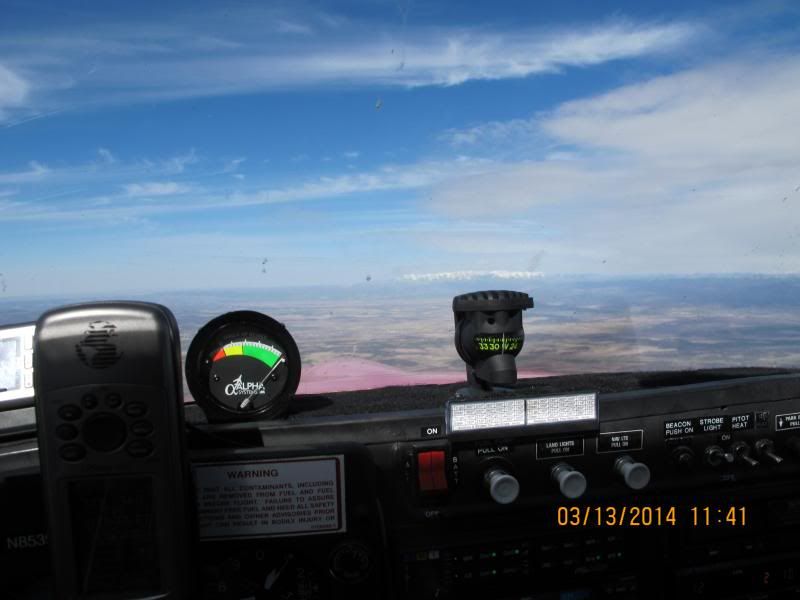
I've had the AOA indicator just about 5 years and +/- 325 hours. When flying close to gross, the airspeed is just about Cessna book. When flying light like I usually do (just me and dog and survival kit and a few other odds & ends), my finals are much slower, my touchdown speed is lower, my roll-outs are shorter, and there's less wear on my tires and brakes.
Nobody is required to own one or to use one. That's your choice, but for me, it's a safety benefit. The FAA seems to agree: http://www.alphasystemsaoa.com/assets/P ... Letter.pdf.
If I were to ever buy another airplane, one of the first additions will be an AOA indicator.
Cary
I've had the AOA indicator just about 5 years and +/- 325 hours. When flying close to gross, the airspeed is just about Cessna book. When flying light like I usually do (just me and dog and survival kit and a few other odds & ends), my finals are much slower, my touchdown speed is lower, my roll-outs are shorter, and there's less wear on my tires and brakes.
Nobody is required to own one or to use one. That's your choice, but for me, it's a safety benefit. The FAA seems to agree: http://www.alphasystemsaoa.com/assets/P ... Letter.pdf.
If I were to ever buy another airplane, one of the first additions will be an AOA indicator.
Cary
"I have slipped the surly bonds of earth..., put out my hand and touched the face of God." J.G. Magee
Sun Dec 21, 2014 1:50 pm
Re: Poor Man's AOA?
Yes .... seeing as the argument appears to have begun...

I'll also chip in for the affirmative, although I never look at my AoA, because it's audible.
Without one, I don't think someone can honestly be sure how close they are to stalling under different conditions. Not saying it's unsafe, just that some approaches will have a smaller safety factor than others, when flying seat of the pants.
Its more than variable weight, other variables are power, airspeed, flap, bank/turns, plus weather like turbulence, variable wind speed, thermals... etc. I don't think anyone can fly "seat of the pants" through those variables with the same precision / safety factor each time, not right on the ragged edge.
Yesterday was a nice example, in the morning I flew a 40kts approach into 15kts headwind with basically zero AoA variation. In the afternoon I flew the same approach, and the winds had changed character. I needed 45kts to have the same small margin over the stall, at the worst moments, due to turbulence in the wind. I could have guessed at the wind, but I might have made a mistake. I have no way of seeing it or knowing exactly what it's doing 100ft above the trees.
I'll also chip in for the affirmative, although I never look at my AoA, because it's audible.
Without one, I don't think someone can honestly be sure how close they are to stalling under different conditions. Not saying it's unsafe, just that some approaches will have a smaller safety factor than others, when flying seat of the pants.
Its more than variable weight, other variables are power, airspeed, flap, bank/turns, plus weather like turbulence, variable wind speed, thermals... etc. I don't think anyone can fly "seat of the pants" through those variables with the same precision / safety factor each time, not right on the ragged edge.
Yesterday was a nice example, in the morning I flew a 40kts approach into 15kts headwind with basically zero AoA variation. In the afternoon I flew the same approach, and the winds had changed character. I needed 45kts to have the same small margin over the stall, at the worst moments, due to turbulence in the wind. I could have guessed at the wind, but I might have made a mistake. I have no way of seeing it or knowing exactly what it's doing 100ft above the trees.
Last edited by Battson on Sun Dec 21, 2014 4:33 pm, edited 1 time in total.

Sun Dec 21, 2014 1:54 pm
Re: Poor Man's AOA?
I feel like an AoA would be a handy tool to use. Just my opinion.
- CamTom12 offline

- Posts: 3705
- Joined: Sun Jul 08, 2012 1:08 pm
- Location: Huntsville
- FindMeSpot URL: https://share.delorme.com/camtom12
- Aircraft: Ruppe Racer
Experimental Pacer
home hand jam "wizard"
Sun Dec 21, 2014 5:36 pm
Re: Poor Man's AOA?
...I'll take proficiency, through development of the original bio mechanical feedback interface device that is OEM in every pilot,enhanced by an increased carbon footprint 
Sun Dec 21, 2014 5:39 pm
Re: Poor Man's AOA?

+1
Gump
Sun Dec 21, 2014 7:37 pm
Re: Poor Man's AOA?
I think my OEM "bio mechanical feedback interface device" works pretty well, but I still like my AOA indicator. If I were to do it again, however, I'd have a slightly fancier one that is lit at night, since I can't see mine at night.
But each to their own--no need to get out the popcorn.
Speaking of which, I'll start a new thread about a popcorn popper that I'm totally infatuated with--it is SUPERB!
Cary
But each to their own--no need to get out the popcorn.
Speaking of which, I'll start a new thread about a popcorn popper that I'm totally infatuated with--it is SUPERB!
Cary
"I have slipped the surly bonds of earth..., put out my hand and touched the face of God." J.G. Magee
Sun Dec 21, 2014 8:48 pm
Re: Poor Man's AOA?
Cary wrote:Speaking of which, I'll start a new thread about a popcorn popper that I'm totally infatuated with--it is SUPERB!
Cary
I declare this thread a success!

Thu Jan 08, 2015 5:31 pm
Re: Poor Man's AOA?
lesuther wrote:
Unless the demand is there, it just hasn't penciled out very well to make it an obviously good way to spend more of my time.
Man, good on you! I make the FAA approved CYA-100, and I say the more competition the merrier! These things save lives, and if you can convince the Feds that your unit is good, then have at it. Jumping through the FAA hoops is NOT easy, although I'll give them kudos for their "fast pass" process for certifying AoA devices, and I'll warn you that any wireless device is going to get serious scrutiny (others have attempted wireless remote ELT switches without success). I'm not trying to discourage you, or anyone, but a "gee, look what I can do" won't cut it. It's an up-hill battle all the way.
Rip
Fri Jan 09, 2015 4:53 am
Re: Poor Man's AOA?
Have any of you AOA owners used the device to enhance a canyon turn? That seems like a flight regime where it might really shine. Curious.
- flyingzebra offline

- Posts: 479
- Joined: Sat Jan 24, 2009 4:53 am
- Location: Northwest Washington state
- Aircraft: Cessna Skylane 182 N3440S, Aviat Husky N2918L
Fri Jan 09, 2015 6:32 am
Re: Poor Man's AOA?
How about the dreaded "downwind turn"? 
- flynbeekeeper offline
- Posts: 372
- Joined: Fri Oct 19, 2007 8:01 pm
- Location: southern colorado
Tom
DISPLAY OPTIONS
Who is online
Users browsing this forum: No registered users and 0 guests
Latest Features
-
Live to Tell
A Minnesota pilot is surprised to learn that the sudden asymmetric drag of an out-of-rig ski can…Read More -
Creators
Working in some of the Yukon's most beautiful and remote environments, photographer Simon Blakesley captures aircraft in…Read More -
Aircraft Ownership and Maintenance
Upgrading to big tires can make a huge difference in backcountry performance, but with those gains come…Read More -
Tales from Yesteryear
In this tale from bush flying yesteryear, Don Cogger signs up to help Atlee Dodge Jr recovery…Read More


Latest Knowledge Base
-
Destinations
A regional guide with ideas for winter camping destinations in California, Nevada, New Mexico, and Arizona.Read More -
Aircraft
Finding an affordable aircraft that can handle the backcountry for $80K or less? A challenge for sure, but with the…Read More -
Aircraft
01.29.2018 - Zane - Updated tire diameter graphic to add 8.50x10 Guide to tires for use in the backcountry and off-airport landing…Read More -
Pilots
12.22.2013 - Initial article format Operating aircraft on skis and negotiating a snow-covered landscape is an entirely unique skillset and environment.…Read More


