I found this online for you. I have referred to these half hitches as hurricane knots because that's how they were described to me about 30 years ago.
http://www.flymafc.com/docs/Tiedown-Knots.pdf
I have fly ties but only use them when there is no preexisting ground anchor point. Otherwise I have other rope in the plane that I use on most occasions.
Gust locks are easy to make. They are also relatively easy to purchase if you bring $$$.
Don't know what type of plane you fly, but I had Burl gust locks for the cub and they worked well for the wings. I had one for each wing that fit between the aileron and flap. For the horizontal, I used two pieces of plywood boards about 8" x 8" with a center hole drilled through them. A long bolt and a wing nut is used for assembly and the bolt is placed in the space between the horizontal stabilator and the elevator. For the rudder (not as practical for traveling) I used 2 2x4s with foam glued to the inner aspects. Keep one end secured and pass it over the vertical from the rear of the plane. Then fasten the pieces nearest you.
Here is a link to burl http://www.burlac.com/Mics_Fab_Items.html
Tie Downs
Tue Apr 29, 2014 9:11 am

Tue Apr 29, 2014 9:21 am
Re: Tie Downs
Oh, wanted to mention that you may want to throw some duckbill anchors in your stash if you should ever end up in a bad windstorm. When you absolutely need help holding the plane, there is no portable system that will perform better. You just can't easily take them with you once installed. They are sort of the transition tiedowns between permanent and portable.
Tue Apr 29, 2014 9:30 am
Re: Tie Downs
Squash wrote:Oh, wanted to mention that you may want to throw some duckbill anchors in your stash if you should ever end up in a bad windstorm. When you absolutely need help holding the plane, there is no portable system that will perform better. You just can't easily take them with you once installed. They are sort of the transition tiedowns between permanent and portable.
Thanks for the reminder on these. I've been trying to remember them all morning.
- rw2 offline
- Posts: 1799
- Joined: Sat Dec 22, 2012 1:10 pm
- Location: San Miguel de Allende
- FindMeSpot URL: https://share.delorme.com/LaNaranjaDanzante
- Aircraft: Experimental Maule
Follow my Flying, Cooking and Camping adventures at RichWellner.com
Tue Apr 29, 2014 11:03 am
Re: Tie Downs
I have never liked the gust locks that sandwich control surfaces together. My flaps and ailerons have evidence of damage in the past by someone doing this. I just pull the yokes aft and secure both with the seat belts, super easy and no extra equipment required. To secure the rudder, I have a length of half inch tubular nylon. It has a truckers hitch on one side. I route around the elevator hinge on one side and pull the lose end through the truckers hitch. I then deflect the rudder to the stop opposite of where the wind is blowing from, go over top of the tail nav light then secure the line to the tube that connects the elevators. This keeps the rudder from banging against the stop. Super easy to do and doesn't take up any space or weight carrying it in the plane. I'd post a pic if my airplane wasn't apart.
Tue Apr 29, 2014 2:06 pm
Re: Tie Downs
There is an AC or some other guidance available on tying down aircraft. I just can't find it right now... it's been posted on BCP before.

Tue Apr 29, 2014 2:15 pm
Re: Tie Downs
Crzyivan13 wrote:This may be helpful. This is probably the test that G44 was referring to.
Seems to me that if you're going to pull straight upwards for the test, you're assuming the pilot hasn't followed the correct procedure for tying down. If the force is applied at an angle, like in a correctly tied down set up, the picket could withstand a higher total loading.
Wed Apr 30, 2014 5:53 pm
Re: Tie Downs
Actually, the FAA in Alaska a number of years ago ran a series of tests to determine the best location for tiedowns, and thus the best angle for tiedowns ropes. This was done by pulling the tiedowns to failure and measuring pull with a strain gauge.
Turned out that the best strength resulted from keeping the tiedowns rings right above the in earth tiedowns....ie: a straight (vertical) pull.
MTV
Turned out that the best strength resulted from keeping the tiedowns rings right above the in earth tiedowns....ie: a straight (vertical) pull.
MTV

Wed Apr 30, 2014 6:25 pm
Re: Tie Downs
I guess that depends on the type of picket used. I know with mine, that's not the case.
Certain FAA guidance specifies having the pickets outboard and forward / aft of the wing, for different reasons I suppose. Of course I can never find the document when I want to, but someone's posted it here before.
Certain FAA guidance specifies having the pickets outboard and forward / aft of the wing, for different reasons I suppose. Of course I can never find the document when I want to, but someone's posted it here before.
Wed Apr 30, 2014 7:49 pm
Re: Tie Downs
Battson wrote:Crzyivan13 wrote:This may be helpful. This is probably the test that G44 was referring to.
Seems to me that if you're going to pull straight upwards for the test, you're assuming the pilot hasn't followed the correct procedure for tying down. If the force is applied at an angle, like in a correctly tied down set up, the picket could withstand a higher total loading.
As a C-130 Loadmaster they teach us a lot about tying crap down, including calculating restraint. Of course im talking about restraining cargo inside of a plane, but the principles will be the same for securing an airplane to the ground. I'm not gonna get into the formulas and chain length versus effective length, although it's pretty simple. But basically if you want the most VERTICAL restraint, the tiedown will be positioned directly below the tiedown ring on the strut. However, this won't give you any forward, aft, or lateral restraint. Start moving the tiedown sideways and you will be adding lateral restraint and losing vertical restraint at the same time. The same principle applies to moving the tie down forward or aft, you will gain forward or aft restraint and lose vertical restraint. When we secure cargo in the Herk we want to find an angle that will provide us with sufficient forward, aft, and lateral restraint based on different G load requirements for each. The primary concern with tying down an airplane to the ground is to keep the wings from lifting the plane (vertically) and blowing it over. This is why I think some tie down manufacturers recommend placing the tie down directly below the attach point on the strut.
Wed Apr 30, 2014 8:58 pm
Re: Tie Downs
In a tandem plane with sticks, I like to tie the rear stick forward to the back of the front seat. Helps keep the tail down in a blow, and the elevator drain holes are down to let moisture out.
- Coyote Ugly offline
- Posts: 897
- Joined: Thu Jan 03, 2008 9:51 pm
- Location: Middle of Nevada (Middle of Nowhere?)
Wed Apr 30, 2014 9:54 pm
Re: Tie Downs
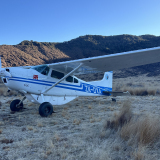
I am an absolute fan of external gust locks. I have had the rudder damaged and the aileron pushrods bent in a storm using only the internal control column lock (C180) when parked tail into the wind. It was not flyable afterward. Some tail dragger people will tell you to park tail into wind so that the airflow will not create lift and will in fact have the opposite effect. Wrong!!!! That is the best way to damage your controls. They are designed to take 200 knots or more on the nose, not so going backwards. If you leave it for any length of time tied down without knowing which direction it might blow you had better have external gust locks on all controls surfaces. Easy to make and even easier to buy. As for tie downs, a homemade copy of Fly Ties.
Thu May 01, 2014 5:34 am
Re: Tie Downs
+1
If out where it's gonna blow, I'll lock the control yoke with a clamp I bought from Spruce.

And I put a surface lock on both ailerons and the rudder.
And it it's REALLY gonna blow. I park my ass with the airplane and babysit until things settle down (if I can).

Gump
If out where it's gonna blow, I'll lock the control yoke with a clamp I bought from Spruce.
And I put a surface lock on both ailerons and the rudder.
And it it's REALLY gonna blow. I park my ass with the airplane and babysit until things settle down (if I can).
Gump
Thu May 01, 2014 7:41 am
Re: Tie Downs
For years in the 170, I used an internal gust lock that extended between the rudder pedals and the yoke, then stretched out and locked with a friction nut. I don't have a photo, and I'm not sure where I got it, but it worked fine for at least fifteen years when the airplane lived outdoors 24/7.
Ditto on the notion of keeping the pointy end into the wind.....I wound up holding up a cub wing, which the owner had parked tail into the prevailing wind....the aft wing strut collapsed. A city cop came by, ran and grabbed a 2x4 which we then strapped to that strut.
MTV
Ditto on the notion of keeping the pointy end into the wind.....I wound up holding up a cub wing, which the owner had parked tail into the prevailing wind....the aft wing strut collapsed. A city cop came by, ran and grabbed a 2x4 which we then strapped to that strut.
MTV
Thu May 01, 2014 8:41 am
Re: Tie Downs
Coyote Ugly wrote:In a tandem plane with sticks, I like to tie the rear stick forward to the back of the front seat. Helps keep the tail down in a blow, and the elevator drain holes are down to let moisture out.
I prefer this method also for the above reason. I had a two pilot crew flying, stopped for lunch, second pilot secured the airplane and went home. Single pilot got back in to fly, taxied to run up, at run up did the control wheel check and found that the other pilot had seat belted the control stick in the back seat! Thank goodness he was doing his checklist. After hearing this, I also secure the back stick to the front seat belt keeping the tail down and an additional safety check.
- Superdan00 offline
- Posts: 59
- Joined: Tue Dec 11, 2012 9:41 pm
- Location: Lexington
- FindMeSpot URL: https://share.delorme.com/DanielKeller#
- Aircraft: Found Aircraft Company Bushhawk FBA-2C2
Aviat Husky A1C-200
Columbia 400
Found FBA-2c2
Bush Hawk XP
Bushhawk
Thu May 01, 2014 1:42 pm
Re: Tie Downs
Another thought related to tie downs; I carry an old army surplus trenching tool when I am away from home. I have excavated pits about axle deep to roll the mains into to make up for difficult tie down conditions. The pits reduce angle of attack for less lift and they stop the plane from walking around in the wind. It helps to have a buddy to push the plane out after you dig ramps. I've also used the trenching tool to dig in deadman anchors (pick a rock or stout stick), which can be more effective than duckbills if buried deep enough.
Beeman
Thu May 01, 2014 3:28 pm
Re: Tie Downs
I use fly-ties, straight down under the wing with the rope they supplied. It could be about a foot longer since we put the 8.50's on.
My uncle killed himself in a rv6 by pulling the right side stick back and securing it to the seat with the seat belt when he tied down at a fly-in. When he got back in, he put the bag he was carrying in the right seat, covering up the stick and seat belt. He did a quick pre-flight (he was trying to leave before they closed the airport for the air-show) and took off. The stick was loose enough to wiggle back and forth, and since he taxied with the stick back he never noticed the other stick was still held back by the seat belt. On take-off he flew straight up in the air, stalled, and returned to the ground, bursting into flames. I always make sure that I can see any gust-locks or yoke locks when I tie down. I use long bright red yarn on the bottoms of my gust locks so I don't miss them. If I do hold the yoke back with the seatbelt, I always do it on the pilots side. That being said, I ran over a set of wheel chocks on Catalina Island trying to get out in a hurry to beat building clouds.
My uncle killed himself in a rv6 by pulling the right side stick back and securing it to the seat with the seat belt when he tied down at a fly-in. When he got back in, he put the bag he was carrying in the right seat, covering up the stick and seat belt. He did a quick pre-flight (he was trying to leave before they closed the airport for the air-show) and took off. The stick was loose enough to wiggle back and forth, and since he taxied with the stick back he never noticed the other stick was still held back by the seat belt. On take-off he flew straight up in the air, stalled, and returned to the ground, bursting into flames. I always make sure that I can see any gust-locks or yoke locks when I tie down. I use long bright red yarn on the bottoms of my gust locks so I don't miss them. If I do hold the yoke back with the seatbelt, I always do it on the pilots side. That being said, I ran over a set of wheel chocks on Catalina Island trying to get out in a hurry to beat building clouds.
- amacbean offline

- Posts: 544
- Joined: Mon Aug 08, 2005 3:22 pm
- Location: Springville
- FindMeSpot URL: http://share.findmespot.com/shared/face ... 7GsCKYBvNX
- Aircraft: Cessna 170b
Thu May 01, 2014 4:43 pm
Re: Tie Downs
home made claw...

- chosstronaut offline

- Posts: 543
- Joined: Thu Apr 05, 2012 5:07 pm
- Location: Corvallis
- FindMeSpot URL: http://share.findmespot.com/shared/face ... 9a7NU2UfGC
- Aircraft: Savannah
Tyler Adams, aka Chosstronaut, perished in a mid-air collision October 12, 2014. He was an enthusiastic and beloved contributor and he will be missed greatly.
Thu May 01, 2014 10:02 pm
Re: Tie Downs
WoooHoooo! The UPS man brought my Flyties today, complete with the nice little bag which I see as just right for a few emergency tools. Thanks for so many clear endorsements of a product. Next it's off to procure a Pool noodle for a clever gust lock idea I saw somewhere. Will post some pics if I can find them again or maybe just take some of my own once I make 'em.
SD
SD
- Straydog offline
- Posts: 154
- Joined: Thu Aug 30, 2012 12:23 pm
- Location: Inchelium
- FindMeSpot URL: https://maps.findmespot.com/s/6KPK
- Aircraft: Stinson 108-1/220
Thu May 01, 2014 10:11 pm
Re: Tie Downs
I've used "the claw" for about 8 years, along with nylon tie-down straps, without any problems, in a variety of soils and in some horrendous winds. I also chock the mains. If the airplane will sit outside for very long and I'm anticipating lots of wind, I also have some Kennon wing covers with spoilers on them, and I supplement the nylon straps with nylon ropes using a hurricane knot. I was taught how to use that knot by the old boy that ran the FBO at Evanston, WY, many years ago--he called it a running lock knot, but it's the same as a hurricane knot or the midshipman's knot. It won't come loose on its own.
I use Kennon external gust locks between the ailerons and flaps, which work well, too. I've been using an Air Gizmo gust lock on the tail, but I'm not happy with it. I think I'm going to build a gust lock for the tail with a couple of padded 1x2s to sandwich the tail between them.
If you use chains somewhere, snug them very tight, so that there's no slack. It's the slack which causes damage, not the chains themselves. We used chains in Laramie, and as long as they were tight, no problems. One day a fellow flew in, in a really nice 170, on a rare calm day. He did a really sloppy job of chaining it down. When he came into the FBO, I suggested he might want to snug up the chains some because the wind was likely to pick up, but he swore at me and essentially told me to mind my own business in pretty vile language (this being a "family site" populated by innocent folk, I won't quote him ). If he'd treated me better, I would have retied his airplane myself, but I left it alone. Well, the wind did come up. When I left the FBO that afternoon, the 170 was rocking in the wind, with the chains banging. The next morning I was taking a charter, so I was out there early. The 170 was still tied down, but with a bent left wing and strut.
Cary
I use Kennon external gust locks between the ailerons and flaps, which work well, too. I've been using an Air Gizmo gust lock on the tail, but I'm not happy with it. I think I'm going to build a gust lock for the tail with a couple of padded 1x2s to sandwich the tail between them.
If you use chains somewhere, snug them very tight, so that there's no slack. It's the slack which causes damage, not the chains themselves. We used chains in Laramie, and as long as they were tight, no problems. One day a fellow flew in, in a really nice 170, on a rare calm day. He did a really sloppy job of chaining it down. When he came into the FBO, I suggested he might want to snug up the chains some because the wind was likely to pick up, but he swore at me and essentially told me to mind my own business in pretty vile language (this being a "family site" populated by innocent folk, I won't quote him
). If he'd treated me better, I would have retied his airplane myself, but I left it alone. Well, the wind did come up. When I left the FBO that afternoon, the 170 was rocking in the wind, with the chains banging. The next morning I was taking a charter, so I was out there early. The 170 was still tied down, but with a bent left wing and strut.Cary
"I have slipped the surly bonds of earth..., put out my hand and touched the face of God." J.G. Magee
DISPLAY OPTIONS
Who is online
Users browsing this forum: No registered users and 0 guests
Latest Features
-
Live to Tell
A Minnesota pilot is surprised to learn that the sudden asymmetric drag of an out-of-rig ski can…Read More -
Creators
Working in some of the Yukon's most beautiful and remote environments, photographer Simon Blakesley captures aircraft in…Read More -
Aircraft Ownership and Maintenance
Upgrading to big tires can make a huge difference in backcountry performance, but with those gains come…Read More -
Tales from Yesteryear
In this tale from bush flying yesteryear, Don Cogger signs up to help Atlee Dodge Jr recovery…Read More


Latest Knowledge Base
-
Destinations
A regional guide with ideas for winter camping destinations in California, Nevada, New Mexico, and Arizona.Read More -
Aircraft
Finding an affordable aircraft that can handle the backcountry for $80K or less? A challenge for sure, but with the…Read More -
Aircraft
01.29.2018 - Zane - Updated tire diameter graphic to add 8.50x10 Guide to tires for use in the backcountry and off-airport landing…Read More -
Pilots
12.22.2013 - Initial article format Operating aircraft on skis and negotiating a snow-covered landscape is an entirely unique skillset and environment.…Read More


