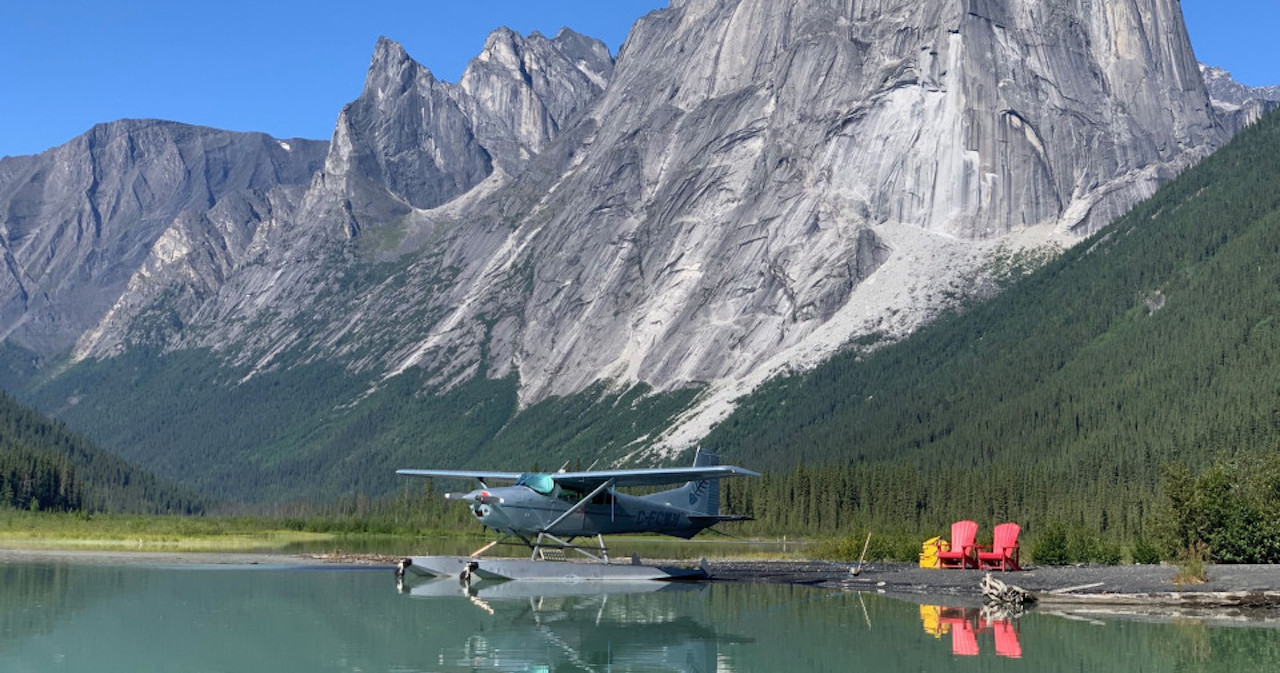
Which amphib floats can handle off field landings?
Wed Mar 11, 2015 9:24 am
Re: Which amphib floats can handle off field landings?
That is why I posted, I have zero float experience and looking for expertise. I saw it as an engineering exercise, floats attached to the main gear mono spring, nose gear large and with travel, gave me the impression that for terra firma landings it would behave like a regular tricycle gear with storage pods (the floats). On the water I would expect softer landings due to the floats having travel.
- deckofficer offline

- Posts: 225
- Joined: Sun Nov 24, 2013 2:10 pm
- Location: 1st Aero Squadron Airpark NM09, New Mexico
Bob
Wed Mar 11, 2015 9:32 am
Re: Which amphib floats can handle off field landings?
mtv wrote:deckofficer wrote:I've seen a video on the gear retraction. It extends to clear a collar then folds back. Couldn't find that video but found another not as good.
https://www.youtube.com/watch?v=tIAabjNMrSw
Interesting. My bad. I could swear I've seen one of those things some years ago that landed with the nose gear fixed.
In any case, that retraction mechanism looks like a pretty serious weak point in the nose gear. But, if it collapsed, looks like the floats would prevent a prop strike on land.....
I still doubt this setup would stand much "off airport" use.
MTV
Deckofficer, thanks for posting the vid, cleared up some of the incorrect guessing on my end as well. Pic is worth 1,000 words, video worth 10,000???
- marcusofcotton offline


- Posts: 259
- Joined: Sun Jan 02, 2011 6:44 am
- Location: Northern MN
Fri Apr 03, 2015 1:38 pm
Re: Which amphib floats can handle off field landings?
Thank you all for your input. I've done some research in the month from starting this thread and feel the CH 701 just might be my choice for 1st plane ownership. My priorities are STOL, light sport, and the ability to get off the water even in high density altitudes like Lake Tahoe on a summer day. The one for sale that I posted the picture of is sale pending, so missed out on it. There are plenty of CH 701 flying, so used market is good even for the ones decked out with the Zenair floats. But to find one that has the Rotax 914 is pretty rare, so maybe I should have jumped on that one sooner. For a truly fun plane, the 914 with Zipper cylinders punches my ticket. The stock 914 in a CH 701 is good for 2050 fpm climb without floats, I would guess the 135 hp Zipper mod would maintain this rate of climb with the added weight of the floats.
Comments?
http://www.zenithair.com/kit-data/7-914.html
Comments?
http://www.zenithair.com/kit-data/7-914.html
- deckofficer offline
- Posts: 225
- Joined: Sun Nov 24, 2013 2:10 pm
- Location: 1st Aero Squadron Airpark NM09, New Mexico
Bob
Fri Apr 03, 2015 9:16 pm
Re: Which amphib floats can handle off field landings?
I think before you get your heart set on any float plane, you should learn to fly floats. I don't mean that as any kind of insult, but if I'm representative of those who thought about float flying for a long time before actually doing it, I had a lot of misconceptions. For one thing, I was not aware of just how much floats impact the performance of an airplane.
Two examples:
My first float flying experience was an intro training flight in BC at Pat Bay Air, out of Patricia Bay just west of the Victoria Airport. It was a 160hp 172 on straight floats. I have a lot of time in that model 172, mostly at high elevations, as that was the model we used as a trainer in Laramie when I was instructing. Well, let me tell you, although it ran very well and appeared to be in very good condition, that airplane was a dog at sea level compared to any of the 172s I flew at Laramie's 7377' elevation! The only reason was the floats. It climbed more slowly, and it cruised at a solid 85 mph IAS compared to 105 mph IAS.
Fast forward a couple of years to last summer, when I took my seaplane lessons and earned my SES. That was at Seattle Seaplanes, and the airplane was virtually a clone of mine. Mine's a P172D with an Avcon conversion, a Lycoming O-360 180hp with CS prop. The seaplane was a 172E with the same conversion, on straight floats. After putting roughly 700 hours on my airplane, I'm really familiar with its performance at everything from the elevation at OSH (800' MSL) in the summer to 15,000' MSL (winter--has to be pretty cool to climb that high). The seaplane had about the same performance at sea level as my airplane has had when I've flown to Laramie in moderately cool weather, with this exception: the "ground" run of the seaplane was much farther, easily 1 3/4 times, the ground run of my airplane at Laramie. According to the book, all things being equal, a seaplane should take 170% to 180% of a similar land plane in similar conditions, but my observation is that it's much longer than that. The seaplane cruised at 95 mph IAS; mine cruises at 115 mph IAS.
One of the DPE's scenarios that he wanted me to calculate was a hypothetical take off from Lake Tahoe on an 80 degree day (9000' DA). I had calculated it the night before, guessing at his weight, and he didn't ask me to calculate it during the oral. My calculations, assuming both of us were about 195 lbs., was that it would take just over a mile to get off the water, about 6000' run. When he told me that he actually weighed about 225, he was satisfied with my answer that it would take "way more than a mile" to get off the water.
Mike (MTV) is the resident float plane expert here, and he may have other ideas than this certificated neophyte, but I think he and the other experienced float planers here will agree, that even powerful float planes have much reduced performance compared to equal land planes. That's especially true at higher elevations.
Cary
Two examples:
My first float flying experience was an intro training flight in BC at Pat Bay Air, out of Patricia Bay just west of the Victoria Airport. It was a 160hp 172 on straight floats. I have a lot of time in that model 172, mostly at high elevations, as that was the model we used as a trainer in Laramie when I was instructing. Well, let me tell you, although it ran very well and appeared to be in very good condition, that airplane was a dog at sea level compared to any of the 172s I flew at Laramie's 7377' elevation! The only reason was the floats. It climbed more slowly, and it cruised at a solid 85 mph IAS compared to 105 mph IAS.
Fast forward a couple of years to last summer, when I took my seaplane lessons and earned my SES. That was at Seattle Seaplanes, and the airplane was virtually a clone of mine. Mine's a P172D with an Avcon conversion, a Lycoming O-360 180hp with CS prop. The seaplane was a 172E with the same conversion, on straight floats. After putting roughly 700 hours on my airplane, I'm really familiar with its performance at everything from the elevation at OSH (800' MSL) in the summer to 15,000' MSL (winter--has to be pretty cool to climb that high). The seaplane had about the same performance at sea level as my airplane has had when I've flown to Laramie in moderately cool weather, with this exception: the "ground" run of the seaplane was much farther, easily 1 3/4 times, the ground run of my airplane at Laramie. According to the book, all things being equal, a seaplane should take 170% to 180% of a similar land plane in similar conditions, but my observation is that it's much longer than that. The seaplane cruised at 95 mph IAS; mine cruises at 115 mph IAS.
One of the DPE's scenarios that he wanted me to calculate was a hypothetical take off from Lake Tahoe on an 80 degree day (9000' DA). I had calculated it the night before, guessing at his weight, and he didn't ask me to calculate it during the oral. My calculations, assuming both of us were about 195 lbs., was that it would take just over a mile to get off the water, about 6000' run. When he told me that he actually weighed about 225, he was satisfied with my answer that it would take "way more than a mile" to get off the water.
Mike (MTV) is the resident float plane expert here, and he may have other ideas than this certificated neophyte, but I think he and the other experienced float planers here will agree, that even powerful float planes have much reduced performance compared to equal land planes. That's especially true at higher elevations.
Cary
"I have slipped the surly bonds of earth..., put out my hand and touched the face of God." J.G. Magee
Sat Apr 04, 2015 1:49 am
Re: Which amphib floats can handle off field landings?
The answer to your question is simple. It depends on how gingerly you can place your landings down with precision. I flew puddle jumper amphibs into some pretty rough and stony strips with minimal problems. It amazes me how many people lack procession in their landings and end up thundering it down hard. This is where the mustard is cut sort of speak. What may seem a smooth landing on regular gear can be down right brutal on amphibs, and I'm talking any amphib, even conventional. They lack the ability to absorb much shock.
Your talking JC and the Sierra place, Well those are definitely not off airport in my books.
Zenair amphibians have had a reputation of having weak bulkheads where the gear was attached. I don't think it was the bulkheads, it was the pilots who lacked the ability to take into consideration the need to have good landing technique and respect for the inherent design of the amphib gear. Know your aircraft and fly with precision and you will have few restrictions... Just like that painter of piper guy, fast, low wing with shopping cart wheels. It don't stop him from playing with the big wheel guys,
Your talking JC and the Sierra place, Well those are definitely not off airport in my books.
Zenair amphibians have had a reputation of having weak bulkheads where the gear was attached. I don't think it was the bulkheads, it was the pilots who lacked the ability to take into consideration the need to have good landing technique and respect for the inherent design of the amphib gear. Know your aircraft and fly with precision and you will have few restrictions... Just like that painter of piper guy, fast, low wing with shopping cart wheels. It don't stop him from playing with the big wheel guys,
- Sidewinder offline
- Posts: 340
- Joined: Mon Sep 30, 2013 5:07 pm
- Location: SouthWest Kanada eh?
Sat Apr 04, 2015 9:27 am
Re: Which amphib floats can handle off field landings?
Thanks for the reply Cary and Sidewinder.
When asking experienced folks like you for input I should have included my mission profile for float flying. My retirement hangar home will be on a paved runway that is 1 mile from the lake. My intention, since I will be retired, is to practice, practice, and do some more practice, much as I did 30 years ago as a student pilot. As a student pilot I had hundreds of hours flying hang gliders where I never was comfortable with my launch and landings and now flying the club's Cessna 150/150 I was determined to practice my take offs and landings and did so at my home field, the small UL field, and the creek bed of the hg landing area. This paid off, I felt good with nailing the numbers and when the flying club had their contest day I wanted to enter but was told it wasn't open to student pilots. For the balloon burst and flour bomb drop, I could understand their logic, but for the spot landing contest I argued that this is something student pilots should be allowed. They let me participate only for the spot landing contest and I won it, first flying trophy.
Most of my water landings will be in my local area of 30 mile radius with elevations of 1900' MSL for the largest lake that is 1 mile from the paved runway to 5800' MSL at a distance of 30 miles. My hopes is as I get comfortable with the 5800' MSL lake, I can venture to Fallen Leaf Lake (1 mile south of Lake Tahoe) which is where I grew up every summer from 1954 to 1975. Back then float planes were popular at the lake, not so much now. I have very good friends that have a cabin and dock at the lake, so this is why I want to be a float pilot. Distance to the lake is 390 miles, and I know a CH 701 is slow but feel 390 miles is doable in a day.
The other part of the mission profile is to meet up with the fine folks here on the forum on some of their fly-ins in Oregon, Nevada, Idaho, and Washington.
Having no experience on floats, let alone floats at high density altitudes, I have come here to ask if flying in and out of Fallen Leaf Lake (6500' MSL) in the summer is doable with a CH 701 weighing 750 lbs empty and powered by the Rotax turbo 914 with Zipper cylinders for 135 hp? The only thing I have to go on is watching YouTube videos of the CH 701 on floats. This video is practicing take offs and landings with a 912S Rotax and it appears to me that even with just 100 hp it does rather well. Granted it is at close to sea level in Alaska, so probably cooler than a standard day. Might have been even shorter take offs with the water rudders retracted.
https://www.youtube.com/watch?v=A8c2gxlw0MU
When asking experienced folks like you for input I should have included my mission profile for float flying. My retirement hangar home will be on a paved runway that is 1 mile from the lake. My intention, since I will be retired, is to practice, practice, and do some more practice, much as I did 30 years ago as a student pilot. As a student pilot I had hundreds of hours flying hang gliders where I never was comfortable with my launch and landings and now flying the club's Cessna 150/150 I was determined to practice my take offs and landings and did so at my home field, the small UL field, and the creek bed of the hg landing area. This paid off, I felt good with nailing the numbers and when the flying club had their contest day I wanted to enter but was told it wasn't open to student pilots. For the balloon burst and flour bomb drop, I could understand their logic, but for the spot landing contest I argued that this is something student pilots should be allowed. They let me participate only for the spot landing contest and I won it, first flying trophy.
Most of my water landings will be in my local area of 30 mile radius with elevations of 1900' MSL for the largest lake that is 1 mile from the paved runway to 5800' MSL at a distance of 30 miles. My hopes is as I get comfortable with the 5800' MSL lake, I can venture to Fallen Leaf Lake (1 mile south of Lake Tahoe) which is where I grew up every summer from 1954 to 1975. Back then float planes were popular at the lake, not so much now. I have very good friends that have a cabin and dock at the lake, so this is why I want to be a float pilot. Distance to the lake is 390 miles, and I know a CH 701 is slow but feel 390 miles is doable in a day.
The other part of the mission profile is to meet up with the fine folks here on the forum on some of their fly-ins in Oregon, Nevada, Idaho, and Washington.
Having no experience on floats, let alone floats at high density altitudes, I have come here to ask if flying in and out of Fallen Leaf Lake (6500' MSL) in the summer is doable with a CH 701 weighing 750 lbs empty and powered by the Rotax turbo 914 with Zipper cylinders for 135 hp? The only thing I have to go on is watching YouTube videos of the CH 701 on floats. This video is practicing take offs and landings with a 912S Rotax and it appears to me that even with just 100 hp it does rather well. Granted it is at close to sea level in Alaska, so probably cooler than a standard day. Might have been even shorter take offs with the water rudders retracted.
https://www.youtube.com/watch?v=A8c2gxlw0MU
- deckofficer offline
- Posts: 225
- Joined: Sun Nov 24, 2013 2:10 pm
- Location: 1st Aero Squadron Airpark NM09, New Mexico
Bob
Sat Apr 04, 2015 2:47 pm
Re: Which amphib floats can handle off field landings?

Yes, Some fly-ins are to "off airport" locations where amphib floats are A-OK!

- Matt 7GCBC offline
- Posts: 330
- Joined: Fri Feb 11, 2005 11:12 pm
- Location: Northwest
- FindMeSpot URL: http://share.findmespot.com/shared/face ... vXLMMuZOv7
Sat Apr 04, 2015 3:42 pm
Re: Which amphib floats can handle off field landings?
First, let me state that I have zero experience with Zenith airplanes, other than watching them takeoo and land a few times.....
But, as Cary said, floats significantly and negatively effect the performance of any airplane. Amphibs are worse, simply because the floats are heavier than straight floats.....usually substantially heavier.
Now, add density altitude to that loss of performance, and you may have a plane that can land on that 5800 msl lake, but it can't take off. My only argument with Carys points is that the hypothetical takeoff scenario his examiner offered might in fact be a case where that airplane, on those floats, that day may not have been able to take off, period....no matter how much lake was available.
Float design, propeller performance, and wing design all play a MUCH larger role in launching a seaplane than they do on wheels.
An example: For nearly a year I was assigned a Cessna 185 on PeeKay 3500 B amphibious floats. These early PeeKays were hell for stout, but water takeoff performance was pretty bad. One day I landed in an ocean bay. Two aboard and 70 gallons or so of gas and survival gear.....light load. When I went to take off, a mile wasn't enough, but I had the whole Pacific, so I set sail for Hawaii, looking for a wave to bounce the thing off, which finally got us airborne. This was true glassy water, and those floats simply weren't inclined to go flying that day.
And, as Sidewinder pointed out, Amphibs on wheels can be hard on an airframe, but much of the abuse there comes from water work....remember, floats generally have no shock absorbers, so any wave action transmits a lot of forces right up the struts to the airframe.
Again, I know little about the Zeniths, but I can tell you that the density altitudes you're describing would be VERY challenging for any seaplane, even the highest performance ones around. Density altitude REALLY has a negative affect on seaplanes. The reason is that, for the airplane to take off, the wing has to accelerate to an airspeed very close to the stall speed. As density altitude increases, the effective stall speed of the wing increases, so to take off, the plane has to accelerate to a higher speed on the surface.
Any hull has, for lack of a better term, a "hull speed". The hull will accelerate to that speed fairly easily, but to accelerate beyond that speed something has to give.....you either have to apply huge amounts more thrust, or use some technique to reduce the amount of water drag on the floats.
And, if the floats hit their hull speed before the wing reaches its required flying speed......... You're a really expensive boat. That's what was happening with those early PeeKay floats on that 185. The later PeeKays are great floats, by the way.
The term hull speed really applies to displacement hulls, not planing hulls, as are used on floats, but the effect is similar, and it's very real.
To operate from the lakes you describe will require really superior seaplane performance. For years there was a Beaver operated from Tahoe. The Beaver is supercharged, so engine power remains at sea level, and the Beaver is a hell of a seaplane. That said, I understand they didn't operate on high DA days, and their loads were light. I doubt that plane would have launched there at max weight, but maybe.
Maybe the Zenith will do the trick. I think the only way you'll find out is to find someone with one and invite them to come demo. Might cost you some, but better to find out that way than to build one, then have to truck it home.
MTV
But, as Cary said, floats significantly and negatively effect the performance of any airplane. Amphibs are worse, simply because the floats are heavier than straight floats.....usually substantially heavier.
Now, add density altitude to that loss of performance, and you may have a plane that can land on that 5800 msl lake, but it can't take off. My only argument with Carys points is that the hypothetical takeoff scenario his examiner offered might in fact be a case where that airplane, on those floats, that day may not have been able to take off, period....no matter how much lake was available.
Float design, propeller performance, and wing design all play a MUCH larger role in launching a seaplane than they do on wheels.
An example: For nearly a year I was assigned a Cessna 185 on PeeKay 3500 B amphibious floats. These early PeeKays were hell for stout, but water takeoff performance was pretty bad. One day I landed in an ocean bay. Two aboard and 70 gallons or so of gas and survival gear.....light load. When I went to take off, a mile wasn't enough, but I had the whole Pacific, so I set sail for Hawaii, looking for a wave to bounce the thing off, which finally got us airborne. This was true glassy water, and those floats simply weren't inclined to go flying that day.
And, as Sidewinder pointed out, Amphibs on wheels can be hard on an airframe, but much of the abuse there comes from water work....remember, floats generally have no shock absorbers, so any wave action transmits a lot of forces right up the struts to the airframe.
Again, I know little about the Zeniths, but I can tell you that the density altitudes you're describing would be VERY challenging for any seaplane, even the highest performance ones around. Density altitude REALLY has a negative affect on seaplanes. The reason is that, for the airplane to take off, the wing has to accelerate to an airspeed very close to the stall speed. As density altitude increases, the effective stall speed of the wing increases, so to take off, the plane has to accelerate to a higher speed on the surface.
Any hull has, for lack of a better term, a "hull speed". The hull will accelerate to that speed fairly easily, but to accelerate beyond that speed something has to give.....you either have to apply huge amounts more thrust, or use some technique to reduce the amount of water drag on the floats.
And, if the floats hit their hull speed before the wing reaches its required flying speed......... You're a really expensive boat. That's what was happening with those early PeeKay floats on that 185. The later PeeKays are great floats, by the way.
The term hull speed really applies to displacement hulls, not planing hulls, as are used on floats, but the effect is similar, and it's very real.
To operate from the lakes you describe will require really superior seaplane performance. For years there was a Beaver operated from Tahoe. The Beaver is supercharged, so engine power remains at sea level, and the Beaver is a hell of a seaplane. That said, I understand they didn't operate on high DA days, and their loads were light. I doubt that plane would have launched there at max weight, but maybe.
Maybe the Zenith will do the trick. I think the only way you'll find out is to find someone with one and invite them to come demo. Might cost you some, but better to find out that way than to build one, then have to truck it home.
MTV


Sat Apr 04, 2015 5:15 pm
Re: Which amphib floats can handle off field landings?
MTV,
I agree, need to find a CH 701 or Savannah on floats for a high density demo. I was just hoping someone would chime in that has first hand experience with LSA amphibs that are in the 10.5 lb per hp range. I really want to believe that with the wing and fixed leading slats of the CH 701 combined with 135 hp, a climb prop and a solo weight of around 1200 lbs, that it would do well at Lake Tahoe summer conditions.
I agree, need to find a CH 701 or Savannah on floats for a high density demo. I was just hoping someone would chime in that has first hand experience with LSA amphibs that are in the 10.5 lb per hp range. I really want to believe that with the wing and fixed leading slats of the CH 701 combined with 135 hp, a climb prop and a solo weight of around 1200 lbs, that it would do well at Lake Tahoe summer conditions.
- deckofficer offline
- Posts: 225
- Joined: Sun Nov 24, 2013 2:10 pm
- Location: 1st Aero Squadron Airpark NM09, New Mexico
Bob
Sun Apr 05, 2015 8:53 am
Re: Which amphib floats can handle off field landings?
There is no way that 172 is getting off Tahoe on an 80 degree day , even with 22 miles of lake to work with . I know nothing of the 701 airplane but did know someone with a 100hp turbo two seater . He could get off the lake on cool days solo.I owned a turbo 185 and operated in Tahoe a lot . Even that thing sucked up here . It would do it but would take all day to get up and go even with edo 3500s'. Coming and going out of Fallen Leaf will be interesting in almost all seaplanes. 180hp cub on straights would be a plane that comes to mind for a comfortable operation in and out of a lake like fallen Leaf .

vail
Sun Apr 05, 2015 9:17 am
Re: Which amphib floats can handle off field landings?
+1
I used to fly Mike Brown's floatplanes at Homewood, and life was marginal during the summer months.
The Zenith looks interesting but I'd sure want some real life time in one, amphib or straight floats, before I invested time or money to see if it would actually work.
I used to fly Mike Brown's floatplanes at Homewood, and life was marginal during the summer months.
The Zenith looks interesting but I'd sure want some real life time in one, amphib or straight floats, before I invested time or money to see if it would actually work.
Sun Apr 05, 2015 9:24 am
Re: Which amphib floats can handle off field landings?
I've landed a Kitfox on Full Lotus floats with heavy, draggy outboard stainless steel retractable gear and a stout photographer on board, with a puny 80 HP normally aspirated Rotax, which at that DA was probably putting out about 50 hp. (See this link for more details: http://scottshotsphoto.blogspot.com/201 ... erial.html)
The "secret" is that I never came off the step and just took off again! I later did a full stop landing in nearby Boca reservoir and barely was able to get out of there with that setup (no passenger). At the time I had a fixed pitch wooden prop. I reckon that with the in flight adjustable IVO prop I later hung on it and with a 914 turbo, it would work fine up here.
Local amphib pilots operate out of Tahoe and Fallen Leaf with a Sea Rey with 914, a Lake Buccaneer (with micro aero VG's as the only performance mod), Super Cub, 185's, and my 182 with an IO 550. Even with that mighty 300 HP engine, the little Sea Rey gets off the water in half the distance I do!
I've never operated a Zenith but from the book numbers, with the 914, I think it would be fun up here!
As far as off-field, the wheel set up for Full Lotus floats has no suspension at all, so is not suitable for anything but smooth runways and very soft landing technique. My Aerocet 3400's have nice big oleo struts on the mains and spring gear nose wheel, but due to my weight and small nose tires, I will only land on smooth runways.
The local Buccaneer, Sea Rey, and the Seabee Warbird have landed at the High Sierra fly in the past two years with no problem. That lakebed is pretty smooth. I posted pictures of them there at 3SGS two years ago.
Hope to see you around Tahoe this summer! I'm looking at pulling the 29" ABW's in late May for the amphibs.
Pierre
The "secret" is that I never came off the step and just took off again! I later did a full stop landing in nearby Boca reservoir and barely was able to get out of there with that setup (no passenger). At the time I had a fixed pitch wooden prop. I reckon that with the in flight adjustable IVO prop I later hung on it and with a 914 turbo, it would work fine up here.
Local amphib pilots operate out of Tahoe and Fallen Leaf with a Sea Rey with 914, a Lake Buccaneer (with micro aero VG's as the only performance mod), Super Cub, 185's, and my 182 with an IO 550. Even with that mighty 300 HP engine, the little Sea Rey gets off the water in half the distance I do!
I've never operated a Zenith but from the book numbers, with the 914, I think it would be fun up here!
As far as off-field, the wheel set up for Full Lotus floats has no suspension at all, so is not suitable for anything but smooth runways and very soft landing technique. My Aerocet 3400's have nice big oleo struts on the mains and spring gear nose wheel, but due to my weight and small nose tires, I will only land on smooth runways.
The local Buccaneer, Sea Rey, and the Seabee Warbird have landed at the High Sierra fly in the past two years with no problem. That lakebed is pretty smooth. I posted pictures of them there at 3SGS two years ago.
Hope to see you around Tahoe this summer! I'm looking at pulling the 29" ABW's in late May for the amphibs.
Pierre
- Pierre_R offline

- Posts: 313
- Joined: Mon Sep 30, 2013 3:17 am
- Location: Minden, Northern Nevada
- FindMeSpot URL: https://share.findmespot.com/shared/fac ... 5KFquxzBYq
- Aircraft: 1964 C182 IO550 on Aerocet 3400's.
Aerotrek A220.
TBM 850
Sun Apr 05, 2015 12:11 pm
Re: Which amphib floats can handle off field landings?
Input from those that have been there, done that, is greatly appreciated. About 50 years ago seems to have been the heyday for seaplanes on Fallen Leaf Lake but I do remember they were gone after the cool AM hours. I've thought about the Searey because a lot of them have the 914, but the landing gear looks a tad fragile for unimproved strips. The 701 with Zenair amphibious floats use the main gear spring and a large nosewheel with decent travel so I think would be better than the Searey for dirt landings.
I think the wing on the 701 is its saving grace for short, low speed rotation and I'm more than willing to give up cruise speed for this dirty, high lift, full leading edge fixed slats wing.
My logic (and maybe failed logic) is if I'm accepting of sub par performance in regards to cruise speed and economy by using such a wing and climb pitched prop, and the 1417 cc Zipper cylinders that shave a few pounds off the turbo 914 and bumps the hp from 115 to 135, I'm at least giving myself a chance of having above par high DA performance. The folks on this forum that have used the Zipper cylinders have very positive reviews of the power increase and cooler running.
I think the wing on the 701 is its saving grace for short, low speed rotation and I'm more than willing to give up cruise speed for this dirty, high lift, full leading edge fixed slats wing.
My logic (and maybe failed logic) is if I'm accepting of sub par performance in regards to cruise speed and economy by using such a wing and climb pitched prop, and the 1417 cc Zipper cylinders that shave a few pounds off the turbo 914 and bumps the hp from 115 to 135, I'm at least giving myself a chance of having above par high DA performance. The folks on this forum that have used the Zipper cylinders have very positive reviews of the power increase and cooler running.
- deckofficer offline
- Posts: 225
- Joined: Sun Nov 24, 2013 2:10 pm
- Location: 1st Aero Squadron Airpark NM09, New Mexico
Bob
Sun Apr 05, 2015 12:26 pm
Re: Which amphib floats can handle off field landings?
BTW Pierre, just came back from your scottshots link, great article and photography of my old stomping grounds. I taught at Squaw Valley from 1971 to 1980 and lived at Donner Lake. My nephew lives there now. Also, are you the one that flew from somewhere in the Midwest to Truckee in a newly purchased Light Sport plane? If memory serves, some gear trouble after a landing and some amazing high altitude flying.
- deckofficer offline
- Posts: 225
- Joined: Sun Nov 24, 2013 2:10 pm
- Location: 1st Aero Squadron Airpark NM09, New Mexico
Bob
Sun Apr 05, 2015 1:17 pm
Re: Which amphib floats can handle off field landings?
Another thing to remember: seaplanes only land or take off at a given attitude, give or take a few degrees, so high lift devices like slats that rely on high AOA are not as effective. At least not until you can break water and employ a higher AOA.
Sun Apr 05, 2015 1:37 pm
Re: Which amphib floats can handle off field landings?
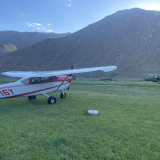
Some additional thoughts, just about density altitude.
Since most of my flying career has been at high DAs, I'm more accustomed to marginal performance than I am to good performance. The first time I flew out of a field at an actual 1000' MSL, on an 80 degree day that made the DA about 2500', I was almost overwhelmed with the extra performance of our fully loaded Skylane. I was accustomed to leaving the throttle full in and only cranking the prop back for cruise--now I actually had to bring the MP down to 25 inches!
I'm often surprised at my current airplane's performance at lower elevations. My annual trips to OSH are about the only time I have much low elevation experience with it. When I see 1200 fpm climb fully loaded coming out of OSH or DBQ, it seems unreal--that nearly 180 hp for real and CS prop biting all that thick air doesn't seem like my airplane!
When I was instructing in 160 hp 172s in Laramie, our summer time performance with just 2 aboard was relatively marginal--300 fpm climb outs were possible in the morning, but as the day progressed, so did the climb rate deteriorate. By early afternoon, 200 fpm was the norm.
One time my step-bro and his wife came out from the Detroit area. Although like I had, both of them had grown up in Cheyenne and were schooled in Laramie, his piloting experience was all at Detroit's environs. We piled into a fairly new 160hp 172 with half tanks to go sight-seeing, on an 85 degree day--warm for Laramie. That put the DA up around 10,500' or greater. Our take off roll was about 3500', and we climbed out at between 150 and 200 fpm. Shortly after take off, he asked, "What's wrong with the airplane?" I said "nothing--it's pretty normal." Long story short, he was shocked at the lack of performance.
I guess what I'm trying to get across is that if you're accustomed to the highest DA being around 5200', and you go to Tahoe where the DA can be 9500' or more, the difference in performance is beyond dramatic. Even turbo charging doesn't make up the difference, because there's still substantially less lift and less propeller efficiency. Add to that mix retractable floats, and it's a recipe for potential disaster, I think. There are likely to be days in which you just can't fly.
All that FWIW.
Cary
Since most of my flying career has been at high DAs, I'm more accustomed to marginal performance than I am to good performance. The first time I flew out of a field at an actual 1000' MSL, on an 80 degree day that made the DA about 2500', I was almost overwhelmed with the extra performance of our fully loaded Skylane. I was accustomed to leaving the throttle full in and only cranking the prop back for cruise--now I actually had to bring the MP down to 25 inches!
I'm often surprised at my current airplane's performance at lower elevations. My annual trips to OSH are about the only time I have much low elevation experience with it. When I see 1200 fpm climb fully loaded coming out of OSH or DBQ, it seems unreal--that nearly 180 hp for real and CS prop biting all that thick air doesn't seem like my airplane!
When I was instructing in 160 hp 172s in Laramie, our summer time performance with just 2 aboard was relatively marginal--300 fpm climb outs were possible in the morning, but as the day progressed, so did the climb rate deteriorate. By early afternoon, 200 fpm was the norm.
One time my step-bro and his wife came out from the Detroit area. Although like I had, both of them had grown up in Cheyenne and were schooled in Laramie, his piloting experience was all at Detroit's environs. We piled into a fairly new 160hp 172 with half tanks to go sight-seeing, on an 85 degree day--warm for Laramie. That put the DA up around 10,500' or greater. Our take off roll was about 3500', and we climbed out at between 150 and 200 fpm. Shortly after take off, he asked, "What's wrong with the airplane?" I said "nothing--it's pretty normal." Long story short, he was shocked at the lack of performance.
I guess what I'm trying to get across is that if you're accustomed to the highest DA being around 5200', and you go to Tahoe where the DA can be 9500' or more, the difference in performance is beyond dramatic. Even turbo charging doesn't make up the difference, because there's still substantially less lift and less propeller efficiency. Add to that mix retractable floats, and it's a recipe for potential disaster, I think. There are likely to be days in which you just can't fly.
All that FWIW.
Cary
"I have slipped the surly bonds of earth..., put out my hand and touched the face of God." J.G. Magee
Mon Apr 06, 2015 7:07 pm
Re: Which amphib floats can handle off field landings?
Since most of my flying career has been at high DAs
Oh brother, talk about a wannabe .......... reminds me of the characters who get thrown out of the military for being unfit to serve and later go around telling everyone who will listen that they are highly decorated veterans.
What a bag of B.S.
Oh brother, talk about a wannabe .......... reminds me of the characters who get thrown out of the military for being unfit to serve and later go around telling everyone who will listen that they are highly decorated veterans.
What a bag of B.S.

Mon Apr 06, 2015 7:32 pm
Re: Which amphib floats can handle off field landings?
DonV wrote:Since most of my flying career has been at high DAs
Oh brother, talk about a wannabe .......... reminds me of the characters who get thrown out of the military for being unfit to serve and later go around telling everyone who will listen that they are highly decorated veterans.
What a bag of B.S.
???? Post #1 and you're into uncalled for insults on a board in which most of us are pretty cordial to one another? Who are you to judge anyone else?
Cary
"I have slipped the surly bonds of earth..., put out my hand and touched the face of God." J.G. Magee
Tue Apr 07, 2015 8:47 am
Re: Which amphib floats can handle off field landings?
Cary wrote:DonV wrote:Since most of my flying career has been at high DAs
Oh brother, talk about a wannabe .......... reminds me of the characters who get thrown out of the military for being unfit to serve and later go around telling everyone who will listen that they are highly decorated veterans.
What a bag of B.S.
???? Post #1 and you're into uncalled for insults on a board in which most of us are pretty cordial to one another? Who are you to judge anyone else?
Cary
I thought that was a bit crude too, but hey he is from the swamps of Florida and high DA is just something he has read about. I have a lot of respect for you pilots that deal with it on a daily basis like yourself. As a student pilot I broke the rules and during my solo flying flew to South Lake Tahoe (TVL) figuring an 8500' runway was enough since I was used to 2200' at my home airport of American Aero Club. This was stupid and irresponsible I know and learned some valuable lessons. First lesson is of course I shouldn't be there and also my take off check list for operating at 500' MSL of my home base wasn't viable at 6300' MSL since it called for full rich mixture. I couldn't believe how slow my ground acceleration was and when I rotated I stayed in ground effect hoping for more speed that I could trade for altitude. It just didn't happen at full rich and I was giving thought to aborting and landing. Before I did I started to think like the hot rodder I've been all my life and starting to lean to see if I could get some more power. RPM started to pick up and I very slowly started to climb. This sure confirms why a student pilot is only approved for local area for practice. I thought that since South Lake Tahoe was less than 70 miles from my home field, I wasn't stretching my approved area by that much. I can say firsthand, this lack of good judgement is how student pilots crash and burn, and I was very lucky to have made it out in one piece. After this I stayed in my approved area and just practiced landings.
There is no defense for my poor judgement, but most of my 10 to 15 hours of solo time was in the club's 150-150. It wasn't available that day so I flew the regular 100 hp 150.
- deckofficer offline
- Posts: 225
- Joined: Sun Nov 24, 2013 2:10 pm
- Location: 1st Aero Squadron Airpark NM09, New Mexico
Bob
Thu Apr 09, 2015 1:05 pm
Re: Which amphib floats can handle off field landings?
Yes, that was me doing the "adventurous" flight from Wisconsin to Colorado Springs to Truckee in the little Kitfox amphib in July 2011. I gave that talk and slide show to the EAA and QB's and a magazine published it. Fun stuff.
I'd recommend you surf to Harbor Sport Aviation's website. Ken Smith has published a couple of pages of advice and opinions on floats for LSA's. He and builder Tom Bauer have built or assisted on probably over 50 planes, including that Kitfox I used to own. They'll build you darn near anything you want, configured the way you want it. They favor Rans, but build others too.
I had a couple of other thoughts/concerns to pass along regarding your proposed mission. First, while the 390 mile trip to Tahoe/Fallen Leaf is long but doable in a day, the problem will be that in addition to the thoroughly-discussed DA, the winds are usually too stiff on summer afternoons for light seaplane ops. In the summer, we all do our water flying early, and from the beach we keep an eagle eye on the water for that telltale wind line moving across the lake and scramble quickly. Typically we're done between 0900 and 1100 local. I've had to spend a day and an overnight when I lingered over a brunch too long!
A common misconception is that the reduced performance from higher DA simply results in a longer water takeoff run, so that with the 22 miles of Tahoe or the 2.9 miles of Fallen Leaf, you can still get off the water. Consult a seaplane drag curve. The big hump occurs between the time you initiate the water run and the point when you get on the step and start planing. If you can get a plane on the step, more than likely you'll be able to take off, given enough distance. The problem is if you can't get it on the step. You can't take off no matter how long the lake is. That is where I learned about the tremendous impact of the right prop. Especially with the Rotax engines, if they don't turn 5800-6000 RPM you won't get the rated HP.
Also, while the huge dimensions of Tahoe make for a lot of room (I jokingly refer to it as a beginner's seaplane lake 'cause, heck, even I can land on a 22 mile long, 11 mile wide runway!) there is a flip side. That length creates a lot of "fetch". So the question is not just about wind velocity, but also direction and which end of the lake you're on in relation. 10 knots from the south is no big deal if you're at Baldwin Beach, but is quite rowdy at Incline! While Fallen Leaf is much smaller, the issue there is more about terrain. It is surrounded on three sides by steeply rising terrain. Any significant wind tends to produce some downdrafts which you just need to be aware of and notice and plan accordingly, including always having a plan that includes a very secure mooring so you can overnight at your friend's cabin and enjoy their hospitality.
Personally, I would be careful about aftermarket mods to a Rotax. I don't know anything about the cylinders you mentioned, but I believe a stock 914 with a prop that lets it turn 5800 RPM or more during the initial nose-high part of a water takeoff run will be fine. That's why a real CS prop or an electric in-flight adjustable like the IVO is helpful.
Ken Smith at Harbor Sport will have useful advice on which LSA amphib gear is more durable for dirt runways.
Best of luck in your project and keep us posted!
Pierre
I'd recommend you surf to Harbor Sport Aviation's website. Ken Smith has published a couple of pages of advice and opinions on floats for LSA's. He and builder Tom Bauer have built or assisted on probably over 50 planes, including that Kitfox I used to own. They'll build you darn near anything you want, configured the way you want it. They favor Rans, but build others too.
I had a couple of other thoughts/concerns to pass along regarding your proposed mission. First, while the 390 mile trip to Tahoe/Fallen Leaf is long but doable in a day, the problem will be that in addition to the thoroughly-discussed DA, the winds are usually too stiff on summer afternoons for light seaplane ops. In the summer, we all do our water flying early, and from the beach we keep an eagle eye on the water for that telltale wind line moving across the lake and scramble quickly. Typically we're done between 0900 and 1100 local. I've had to spend a day and an overnight when I lingered over a brunch too long!
A common misconception is that the reduced performance from higher DA simply results in a longer water takeoff run, so that with the 22 miles of Tahoe or the 2.9 miles of Fallen Leaf, you can still get off the water. Consult a seaplane drag curve. The big hump occurs between the time you initiate the water run and the point when you get on the step and start planing. If you can get a plane on the step, more than likely you'll be able to take off, given enough distance. The problem is if you can't get it on the step. You can't take off no matter how long the lake is. That is where I learned about the tremendous impact of the right prop. Especially with the Rotax engines, if they don't turn 5800-6000 RPM you won't get the rated HP.
Also, while the huge dimensions of Tahoe make for a lot of room (I jokingly refer to it as a beginner's seaplane lake 'cause, heck, even I can land on a 22 mile long, 11 mile wide runway!) there is a flip side. That length creates a lot of "fetch". So the question is not just about wind velocity, but also direction and which end of the lake you're on in relation. 10 knots from the south is no big deal if you're at Baldwin Beach, but is quite rowdy at Incline! While Fallen Leaf is much smaller, the issue there is more about terrain. It is surrounded on three sides by steeply rising terrain. Any significant wind tends to produce some downdrafts which you just need to be aware of and notice and plan accordingly, including always having a plan that includes a very secure mooring so you can overnight at your friend's cabin and enjoy their hospitality.
Personally, I would be careful about aftermarket mods to a Rotax. I don't know anything about the cylinders you mentioned, but I believe a stock 914 with a prop that lets it turn 5800 RPM or more during the initial nose-high part of a water takeoff run will be fine. That's why a real CS prop or an electric in-flight adjustable like the IVO is helpful.
Ken Smith at Harbor Sport will have useful advice on which LSA amphib gear is more durable for dirt runways.
Best of luck in your project and keep us posted!
Pierre
- Pierre_R offline
- Posts: 313
- Joined: Mon Sep 30, 2013 3:17 am
- Location: Minden, Northern Nevada
- FindMeSpot URL: https://share.findmespot.com/shared/fac ... 5KFquxzBYq
- Aircraft: 1964 C182 IO550 on Aerocet 3400's.
Aerotrek A220.
TBM 850
DISPLAY OPTIONS
Who is online
Users browsing this forum: No registered users and 0 guests
Latest Features
-
-
Featured Bush Planes
As one of the undisputed legends of bush flying, the Cessna 180 hauls a…Read More -
Aircraft Ownership and Maintenance
9 modification mistakes aircraft owners make when trying to "bush out" their birds—why some…Read More -
Live to Tell
A Minnesota pilot is surprised to learn that the sudden asymmetric drag of an…Read More


Latest Knowledge Base
-
Destinations
Canada offers some of the most spectacular backcountry flying on the continent. Here's what you need to know before you go.Read More -
Safety and Survival
Hope that you never have to use your survival vest but knowing you have it and knowing how to use…Read More -
Destinations
A regional guide with ideas for winter camping destinations in California, Nevada, New Mexico, and Arizona.Read More -
Aircraft
Finding an affordable aircraft that can handle the backcountry for $80K or less? A challenge for sure, but with the…Read More