Retracting flaps on landing
Tue Feb 02, 2016 9:51 am
Re: Retracting flaps on landing
Very well said North River! Spot on.


Tue Feb 02, 2016 9:07 pm
Re: Retracting flaps on landing
Recently I flew with someone else and he mentioned it was not good practice to retract the flaps.I would not normally let this bother me but I vagly remember reading the samething somewhere....can't remember where, but it was not a POH nor was it aircraft specific,something the FAA put out maybe?
If you’re looking for something in an FAA document to hang your hat on, the following quote is from the FAA Publication, On Landings II, FAA-P-8740-49:
... some Handbooks and Owner's Manuals suggest that retracting the flaps will decrease hit and put more weight on the gear. It's really best, however, to wait on flap retraction until you're clear of the runway and less busy, especially in retractable gear aircraft where a misidentified control could lead to a gear-up landing.
The argument in favor of raising the flaps before clearing the runway is that it can yield a shorter landing distance, and that is true in many, but not all airplanes. However, there are a plethora of arguments in support of waiting until clear of the runway. The key one is that once you get in the habit of doing that, it’s a hard habit to break. Even if you break the habit, you may revert to that procedure under stress. If you’re flying a retractable gear airplane when that happens there is a chance you’ll pull the wrong control. There is also a problem with the distraction and in some airplanes you may need to move your body position to raise the flaps.
Consider why a pilot would feel the need to shorten the landing with such a technique. If the runway length is that much in doubt to warrant raising the flaps early, the takeoff is going to be even more thrilling than the landing. A pilot who finds himself in such a situation needs to seriously question the reason for going into that location before accepting that risk. Short of combat, an EMS operation, or an emergency, it would be difficult to justify accepting that level of risk.

Tue Feb 02, 2016 9:42 pm
Re: Retracting flaps on landing
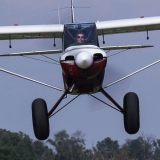
I think retracting the flaps on landing is highly dictated by the aircraft you are flying. In my Husky, especially when light, the tail is difficult to bring down with full flaps so retracting them on touchdown brings the tail down and makes braking far more effective. This is something that I practiced over and over again on the ground, pull throttle back dump flaps, until it became muscle memory. Then transitioned to using it on long grass strips and now it is completely automatic. It may not be something for a beginner to try to use all the time but it is something that can be practiced when conditions are ideal in order to make it a tool that a pilot has in his bag of tricks.
In the Beaver I usually leave the flaps out when landing since on floats it takes far more power to step taxi without them if you have a little ways to go. If it is very windy I will retract them right after touching down.
I tried to translate these bush methods to the Cessna 421 I used to fly and found that they didn't work. That plane has huge split flaps that produce a tremendous amount of drag but not allot of lift. Retracting them on landing seemed to actually make the plane accelerate from the huge loss of drag. It was far better to plant it at a fairly low airspeed and use the flaps and elevator as air brakes to get it in short. Using that method I could routinely land that thing in 1500 feet or less on grass.
The flaps are another tool we have at our disposal and how they should be used will change greatly depending on the aircraft and the environment it is flown in.
In the Beaver I usually leave the flaps out when landing since on floats it takes far more power to step taxi without them if you have a little ways to go. If it is very windy I will retract them right after touching down.
I tried to translate these bush methods to the Cessna 421 I used to fly and found that they didn't work. That plane has huge split flaps that produce a tremendous amount of drag but not allot of lift. Retracting them on landing seemed to actually make the plane accelerate from the huge loss of drag. It was far better to plant it at a fairly low airspeed and use the flaps and elevator as air brakes to get it in short. Using that method I could routinely land that thing in 1500 feet or less on grass.
The flaps are another tool we have at our disposal and how they should be used will change greatly depending on the aircraft and the environment it is flown in.
Big fish, Beavers, and Bears!
http://www.alaskarainbowlodge.com
http://www.alaskarainbowlodge.com
Wed Feb 03, 2016 11:52 am
Re: Retracting flaps on landing
DonV wrote: ......Consider why a pilot would feel the need to shorten the landing with such a technique. If the runway length is that much in doubt to warrant raising the flaps early, the takeoff is going to be even more thrilling than the landing. A pilot who finds himself in such a situation needs to seriously question the reason for going into that location before accepting that risk. Short of combat, an EMS operation, or an emergency, it would be difficult to justify accepting that level of risk.
That might be the wrong comment to post here. For some people, "because it's there" is enough reason.
Risk often outweighs reward-- just ask anyone who's ever piled one up on a gravel bar they were landing on "just because". Esp if they didn't have hull insurance....
Cessna Skywagon -- accept no substitute!
Thu Feb 04, 2016 11:29 am
Re: Retracting flaps on landing
DonV wrote:Recently I flew with someone else and he mentioned it was not good practice to retract the flaps.I would not normally let this bother me but I vagly remember reading the samething somewhere....can't remember where, but it was not a POH nor was it aircraft specific,something the FAA put out maybe?
If you’re looking for something in an FAA document to hang your hat on, the following quote is from the FAA Publication, On Landings II, FAA-P-8740-49:... some Handbooks and Owner's Manuals suggest that retracting the flaps will decrease hit and put more weight on the gear. It's really best, however, to wait on flap retraction until you're clear of the runway and less busy, especially in retractable gear aircraft where a misidentified control could lead to a gear-up landing.
I wasn't looking for a document to hang my hat on,just remembered reading it somewhere and couldn't remember where.
- MountainFlyerN22 offline
- Posts: 80
- Joined: Fri Nov 20, 2015 12:23 am
- Location: Catskill
Thu Feb 04, 2016 12:50 pm
Re: Retracting flaps on landing
hotrod180 wrote:DonV wrote: ......Consider why a pilot would feel the need to shorten the landing with such a technique. If the runway length is that much in doubt to warrant raising the flaps early, the takeoff is going to be even more thrilling than the landing. A pilot who finds himself in such a situation needs to seriously question the reason for going into that location before accepting that risk. Short of combat, an EMS operation, or an emergency, it would be difficult to justify accepting that level of risk.
That might be the wrong comment to post here. For some people, "because it's there" is enough reason.
Risk often outweighs reward-- just ask anyone who's ever piled one up on a gravel bar they were landing on "just because". Esp if they didn't have hull insurance....
A short landing contest is plenty good rason enough, especially for the guys pushing a particular make/ model bird. Bragging rights can pay off for them. Little practical use unless you don't have to take off again, not much use landing shorter then you need for takeoff.
- courierguy offline

- Posts: 4197
- Joined: Thu Mar 31, 2005 6:52 pm
- Location: Idaho
"Its easier to apologize then ask permission"
Tex McClatchy
Tex McClatchy
Thu Feb 04, 2016 1:29 pm
Re: Retracting flaps on landing
"Consider why a pilot would feel the need to shorten the landing with such a technique. If the runway length is that much in doubt to warrant raising the flaps early, the takeoff is going to be even more thrilling than the landing. A pilot who finds himself in such a situation needs to seriously question the reason for going into that location before accepting that risk. Short of combat, an EMS operation, or an emergency, it would be difficult to justify accepting that level of risk."
Because it's FUN, and that's why I fly
Practical example from yesterday, I took my C177B into a 300m one way ag strip with a gusting 15kt tailwind and 30'C, no chance of a go around. 60kt approach, dumped flap on round out which gave me the nice positive arrival I needed and stopped with room to spare. Last thing I wanted was to float a little in that situation. There was a broken Airtractor sitting right at the end... The 177 is proving to be quite a good strip machine
Because it's FUN, and that's why I fly
Practical example from yesterday, I took my C177B into a 300m one way ag strip with a gusting 15kt tailwind and 30'C, no chance of a go around. 60kt approach, dumped flap on round out which gave me the nice positive arrival I needed and stopped with room to spare. Last thing I wanted was to float a little in that situation. There was a broken Airtractor sitting right at the end... The 177 is proving to be quite a good strip machine
Thu Feb 04, 2016 1:47 pm
Re: Retracting flaps on landing
IMHO any instructor who is teaching their students that one size fits all, or one technique fits all, is doing a dis-service to the student. "Dumping" the flaps on landing is a long-standing practice that is used by a large number of pilots who are doing short field operations frequently. Many of these pilots are highly experienced, and this technique allows them to get stopped faster when it counts. A pilot in a 152 at any "normal" airport probably doesn't need to do this of course. And there are other situations, even back country, where you probably would be better off leaving the flaps out until stopped. My point is that there will be different situations that favor different techniques, even with identical airplanes There are plenty of times when you want the airplane to stop making as much lift as you can stop making. Crosswinds, gusts, water on the runway, whatever.
In my development research, I found that many of the practices and recommended/required procedures are there for different reasons. One manual flap STOL aircraft family changed the POH from permitting "dumping" on landing to instructing pilots to not retract the flaps on landing. The reason for this was not aerodynamic, it was because retracting the flaps had been shown to increase the risk of loss of control and groundloops. I'm happy to have played a significant part in finally fixing that problem for owners of airplanes affected by this phenomenon
Despite the various levels of experience and differing opinions on this subject, I'm sure we can all agree that retracting the flaps on landing is a useful option to have if and when it is appropriate, and that if you do retract the flaps on landing, safety and success clearly dictates that one should take every possible measure to ensure you have precise, full, fingertip control over the flaps.
Hey what's that? Sounds like a rope being thrown over a tree branch...
In my development research, I found that many of the practices and recommended/required procedures are there for different reasons. One manual flap STOL aircraft family changed the POH from permitting "dumping" on landing to instructing pilots to not retract the flaps on landing. The reason for this was not aerodynamic, it was because retracting the flaps had been shown to increase the risk of loss of control and groundloops. I'm happy to have played a significant part in finally fixing that problem for owners of airplanes affected by this phenomenon
Despite the various levels of experience and differing opinions on this subject, I'm sure we can all agree that retracting the flaps on landing is a useful option to have if and when it is appropriate, and that if you do retract the flaps on landing, safety and success clearly dictates that one should take every possible measure to ensure you have precise, full, fingertip control over the flaps.
Hey what's that? Sounds like a rope being thrown over a tree branch...

.
Thu Feb 04, 2016 1:58 pm
Re: Retracting flaps on landing
EZFlap wrote:IMHO any instructor who is teaching their students that one size fits all, or one technique fits all, is doing a dis-service to the student. "Dumping" the flaps on landing is a long-standing practice that is used by a large number of pilots who are doing short field operations frequently. Many of these pilots are highly experienced, and this technique allows them to get stopped faster when it counts. A pilot in a 152 at any "normal" airport probably doesn't need to do this of course. And there are other situations, even back country, where you probably would be better off leaving the flaps out until stopped. My point is that there will be different situations that favor different techniques, even with identical airplanes There are plenty of times when you want the airplane to stop making as much lift as you can stop making. Crosswinds, gusts, water on the runway, whatever.
In my development research, I found that many of the practices and recommended/required procedures are there for different reasons. One manual flap STOL aircraft family changed the POH from permitting "dumping" on landing to instructing pilots to not retract the flaps on landing. The reason for this was not aerodynamic, it was because retracting the flaps had been shown to increase the risk of loss of control and groundloops. I'm happy to have played a significant part in finally fixing that problem for owners of airplanes affected by this phenomenon
Despite the various levels of experience and differing opinions on this subject, I'm sure we can all agree that retracting the flaps on landing is a useful option to have if and when it is appropriate, and that if you do retract the flaps on landing, safety and success clearly dictates that one should take every possible measure to ensure you have precise, full, fingertip control over the flaps.
Hey what's that? Sounds like a rope being thrown over a tree branch...
I thought I heard the sounds of carbines being chambered

Being totally honest what advantage is the ezflap for dumping flaps? all the manual flap equipped planes I have flown reaching for the flap handle in the full flap position is very easy and releasing them is just getting the latch to release and stay release for a second and the air pressure will retract the flaps for you. I do see they usefullness for some people for adding flaps although I have never felt a need for it.
- cstolaircraft offline
- Posts: 523
- Joined: Wed Sep 29, 2010 12:50 pm
- Location: Blackwell, Mo
Mission Pilot in training. C-170B N8098A.
But they that wait upon the Lord shall renew their strength; they shall mount up on wings as eagles... Isaiah 40:31
But they that wait upon the Lord shall renew their strength; they shall mount up on wings as eagles... Isaiah 40:31
Thu Feb 04, 2016 2:52 pm
Re: Retracting flaps on landing
But... but ... but ...... think of the NTSB statistic, which is CHUCK FULL of premature flap retraction horror stories...
Ya'll don't wanna become a statistic, do you? 1.3Vso, by the book. Checklists. PAVE. IMSAFE. All that jazz.

Ya'll don't wanna become a statistic, do you? 1.3Vso, by the book. Checklists. PAVE. IMSAFE. All that jazz.

"Integrity Is A Choice. It is consistently choosing the simplicity and purity of truth over popularity." ~ Unknown
Thu Feb 04, 2016 7:50 pm
Re: Retracting flaps on landing
hotrod180 wrote:That might be the wrong comment to post here. For some people, "because it's there" is enough reason.
Risk often outweighs reward-- just ask anyone who's ever piled one up on a gravel bar they were landing on "just because". Esp if they didn't have hull insurance....
........ or just ask any car roof surfer.
Thu Feb 04, 2016 8:14 pm
Re: Retracting flaps on landing
courierguy wrote:Little practical use unless you don't have to take off again, not much use landing shorter then you need for takeoff.
Yes. To the question of "can you get it in there" the answer was always "I can get in anyplace; getting it out is a whole different question".
Thu Feb 04, 2016 8:16 pm
Re: Retracting flaps on landing
cstolaircraft wrote:Being totally honest what advantage is the ezflap for dumping flaps? all the manual flap equipped planes I have flown reaching for the flap handle in the full flap position is very easy.
Hi Reuben, I was kidding around far more than I was trolling or looking for a fight. Honest.
I will be glad to address that question more seriously and in more depth if you want, but it should be in one of the previous threads specifically on the subject of flap handle extensions. But out of respect to the forum admin, he would be the first to say that my answers to your question have already been posted many times. So go through all of the previous threads where we all beat each other half to death on this subject, and you will find everyone's opinion for and against it.
jjbaker,the NTSB reports are actually overflowing with "loss of control on landing rollout" incidents. I believe that is one of the most common of all non-fatal accidents or incidents on the books.
.
Thu Feb 04, 2016 8:18 pm
Re: Retracting flaps on landing
..... and I can't recall every reading one where the pilot was faulted for not retracting the flaps quickly enough.jjbaker wrote:But... but ... but ...... think of the NTSB statistic, which is CHUCK FULL of premature flap retraction horror stories...
Thu Feb 04, 2016 8:34 pm
Re: Retracting flaps on landing
EZFlap wrote:cstolaircraft wrote:Being totally honest what advantage is the ezflap for dumping flaps? all the manual flap equipped planes I have flown reaching for the flap handle in the full flap position is very easy.
Hi Reuben, I was kidding around far more than I was trolling or looking for a fight. Honest.
I will be glad to address that question more seriously and in more depth if you want, but it should be in one of the previous threads specifically on the subject of flap handle extensions. But out of respect to the forum admin, he would be the first to say that my answers to your question have already been posted many times. So go through all of the previous threads where we all beat each other half to death on this subject, and you will find everyone's opinion for and against it.
jjbaker,the NTSB reports are actually overflowing with "loss of control on landing rollout" incidents. I believe that is one of the most common of all non-fatal accidents or incidents on the books.
I got the since you were tongue in cheek with your comment.
I have read all the threads that about it's usefulness or uselessness for pulling flaps on take off I just don't remember seeing discussion on Landings new concept you through out when I thought ur goals were easy of pulling flaps not releasing them. But as you say this could turn into to egg and tomato fight.
- cstolaircraft offline
- Posts: 523
- Joined: Wed Sep 29, 2010 12:50 pm
- Location: Blackwell, Mo
Mission Pilot in training. C-170B N8098A.
But they that wait upon the Lord shall renew their strength; they shall mount up on wings as eagles... Isaiah 40:31
But they that wait upon the Lord shall renew their strength; they shall mount up on wings as eagles... Isaiah 40:31
Fri Feb 05, 2016 5:09 am
Re: Retracting flaps on landing
EZFlap wrote:jjbaker,the NTSB reports are actually overflowing with "loss of control on landing rollout" incidents. I believe that is one of the most common of all non-fatal accidents or incidents on the books.
I know its a bit of a sport to disagree with everything this darn jjbaker could ever write but at least read what I wrote...

My focus wasn't on your flap handle extension, nor was it on discussing LOC accidents on roll-out, but more on trying to avoid teaching to the lowest available level out there, or treating people as if they were dumb. Doing so breeds fear instead of knowledge. We can do that with student pilots who show attitudes or believe their name belongs in the aviation hall of fame, before having soloed.
When talking about back-country operations or anything related to STOL flying, we should not copy and paste going primary training agenda or try to build up a division between "old hands" and newcomers. No wondrous skills (or equipment) are required and using the aircraft within its full performance envelope is something everyone can learn and practice. Raising the flaps to get more grip is just another tool in the box, albeit not recommended for all types of airplanes and definitely not useful in all scenarios.
Leaving the flap handle alone could spell disaster in the wrong situation and could fill body-bags at any "no go-around" landing site. Hence my suggestion to shrink the landing- sites length as we gain experience and find ways to get the aircraft to do what we want, 100% of the time. Plenty of CFI's out there will have a blast helping one build the necessary skill-set. "Don't touch that" or "Because I said so" are not the way to go about it, in my opinion.
"Integrity Is A Choice. It is consistently choosing the simplicity and purity of truth over popularity." ~ Unknown
Fri Feb 05, 2016 11:26 am
Re: Retracting flaps on landing
cstolaircraft wrote: Being totally honest what advantage is the ezflap for dumping flaps?......
Please oh please don't go there with this thread.

Cessna Skywagon -- accept no substitute!
Sat Feb 06, 2016 8:59 am
Re: Retracting flaps on landing
Flaps again? ](/phpbb3/images/smilies/eusa_wall.gif "Brick wall")
Soo… if a guy who constantly dumps the flaps with his right hand on the switch or johnson bar is at risk of dumping the gear when he gets in a different airplane…
Is the guy who constantly rotates on departure with his right hand on the stick, at risk of pulling the throttle out at rotation with his right hand on it while in a SxS airplane?
… jus' sayin'….
It is all about what the airplane wants. The guy who rotely reaches over and slaps the flaps up because he is on landing is subject to as much failure as the guy who is terrified of dumping them. Treat each and every landing with the special attention it deserves and make each move within that landing with purpose expecting a certain action or result of that move and you'll never be surprised, regardless of what the numbers in your logbook add up to. !000 hrs. is hardly a place to say someone has it figured out, IMHO milestone numbers are when people are at their most cockiness (read; dangerous) with 5000 hrs based on loose survey being the absolute worst. Waiting for a 'number' to start educating yourself is a great way to delay the learning curve.
Take care, Rob
Soo… if a guy who constantly dumps the flaps with his right hand on the switch or johnson bar is at risk of dumping the gear when he gets in a different airplane…
Is the guy who constantly rotates on departure with his right hand on the stick, at risk of pulling the throttle out at rotation with his right hand on it while in a SxS airplane?
… jus' sayin'….
It is all about what the airplane wants. The guy who rotely reaches over and slaps the flaps up because he is on landing is subject to as much failure as the guy who is terrified of dumping them. Treat each and every landing with the special attention it deserves and make each move within that landing with purpose expecting a certain action or result of that move and you'll never be surprised, regardless of what the numbers in your logbook add up to. !000 hrs. is hardly a place to say someone has it figured out, IMHO milestone numbers are when people are at their most cockiness (read; dangerous) with 5000 hrs based on loose survey being the absolute worst. Waiting for a 'number' to start educating yourself is a great way to delay the learning curve.
Take care, Rob

Sat Feb 06, 2016 9:37 am
Re: Retracting flaps on landing
I'm a little more cautious in an airplane I'm not familiar with. I wound hop in someone else's airplane and go land where I land my cub. I usually go up and do stalls and get a feel for it. Do I dump the flaps on landing? Sometimes, depends on how short it is.
DISPLAY OPTIONS
Who is online
Users browsing this forum: No registered users and 0 guests
Latest Features
-
Live to Tell
A Minnesota pilot is surprised to learn that the sudden asymmetric drag of an out-of-rig ski can…Read More -
Creators
Working in some of the Yukon's most beautiful and remote environments, photographer Simon Blakesley captures aircraft in…Read More -
Aircraft Ownership and Maintenance
Upgrading to big tires can make a huge difference in backcountry performance, but with those gains come…Read More -
Tales from Yesteryear
In this tale from bush flying yesteryear, Don Cogger signs up to help Atlee Dodge Jr recovery…Read More


Latest Knowledge Base
-
Destinations
A regional guide with ideas for winter camping destinations in California, Nevada, New Mexico, and Arizona.Read More -
Aircraft
Finding an affordable aircraft that can handle the backcountry for $80K or less? A challenge for sure, but with the…Read More -
Aircraft
01.29.2018 - Zane - Updated tire diameter graphic to add 8.50x10 Guide to tires for use in the backcountry and off-airport landing…Read More -
Pilots
12.22.2013 - Initial article format Operating aircraft on skis and negotiating a snow-covered landscape is an entirely unique skillset and environment.…Read More


