corefile wrote:Bao205 wrote:corefile wrote:This whole project turned into a pretty extensive rebuild - amazing how many things you can find when you really dig into your plane.
This is not the approved way to save on fuel burn - this is where the fuel line turns to run down the door post - both side were like this:
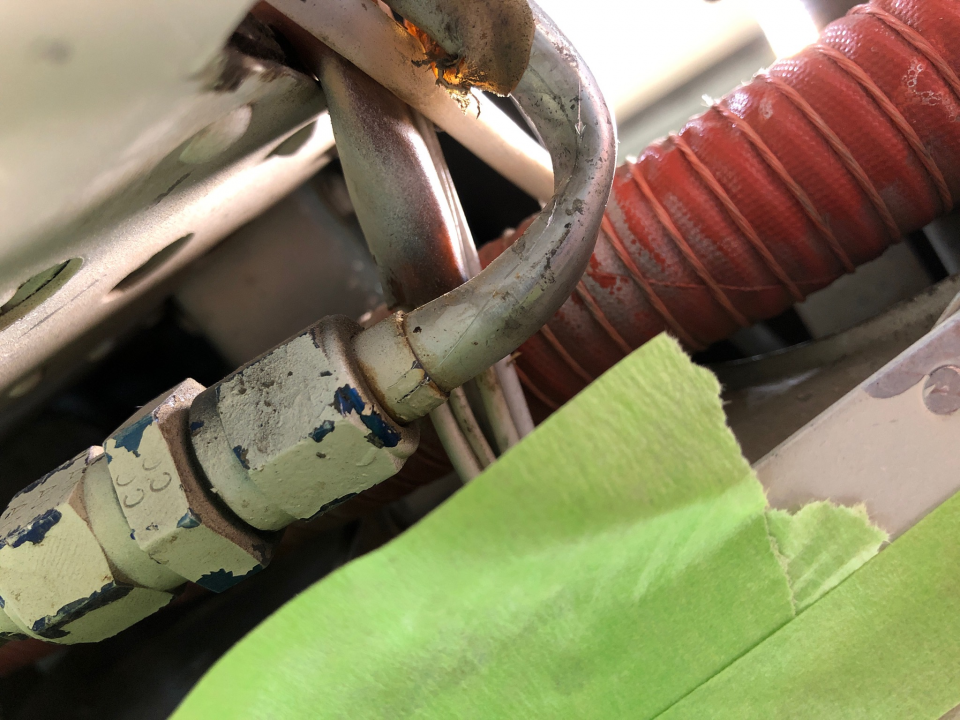
New to the forum, and new to flying, really enjoying your build thread! I’m not an airplane mechanic, but have been in the automotive repair business for many many years, I’d be curious if these kinked lines could have been causing your motor to run lean on full throttle/ high load scenarios after mixture was set proper at less throttle? Just a thought on why your motor may have eaten itself, either way good you caught and fixed it!
Thanks for the comments - hoping this thread is somewhat interesting to others.
As for the that - I don't thinks so - well not from the kinked lines at least, unless my following thought process is in correct.
1. My 62 180E was the first year they switched to new fuel tank outlets to give each wing tank two outlets rather than only one per tank. So even if that one was severely restricted (which is looks like it was) I still had another line for the tank that is capable of providing the full amount of fuel flow.
2. I had a JPI 450 fuel flow gauge - which is measuring the fuel flow after that bend, and I would adjust the fuel flow based on CHT's, Altitude, and power settings - I never saw any reduced fuel flow issue from my JPI 450 - but I think I over focused on fuel flow, power %, and altitude, and sometimes lost sight of CHT's.
So I don't think that it was the cause of the engine problems - now maybe there was pilot error (was I flying my plane too lean?), but I never saw excessive CHT's (but part of my retrospect - was I paying enough attention to CHT's?). As part of this I'm going to be re-evaluating my engine management to make sure I was not doing something wrong. The new Dynon HDX w/ engine monitoring module will be the start of that process. I'm not sure it really gives me anymore info then my JPI-450 and JPI 700 did, but it does give me a combined view with a little more modern UI and it now right in front of me where as my old JPI 700 was all the way to the right edge of the panel (honestly it was kind of hard to see way over there). One of the things I got into a bad habit of was I would set it at a certain fuel flow for a certain altitude and power setting - and I would not pay as much attention to the JPI 700 and the CHT's. I think it is certainly possible there were times that I could have leaned based on the power setting and fuel flow - and not paid enough attention to the CHT way they hell over on the other side of my plane (JPI 700) - so could I have been running it hotter then I should have... totally possible and something I will be changing in how I fly now.
But I agree, I'm glad we caught it! I think the new line looks so much better:


When leaning, particularly if you're leaning sort of aggressively (whether intending to or not) CHTs aren't necessarily the best indicator of over leaning. EGT is a better indicator of what's going on in your combustion chambers for the purpose of leaning.
For example, when you lean an engine to run lean of peak (LOP), you lean using EGT, and if you watch your Cylinder Head temperatures (CHT) as you pass through Peak EGT, you'll note that the CHTs rise as they approach peak EGT, then they actually decrease and run cooler as you go to LOP.
As you lean, you are reducing the amount of fuel available for the combustion process. As you go past peak EGT, you are actually slightly reducing the amount of power the engine is making, thus slightly lower CHTs.
Before you run this new engine, do some serious reading on engine leaning procedures. It's not rocket science, but there are some basic procedures you need to understand.
And, according to the engine manufacturers, if you keep engine power below a certain percent of power, you really can't damage the engine by over leaning. Most engines I've been around put that number at around 70% power. That's not to suggest you shouldn't learn how to properly lean your engine, though.
MTV