



Flyhound wrote:I thought the company went belly up in 2014. Did somebody buy the assets/tooling and start building them again?

 )
) 


mtv wrote:We did a comparison between a brand new Bush Hawk and a well worn Cessna 185, both on floats. With the same load in each airplane, the 185 was considerably lighter than the Found.
Predictably, the 185 took off somewhat shorter, with three different pilots flying each airplane, after some practice to get the feel of the planes.
In cruise, the Found was at 24 square, burning 18 gph, and the 185 was back at 13 gph to stay slow enough to fly formation on the Found. The 185 driver pushed power up to 24 square, and the 185 walked away from the Found rapidly.
The airplane is indeed much easier to load than a 185. Big doors, flat floor, etc.
I really detested that big main spar carry through (it's a one piece wing) that's just behind the pilot's heads....see the picture above of the pilots looking aft....
I really didn't like the stall characteristics of at least the first one we bought. It rolled off really hard to the left when it broke, and it had virtually no aerodynamic indication of an approaching stall. A DER from Ontario (I think) finally came to Anchorage, flew the plane and deflected one flap to compensate for the roll off at the stall.....which of course, slows the plane down even more than it is. Only way to re rig the wing.
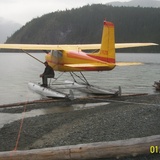
On floats, it was not a very good performer. Our folks in Galena kept a 185 in Alexander Lake for years. When they started flying the Found, they had to move it down to the Yukon River....they nearly took out the power line at the south end of Alexander Lake. The Founds we had were all pretty heavy. Yes, they are built like tanks, but they are heavy.
On wheels or wheel skis, I found the airplane to be one of the easiest tailwheel airplanes to land and manage on the runway. They track straight. On skis, the gear geometry is much better than Cessna's spring gear, and as a consequence the Found did really well in deep snow.
It'll be interesting to see how the new company does and if they can produce and sell many of these airplanes. The existing fleet has not had a source of parts for several years, so hopefully, the company will succeed.
I'm not a fan of the Found on floats. A good strong 206 with an IO 550 will out work the Found every day of the week on floats. But, the new 206s are heavy, like the Found, and also are equipped with the big Lycoming engines, which like fuel.
The old story applies: Whatever winds your watch.
MTV
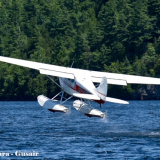
hotrod180 wrote:A friend of mine posted a video on FB of a Found taking off from the lake he lives on.
About 500' elevation, mild western Washington fall weather.
I don't know shit about flying floatplanes,
and I don't know how heavily it was loaded,
but that thing seemed to take forever to get off the water.
mtv wrote:hotrod180 wrote:A friend of mine posted a video on FB of a Found taking off from the lake he lives on.
About 500' elevation, mild western Washington fall weather.
I don't know shit about flying floatplanes,
and I don't know how heavily it was loaded,
but that thing seemed to take forever to get off the water.
Yup.....
MTV
whee wrote:mtv wrote:hotrod180 wrote:A friend of mine posted a video on FB of a Found taking off from the lake he lives on.
About 500' elevation, mild western Washington fall weather.
I don't know shit about flying floatplanes,
and I don't know how heavily it was loaded,
but that thing seemed to take forever to get off the water.
Yup.....
MTV
So MTV, In your opinion what is it that makes some planes take longer to get off the water than others. IE, is there something specific to consider when setting up a plane on floats? I’ve read about some planes taking a long time because of angle the floats are mounted. I’m studying up to put my Bearhawk on 2870s and want to make sure I don’t turn it into a water loving machine.

Users browsing this forum: No registered users and 4 guests